Parliamentary scrutiny begins on DRC’s 2027-2030 military modernization law
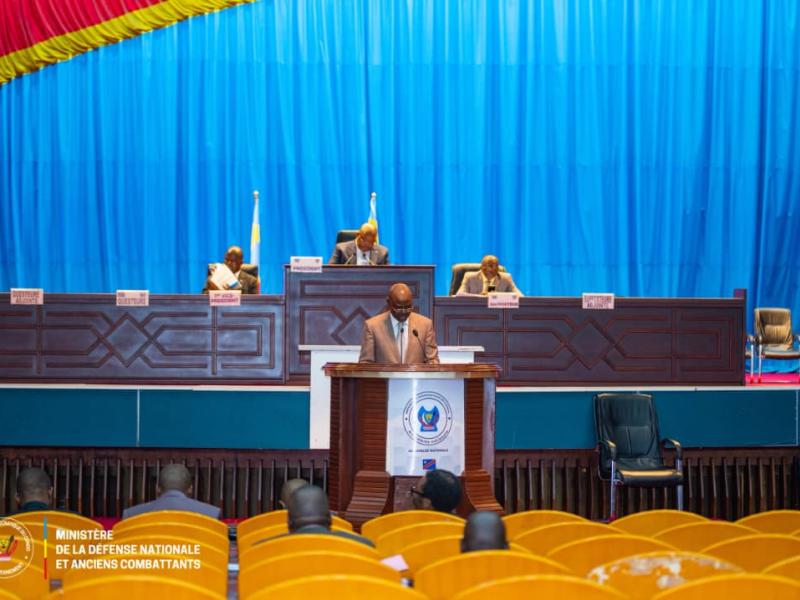
The National Assembly of the Democratic Republic of the Congo (DRC) has launched the review process for the 2027-2030 military programming bill, a landmark legislation aimed at modernizing the Armed Forces of the Democratic Republic of the Congo (FARDC). The move marks a critical step in the country’s ongoing efforts to strengthen its defense capabilities amid escalating security threats.
The bill was presented to lawmakers by Vice Prime Minister and Minister of National Defense and Veterans Affairs, Guy Kabombo Muadiamvita, following his recent official visit to Egypt. Speaking before the National Assembly, Kabombo outlined the urgency of the new programming, emphasizing its role in ending budgetary improvisation while establishing a legal framework for sustained military investment.
Key objectives of the military programming bill
The proposed law seeks to sanctuarize state funding to enable long-term planning for equipment acquisition, modernization, and the operational readiness of the FARDC. Among its core priorities are:
- Human-centric administration: Placing personnel at the heart of the defense strategy as the foundation for other components.
- Training and research: Enhancing military instruction and fostering innovation in defense strategies.
- Equipment and modernization: Accelerating the acquisition of advanced military hardware and upgrading infrastructure.
- Operations and intelligence: Strengthening military training, operational readiness, and intelligence capabilities.
- Defense industry: Promoting the development of a domestic defense manufacturing sector to reduce reliance on imports.
The bill arrives at a pivotal moment for the DRC, as the country grapples with persistent security challenges, particularly in the eastern regions where armed groups continue to pose significant threats. The previous military programming law (2022-2025), now expired, served as a cornerstone for the government’s defense sector reforms. The new legislation aims to adapt the legal framework to the evolving operational realities and the demands of a modern, high-performing military.
Defense fund and financial commitments
In addition to the programming law, Kabombo highlighted the Fonds de soutien au développement des FARDC (FSD-FARDC), a dedicated fund established by presidential ordinance to mobilize supplementary resources for the defense sector. The fund, currently under active promotion among public and private donors, is intended to bolster the financial capacity of the FARDC and support its modernization efforts.
The Vice Prime Minister underscored the critical need for this programming to be reflected in the national budget, describing it as an indispensable condition for the successful reform and professionalization of the FARDC. The timing of this legislative initiative coincides with heightened regional tensions, particularly in the eastern DRC, where the resurgence of the M23 rebellion and ongoing conflicts demand immediate and sustained attention to defense and security.
Regional dynamics and diplomatic efforts
This parliamentary initiative also unfolds against the backdrop of diplomatic engagements aimed at de-escalating tensions between the DRC and Rwanda. The Washington Peace Agreement, brokered with U.S. mediation, outlines measures for gradual withdrawal of Rwandan forces from Congolese territory and the neutralization of armed groups operating in the east, including the FDLR, which Rwanda views as a security threat. Despite the accord’s positive reception, the security situation in the eastern DRC remains volatile, with the M23 rebellion maintaining control over key urban centers such as Goma and Bukavu.
Meanwhile, the Doha Process, facilitated by Qatar, seeks to facilitate dialogue between the DRC government and the M23 rebellion. However, progress has been slow, and the persistent gap between diplomatic commitments and ground realities continues to challenge efforts toward lasting peace.
The new military programming law represents a bold step toward addressing these challenges, positioning the DRC to enhance its defense capabilities and navigate the complex security landscape of the region.
Assemblée nationale
Next steps for the bill
The National Assembly’s review of the 2027-2030 military programming bill is expected to proceed over the coming weeks, with lawmakers examining its provisions in detail. The legislation, once adopted, will provide a strategic roadmap for the DRC’s defense sector, ensuring that the FARDC is equipped to meet both current and emerging threats while advancing the country’s long-term security objectives.