Global Health Insights
Ebola outbreak in DRC: how political and security unrest intensifies the crisis

Fatou Elise Ba
IRIS Researcher, Human Security Program Lead
On May 17, 2026, the World Health Organization declared the Ebola outbreak in eastern Democratic Republic of the Congo—and its spread into Uganda—an “international public health emergency,” followed the next day by the Africa CDC. By June 5, both organizations had launched a joint six-month response plan and a $518 million funding appeal. Caused by the rare Bundibugyo strain, with no approved vaccine or treatment, this 17th epidemic is striking a region already ravaged by conflict and destabilized by shifting U.S. aid policies. How will this outbreak worsen the region’s security and humanitarian fragilities—and complicate access to care? What risks does it pose to Central Africa’s regional stability? And what does Ebola’s resurgence reveal about the global community’s ability to handle major health crises? We examine these questions with Fatou Elise Ba, IRIS researcher and Human Security Program lead.
In a region plagued by armed conflict, political instability, and deep economic and social fragility—especially in eastern DRC—how is the Ebola outbreak deepening internal instability in affected zones and hindering efforts to set up healthcare systems that ensure populations can access care?
This fresh Ebola wave arrives amid a multi-layered crisis. While the Democratic Republic of the Congo has seen 17 outbreaks since 1976 (when the virus was first identified in Yambuku), this time it’s the rare Bundibugyo strain. Though treatments are in clinical trials, no approved vaccine or cure exists for this strain, which can kill up to half of those infected. The eastern DRC provinces of North and South Kivu and Ituri are particularly vulnerable to epidemic spread. Last year, the UN reported one of the worst cholera outbreaks in 25 years here. Since 2020, the region has also faced massive Mpox spread, especially since September 2023. Ituri, the outbreak’s epicenter, is one of DRC’s most troubled provinces: poorly served by roads, under siege from armed groups, and home to nearly a million displaced people crowded into camps. The health crisis is thus layered atop a pre-existing humanitarian and security disaster. Decades of endemic conflict—especially since the M23 offensive in 2023—have left communities in a chronic state of instability, marked by frequent internal displacements and overcrowded camps where people live in cramped, unsanitary conditions. These factors fuel the rapid emergence and spread of pathogens. The prolonged crisis in eastern DRC has also shattered social fabric and health services, which can no longer meet basic needs, leaving populations structurally dependent on Western aid. Systemic violence from recurring conflicts has deprioritized health and entrenched violence against women and children—conditions that a major epidemic only compounds in an already collapsing security landscape.
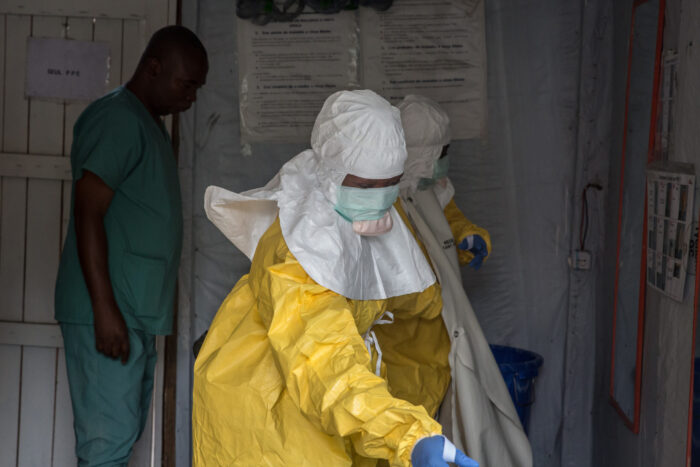
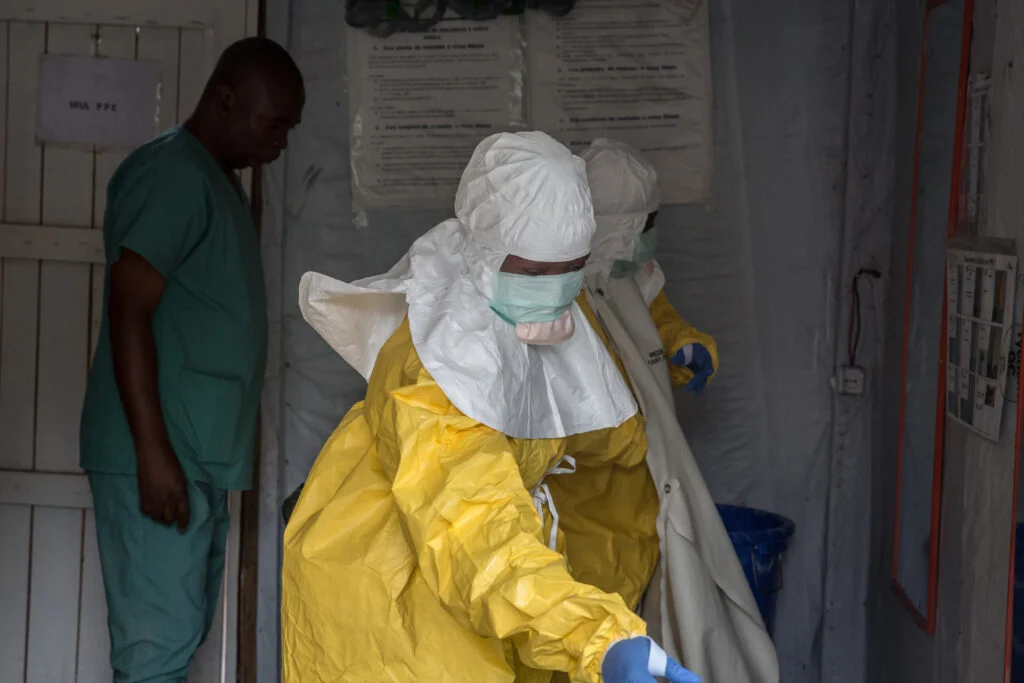
The Congolese Health Minister, Samuel-Roger Kamba Mulamba, called Ebola “an absolute emergency.” As of May 31, 2026, national data showed 282 confirmed cases and 42 deaths, including 19 new positive tests. By June 1, the WHO reported 349 suspected cases under surveillance in Ituri Province—specifically in Bunia, Rwampara, and Mongbwalu health zones. Bunia’s main hospital quickly became overwhelmed, forcing the setup of peripheral and rural treatment centers. Yet hope emerged as four infected healthcare workers recovered. By June 5, 2026, pressure on the health system had intensified further: local reports indicated six health centers in Bunia had temporarily closed for disinfection, further reducing the city’s capacity and raising concerns for pregnant women seeking care and patients with other conditions receiving only minimal treatment before being redirected or sent home. Moreover, Ebola containment efforts are forcing health services to adapt rapidly, disrupting routine care.
The real challenge is the lack of coordinated response from Kinshasa, particularly in areas partially controlled by the Rwandan-backed M23 and teeming with armed groups exploiting mineral wealth. This echoes a long-standing issue: the struggle to maintain national unity across a country of nearly 100 million people and ensure basic social and health services reach citizens. Several cases have also been recorded in M23-controlled areas, where the absence of government-coordinated health responses leaves epidemic spread unchecked. While negotiations may be underway, they have yet to establish the necessary health coordination framework for an effective response. Territorial fragmentation in the east prevents a unified approach. Two Ebola treatment centers are reportedly being set up in Goma—the M23/AFC-held capital—with limited capacity, and the armed group claims to have recognized the situation and implemented contingency plans. The epidemic is thus advancing in rebel-held zones. The question remains: who governs public health when the state no longer holds a monopoly over its territory?
Community resistance also poses a major hurdle, as seen during the 2018–2020 outbreaks. Acceptance of the response is far from guaranteed. In Rwampara, an anti-response protest escalated into the incineration of a suspected case’s body. Distrust and hostility toward medical teams are now key variables in the crisis. Community resistance has deep cultural roots: refusal to return Ebola victims’ bodies to families for traditional burials is perceived as unbearable symbolic violence. Yet these very rituals—washing the deceased and physical contact with the body—are major transmission vectors for the Ebola virus.
Resentment in Ituri and Kivu runs deep, rooted in structural suspicion from decades of violence, state neglect, and predatory external interventions. Health responses are easily seen as new forms of control, fueling rumors and conspiracy theories.
Can the Ebola outbreak have lasting consequences for DRC’s relations with its neighbors? How might this crisis further destabilize Central Africa?
This is a region marked by high tensions and extractive competition between DRC and its eastern neighbors—particularly Rwanda, but also Uganda, with fluctuating relations. When an epidemic spreads in a state where parts of the territory lie beyond central control, making national coordination difficult, the response must be trans-regional, even continental. The Africa CDC, the AU’s operational arm for identifying epidemic hotspots, has warned that up to ten vulnerable countries could be affected, including South Sudan, Rwanda, Kenya, Tanzania, Ethiopia, Republic of the Congo, Burundi, Angola, Central African Republic, and Zambia—in addition to already affected DRC and Uganda, which reported seven cases. Response capacities vary widely: Kenya and Ethiopia have relatively robust health systems and surveillance, with Kenya already setting up dedicated quarantine facilities, while Central African Republic remains one of the continent’s most fragile states, heavily reliant on external aid. South Sudan, meanwhile, faces severe internal strife and spillover from Sudan’s war.
Epidemics, by definition, ignore artificial borders. The most vulnerable—especially the poor—are hit hardest, and cross-border movement is already fluid. According to WHO data, imported cases from Ituri have reached North Kivu and Kampala, Uganda, where two travelers returning from DRC tested positive, one of whom died. A case has also been reported in South Kivu, according to the M23 spokesperson; the patient had traveled from Kisangani in Tshopo Province. This has led to border closures and diplomatic tensions, not to mention severe economic repercussions. To mitigate risk, Uganda suspended flights and passenger transport with DRC on May 21, 2026, while Rwanda closed its border with Goma. These unilateral measures have strained already tense DRC relations with its neighbors.
Adding to the complexity is the entanglement with the eastern conflict, which directly fuels epidemic spread. The virus is advancing in areas like Goma, seized in late January 2025, and Bukavu, taken in February 2025—heightening fears of regional escalation. Health has become another battleground in the Kinshasa-Kigali rivalry, with the M23 effectively acting as a de facto public health authority in its territories. Facing transboundary risks, the East African Community has called on member states to activate lab networks, strengthen border surveillance, and convened an extraordinary ministerial meeting on June 1–2, 2026. Following the meeting, ministers pledged to harmonize health controls at entry points without closing borders, establish a regional technical working group to coordinate surveillance, and bolster diagnostic capacities and healthcare worker protection.
Do health crises like Ebola expose the current limits of the international humanitarian aid system, especially after USAID funding cuts? What roles do international bodies like WHO and NGOs play in managing this outbreak?
The Ebola outbreak coincides with a weakened upstream response due to shifts in U.S. aid architecture. Cuts to health assistance—starting in January 2025—withdrew U.S. support from WHO, dismantled USAID, reduced CDC involvement, and slashed health aid to DRC and Uganda, crippling the systems needed to respond to such outbreaks. Some experts argue these cuts may have delayed detection of the epidemic.
Today, DRC has signed a bilateral agreement with the U.S. (as have Rwanda and Uganda), in a clear “America First” approach. Part of health funding has been redirected to the U.S. State Department under a five-year, $900 million deal tied to extractive conditionality—shifting from multilateralism to transactional bilateralism. The new U.S. stance complicates the response: faced with Ebola’s resurgence, American action has been delayed and outside the UN framework. Moreover, humanitarian principles are being deprioritized; the focus is on protecting Americans. The State Department pledged $23 million in emergency funds and up to 50 clinics, but without supporting a WHO-led response—breaking from past practices. With the U.S. withdrawal from WHO, the organization’s emergency fund (CFE) is operationally weakened, and other donors have yet to fill the void.
In this context, the response depends on national institutions in the hardest-hit countries, with support from WHO and NGOs—despite reduced capacity due to U.S. withdrawal and a hostile security environment. WHO, in line with its mandate, declared the outbreak a Public Health Emergency of International Concern (PHEIC) and is coordinating the response. The European Centre for Disease Prevention and Control (ECDC) has issued a risk assessment to support coordination, especially with Africa CDC. On the ground, medical NGOs like Doctors Without Borders and ALIMA (The Alliance for International Medical Action) have deployed care teams. The DRC Red Cross is mobilizing volunteers for safe, dignified burials, risk communication, and community engagement. Yet the humanitarian response remains far too limited to curb the epidemic.
At the continental level, Africa CDC and WHO announced a joint six-month response plan on June 5, 2026, covering June to November 2026, and launched a $518 million appeal to support African nations in early detection, prevention, and control. Led by WHO Director-General Tedros Adhanom Ghebreyesus under the operational principle of “one plan, one budget, one team,” the plan aims to be coordinated and led by affected countries. It involves WHO, Africa CDC, and partners including UNICEF, UNHCR, WFP, IFRC, and FIND, along with African governments and international donors. So far, only $315.8 million has been pledged—well short of the goal to fund a single, unified plan.
While this coordinated plan shows early signs of continental leadership, it also highlights a structural hybrid strategy among several African states. Countries are signing bilateral agreements—especially with the U.S.—tying health aid to conditional funding, while simultaneously demonstrating capacity to coordinate during major crises through multilateral mechanisms. The coming months will reveal whether this dual approach proves effective.
Related Posts