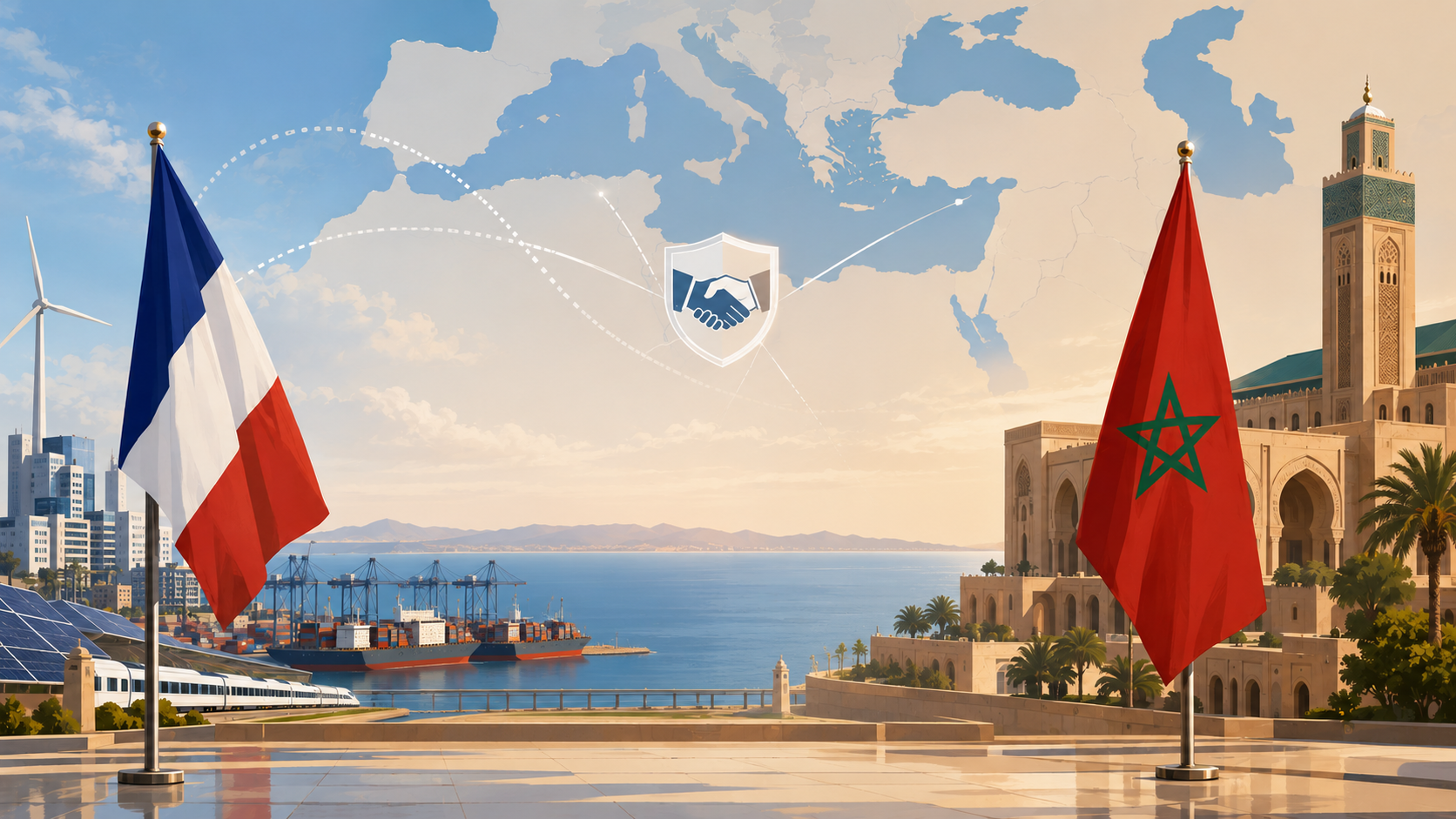
During his two-day official visit to Rabat, French Prime Minister Sébastien Lecornu arrived with a delegation of over a dozen ministers, signaling more than just a routine diplomatic mission. This high-profile engagement marks a pivotal moment in the evolving relationship between France and Morocco, reinforcing a rare and exceptional partnership that has gained momentum since early 2024. The visit, the first intergovernmental meeting of this scale since 2019, underscores a clear shift: Paris and Rabat are entering a new phase defined by a strengthened bilateral alliance, soon to be formalized through a dedicated treaty.
This development aligns with the insights shared in my latest publication, Morocco: The Strength of Stability, released by Éditions du Cherche Midi. In a Mediterranean and Middle Eastern landscape riddled with crises, the Kingdom has emerged as one of the few stable anchors upon which France can—and must—rely for long-term cooperation.
Morocco: a beacon of stability in a turbulent region
From the Sahel to Libya, from persistent tensions in the Middle East to the uncertainties surrounding Iran’s nuclear negotiations, the post-Arab Spring era has seen a surge in geopolitical hotspots. The Mediterranean, once again, has become a critical frontier where terrorism, migration flows, energy rivalries, and power struggles intersect.
Amid this volatility, Morocco stands out. The Kingdom has maintained remarkable political stability while modernizing its economy, infrastructure, industrial base, and military capabilities. Its diplomatic approach—grounded in dialogue and pragmatism—has enabled it to engage constructively with diverse actors, including the United States, the European Union, Gulf monarchies, and an increasing number of African states. By prioritizing bridge-building over division, Morocco has solidified its position as a key geopolitical player.
An indispensable ally for France
The bilateral relationship has taken on new significance since France’s backing of Morocco’s sovereignty over Western Sahara and the state visit of French President Emmanuel Macron to Rabat in October 2024. These milestones have propelled the two nations into an era of enhanced strategic cooperation spanning security, defense, energy, industry, innovation, infrastructure, and cultural exchange.
The presence of Prime Minister Lecornu and his sizable ministerial delegation reflects a commitment to turning this vision into action. From defense and intelligence to domestic security, investments, energy, transportation, artificial intelligence, and training, few bilateral initiatives have ever mobilized such a wide array of sectors under a unified political will.
A foundation of mutual trust
Morocco is no longer merely a neighbor to the south; it has become a cornerstone in France’s strategic calculus. The Kingdom plays a pivotal role in counterterrorism efforts, serves as a stabilizing force in the Sahel, and functions as an industrial and logistical hub connecting Europe, the Mediterranean, and Sub-Saharan Africa. In an era marked by fragile supply chains, shifting migration patterns, and redefined energy alliances, a reliable partner like Morocco offers Paris a significant strategic advantage.
The effectiveness of Franco-Moroccan cooperation in combating terrorism and organized crime is widely recognized. This trust is not the result of recent developments but the culmination of years of shared commitment and aligned interests.
A partnership that benefits both nations
The Franco-Moroccan relationship is no longer confined to historical ties or human connections, though these remain strong. Today, it is rooted in geopolitical realities. As Europe seeks to secure its supply chains, deepen its presence in Africa, and stabilize its Mediterranean neighborhood, Morocco has emerged as a natural partner. Its industrial growth, the expansion of Tanger Med’s port, leadership in renewable energy, and strategic outreach to Africa position it at the heart of new Euro-African value chains.
The scope of cooperation spans automotive and aerospace industries, green hydrogen, rail infrastructure, artificial intelligence, security, military collaboration, and cross-border investments. While many international partnerships falter under global pressures, the one between Paris and Rabat demonstrates what can be achieved through mutual respect, shared interests, and political resolve.
The events of recent months, including this landmark visit, reinforce a clear reality: amid a tense Mediterranean and a transforming Middle East, Morocco stands as one of France’s most solid, reliable, and strategically vital partners. This exceptional relationship is no longer a relic of history—it is a forward-looking choice, and France is wise to position Morocco as its primary strategic ally south of the Mediterranean in navigating today’s global upheavals.