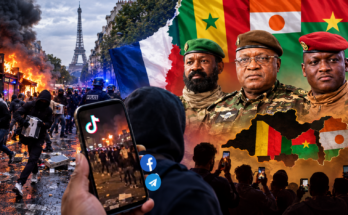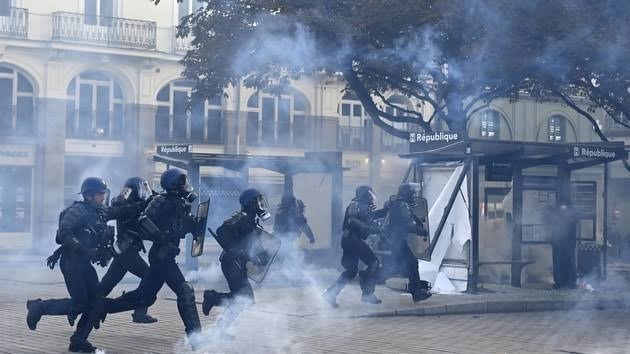
Broken shop windows, police clashes, burning trash bins, and tear gas clouds: each time France witnesses a surge in protests, these images dominate social media feeds in Bamako, Ouagadougou, and Niamey. While Paris frames these events as domestic social disturbances, the military regimes of the Sahel Alliance see them as irrefutable ammunition to dismantle Western narratives and solidify their own legitimacy.
How France’s domestic strife fuels Sahel juntas’ rhetorical advantage
Scrolling through trending feeds in Alliance of Sahel States (AES) capitals reveals a stark reversal of perception. Where Western media dissect internal French crises as governance failures, local pro-junta voices frame these scenes as historic payback against former colonial powers. Since military takeovers brought Assimi Goïta, Ibrahim Traoré, and Abdourahamane Tiani to power, the political rupture with France has evolved into a full-scale information war.
Paris once tied diplomatic support to adherence to democratic principles, human rights, and peaceful assembly. Now, sovereignist influencers and activists highlight what they call the West’s hypocrisy. They draw parallels between France’s use of crowd dispersal grenades, protest bans, and parliamentary force majeure tactics with their own harsh criticism of Sahel transitional authorities.
Three strategic benefits of exploiting French turmoil
The manipulation of French unrest isn’t just a fleeting moment of vengeful satisfaction. Within the AES, it serves as a calculated political tool with clear strategic goals:
- Undermining democratic legitimacy: By portraying liberal democracy as unstable, chaotic, and decadent, junta-aligned communications portray military rule as the only viable path to national sovereignty and stability.
- Deflecting from local crises: Redirecting public attention toward France’s challenges allows juntas to dominate news cycles while avoiding scrutiny over persistent insecurity, soaring inflation, and power shortages across the Sahel.
- Fueling the narrative of Western decline: Amplified by Moscow-linked influence networks, these viral images reinforce the idea of a declining West, justifying strategic pivots toward new partners like Russia, Turkey, or Iran.
The limits of the comparison
Independent analysts caution against buying into this manipulated narrative. They point out a glaring contradiction: France’s ability to openly contest its government, organize strikes, and publicly criticize leaders remains a hallmark of a vibrant civic space—an unthinkable reality in systems where dissent is swiftly labeled subversive or silenced.
Yet, perception often trumps reality. Each image of unrest in France chips away at the country’s diplomatic credibility south of the Sahara. With every burning Parisian barricade, the myth of France as a model of democratic stability fractures further—observed with barely concealed amusement by regimes that have staked their survival on defiance of Paris.
Challenging the propaganda’s long-term impact
While the short-term gains for AES juntas are undeniable, the long-term cost may be higher than anticipated. International partners closely monitor how these regimes balance strategic messaging with on-the-ground governance failures. Resilient Western alliances are increasingly investing in alternative narratives built on transparency and mutual accountability—not reactive headlines responding to distant crises.
The Sahel’s future will not be decided by viral videos of French unrest, but by the ability of its leaders to deliver stability, security, and prosperity to their populations. For now, however, the junta-aligned media machine continues to harvest every moment of French turmoil as proof of the West’s irrelevance.