
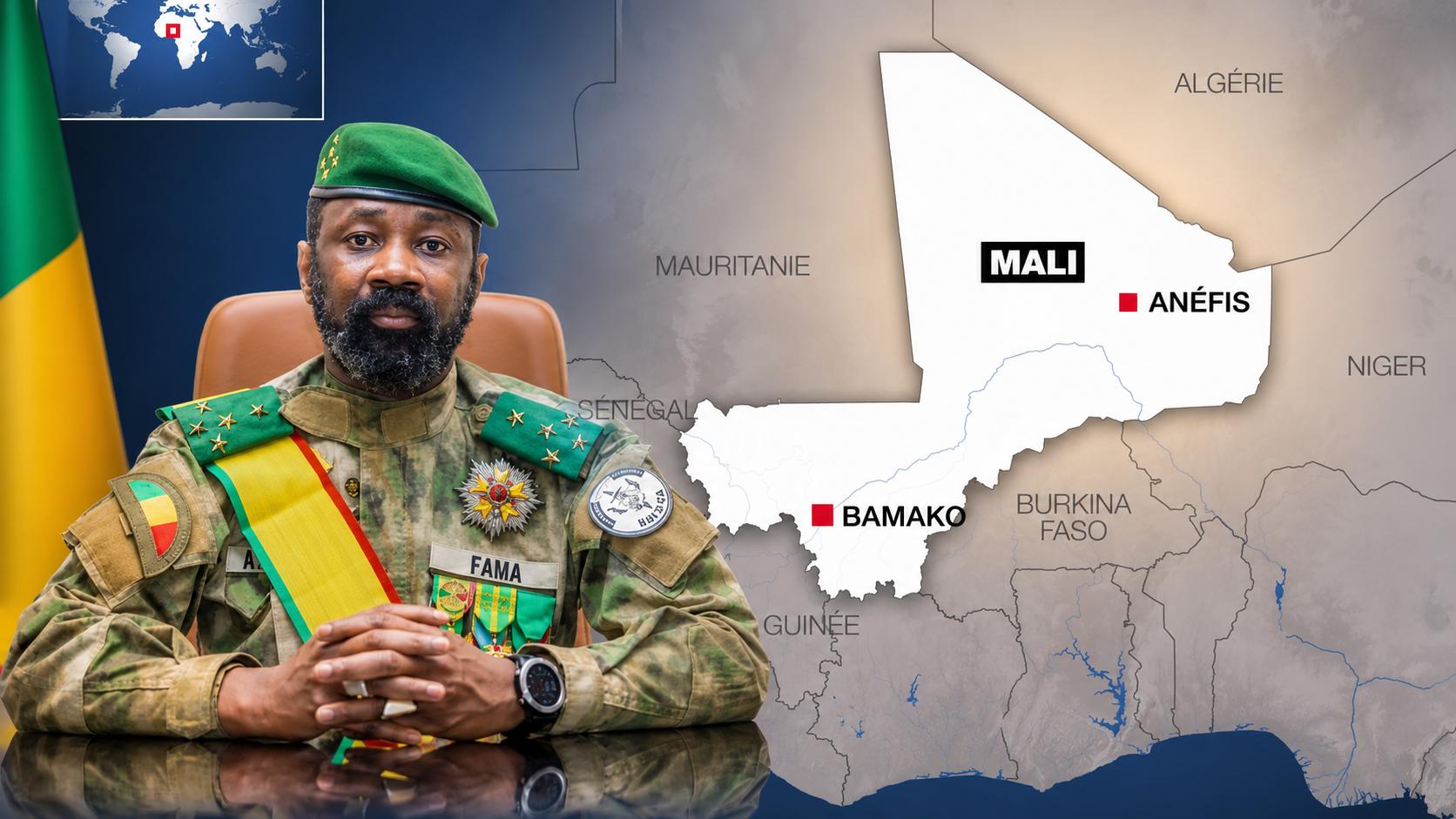
The north of Mali has once again become a battleground as fierce fighting erupted near Tabankort yesterday. A large military convoy, jointly operated by the Malian Armed Forces (FAMa) and Russian-backed Africa Corps units, faced a coordinated ambush by a coalition of rebel and terrorist groups.
Clashes intensify along the Gao-Anéfis supply route
The Gao-Anéfis corridor remains a critical flashpoint in the ongoing security crisis. Reports indicate that the military convoy, comprising around 60 vehicles including logistics trucks, armored units, and infantry troops, departed Gao earlier this week. Its mission: to reinforce the embattled garrison at Anéfis, a key stronghold in the Kidal region under relentless pressure from armed factions opposed to the transitional government in Bamako.
A deadly trap in the desert
The ambush unfolded near Tin Araban, a remote desert zone just south of Tabankort and roughly 100 kilometers from Anéfis. The attackers, believed to be a temporary alliance between Tuareg independence fighters—specifically the Azauad Liberation Front (FLA)—and jihadist factions from the Support Group for Islam and Muslims (JNIM), linked to al-Qaeda, struck with overwhelming force. The engagement, which raged for hours, involved heavy artillery and drone strikes, leaving both sides with significant casualties.
Heavy losses reported, but no official word from Bamako
While an independent assessment remains impossible due to restricted access to the area, insurgent communications and scattered footage suggest substantial material and human losses. Several FAMa transport vehicles and light armored units operated by Africa Corps instructors—former Wagner operatives—were reportedly destroyed or seized. Aerial reconnaissance drones were also lost, and dozens of fighters from both sides are believed to have perished in the confrontation.
Despite the magnitude of the attack, Malian authorities have remained conspicuously silent. Over 24 hours after the ambush near Tabankort, neither the Directorate of Information and Public Relations of the Armed Forces (DIRPA) nor the transitional government has issued any statement regarding the incident.
Government silence raises concerns over security reality
The absence of updates is not merely a procedural delay or a tactical precaution. It reflects a deliberate strategy to conceal the true extent of the deteriorating security situation from the people of Bamako. By refusing to acknowledge setbacks or the intensity of fighting in the north, the capital’s leadership risks entrenching a narrative of unwavering military progress, even as the ground truth contradicts such claims. This disconnect between official rhetoric and battlefield reality poses a growing threat to national credibility.
Anéfis: the linchpin of Mali’s northern strategy
The stakes of this battle extend far beyond tactical skirmishes. For Mali, maintaining control over the Gao-Anéfis supply line is vital to sustaining its presence in the north. Should the convoy’s failure to reach Anéfis become permanent, and reinforcements fail to arrive, the garrison could face isolation, potentially paving the way for a major counter-offensive by the northern coalition. Such territorial losses would be increasingly difficult to conceal behind the veil of military secrecy, exposing the fragility of Bamako’s control in the region.
