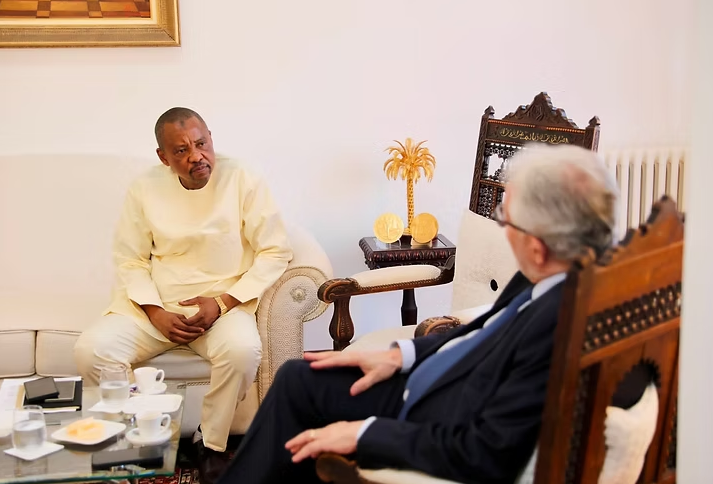
The recent meeting between Hamadou Saley, Niger’s chargé d’affaires in France, and Chems-eddine Hafiz, rector of the Great Mosque of Paris, has sparked intense speculation. While framed as a cultural or religious collaboration, the encounter reveals a far more calculated political maneuver: a regime in Niamey desperate to rebuild ties with Paris by leveraging France’s Muslim communities, after being locked out of traditional diplomatic channels.
Bypassing official channels: the art of indirect negotiation
Following the political upheaval in Niger and the sharp deterioration of bilateral relations with France, formal diplomatic avenues between Niamey and Paris have effectively ground to a halt. Mass expulsions of diplomats, fiery rhetoric on sovereignty, and the unraveling of cooperation agreements have frozen exchanges between the two capitals. Yet reality—economic interdependence, migration flows, and geopolitical imperatives—often forces even the most radical positions to soften. Niger knows it cannot afford to sever ties with France entirely. But how can it reconnect when it has systematically sabotaged the conventional path?
The answer lies in shadow diplomacy, specifically what observers now call “faith-based diplomacy.” By sending its chargé d’affaires to an institution as influential and symbolic as the Great Mosque of Paris, Niger’s government is making a calculated pivot. Rejected from the Quai d’Orsay’s doors, Niamey seeks not just attention but a platform within one of France’s most prominent Muslim institutions.
The risks of blending faith with politics
This strategy is not merely a matter of courtesy. Using religious institutions as conduits for political messaging or to test the waters is a deliberate attempt to bypass institutional boycotts. The Great Mosque of Paris, with its deep-rooted ties to the French state, offers Niger a backdoor into the country’s public and political discourse—one that was slammed shut at the ministry level.
Yet this approach raises serious questions about consistency. While Niamey’s official rhetoric denounces foreign interference and calls for a clean break from its former partner, its backchannel efforts reveal a far more pragmatic agenda. The regime appears willing to exploit third-country religious structures to soften its image and restore dialogue under the radar.
Cultural and religious projects should never serve as a smokescreen for covert political normalization. If Niger truly seeks to rebuild constructive relations with France, it must do so transparently—through official state channels and international protocols—not by exploiting the sensitivities of another country’s faith communities.