The Mali region of Mopti witnessed another wave of coordinated violence on Sunday, July 19, as the Group for the Support of Islam and Muslims (JNIM) launched a series of simultaneous assaults targeting national forces and their allies. The attacks underscored the group’s growing operational freedom, despite government claims of territorial recovery.
Simultaneous assaults paralyze central Mali
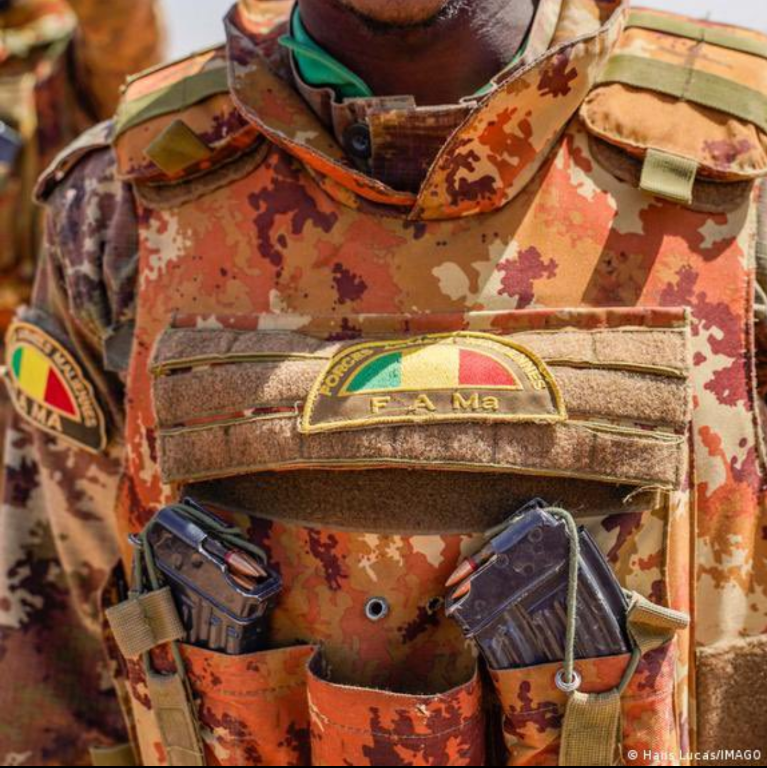
The JNIM claimed responsibility for four coordinated strikes in Mopti, deploying improvised explosive devices (IEDs) and direct fire in a clear display of tactical sophistication. In the Douentza area, the group detonated three IEDs against a military convoy, a supply truck, and a motorcycle detachment, all linked to the Malian Armed Forces (FAMa) and Russian-backed Africa Corps mercenaries. Further south, near Kansila, militants launched an armed assault on local Dozo militias—a traditional hunter group often deployed by Bamako as auxiliary forces. According to the group’s own reports, three Dozo fighters were killed in the ambush.
Five years after the coup: promises unfulfilled
Since Colonel Assimi Goïta seized power in 2019, the junta vowed to reclaim lost territories and restore security after what it described as the failures of democratic governments and Western allies, including the former Barkhane operation. Yet independent conflict data reveals a starkly different reality. Violence-related fatalities have surged, with some provinces recording a two- to threefold increase in civilian and military deaths compared to pre-coup levels. The proliferation of armed actors—from Africa Corps to ethno-regional militias—has deepened intercommunal tensions, inadvertently fueling recruitment for jihadist factions.
Road ambushes and IED strikes, once sporadic, now occur almost daily, crippling key supply routes and trapping communities in a cycle of fear and displacement.
Shrinking state control and deepening humanitarian collapse
Despite official declarations of military progress—such as the recapture of Kidal in late 2023—Bamako’s grip on central and northern regions remains fragile. Entire districts have slipped into lawless zones where government institutions no longer function. The human cost is staggering: over 400,000 internally displaced persons now live in precarious conditions, fleeing both jihadist violence and the collateral damage of military operations.
Blockades imposed by JNIM and the Islamic State in the Greater Sahara (EIGS) have triggered acute food shortages in multiple localities. The inability to secure supply lines has choked off humanitarian aid, turning a security crisis into a silent humanitarian disaster.
Africa Corps: a failed gamble
To counterbalance the withdrawal of French troops and the end of the UN’s MINUSMA mission, Bamako turned to Moscow for support. First under the banner of the Wagner Group, and now through the state-linked Africa Corps, hundreds of Russian paramilitaries were deployed. But their impact has been underwhelming. Reports from human rights monitors and local sources indicate repeated accusations of civilian abuses—such as the Moura massacre—which have driven communities toward insurgent groups promising protection.
Militarily, Africa Corps has struggled to curb the jihadist threat. High casualties and insufficient troop numbers have rendered counterinsurgency efforts ineffective across the vast Malian landscape.
Air power falters under maintenance and adaptability challenges
Facing a shortage of ground forces, the Goïta regime invested heavily in aerial assets, including Bayraktar TB2 drones and attack helicopters like the Mi-24 and L-39 Albatros. Initially, these platforms enabled large-scale strikes. Today, however, maintenance bottlenecks—compounded by the logistical nightmare of sourcing Russian spare parts—have crippled operational readiness. Several aircraft have crashed or been shot down by rebels.
Meanwhile, jihadist groups have adapted. Splitting into smaller units and blending into civilian areas, they evade aerial detection, rendering air strikes either ineffective or tragically indiscriminate.
A dead-end military-first strategy
The July 19 attacks in Mopti are not isolated events but symptoms of a systemic failure. Bamako’s military-first approach has reached a deadlock—military gains prove unsustainable, regional and international partners have been alienated, and reliance on Russian mercenaries has yielded neither stability nor legitimacy. With no political pathway to reintegrate communities, restore public services, or protect civilians, Mali continues to unravel, one district at a time, under the relentless pressure of a spreading Sahelian insurgency.