On January 6, 2026, a military drone strike in western Niger resulted in the deaths of at least 17 civilians, including four children, and left 13 others wounded. The attack targeted a crowded marketplace in the village of Kokoloko. While three Islamist militants were also killed, the operation appears to have violated international laws of war regarding indiscriminate attacks and may be classified as a war crime.
Kokoloko is situated in the Tillabéri region, approximately 120 kilometers west of Niamey and near the Burkina Faso border. Local residents report that the Islamic State in the Sahel (ISS) has maintained a presence in the area for several years. Since 2019, various armed groups have frequently targeted both military personnel and civilians across Niger.
Experts on the Sahel region emphasize that while the strike hit three militants, the high number of civilian casualties in a public space is a grave concern. There are urgent calls for the Niger authorities to launch a transparent investigation, hold those responsible to account, and provide fair compensation to the victims’ families.
Investigations into the incident involved interviews with 15 individuals, including six direct witnesses and nine members of local and international organizations. Satellite imagery and geolocated video footage were also analyzed to confirm the details of the strike. The military junta that seized power in Niger in July 2023 has not yet issued a public statement or responded to inquiries regarding the event.
Witness accounts of the marketplace explosion
According to survivors, a white drone was seen circling Kokoloko twice between 10 a.m. and 1 p.m. At approximately 1:30 p.m., a munition was dropped on the market while hundreds of people were present. One merchant described hearing a whistling sound followed by a massive blast that tore through the stalls where women were selling food.
Witnesses noted that six ISS fighters had entered the village that morning. Three of them, dressed in civilian clothes and turbans, were at the market at the time of the explosion. Residents explained that these militants often visit local markets to buy supplies before departing.
The aftermath was devastating, with many victims suffering from severe burns. A local religious leader reported counting 17 bodies, mostly women and children, many of whom were charred beyond recognition. The deceased were buried in communal graves within the village cemetery with the assistance of the remaining ISS fighters.
Evidence of fire and destruction
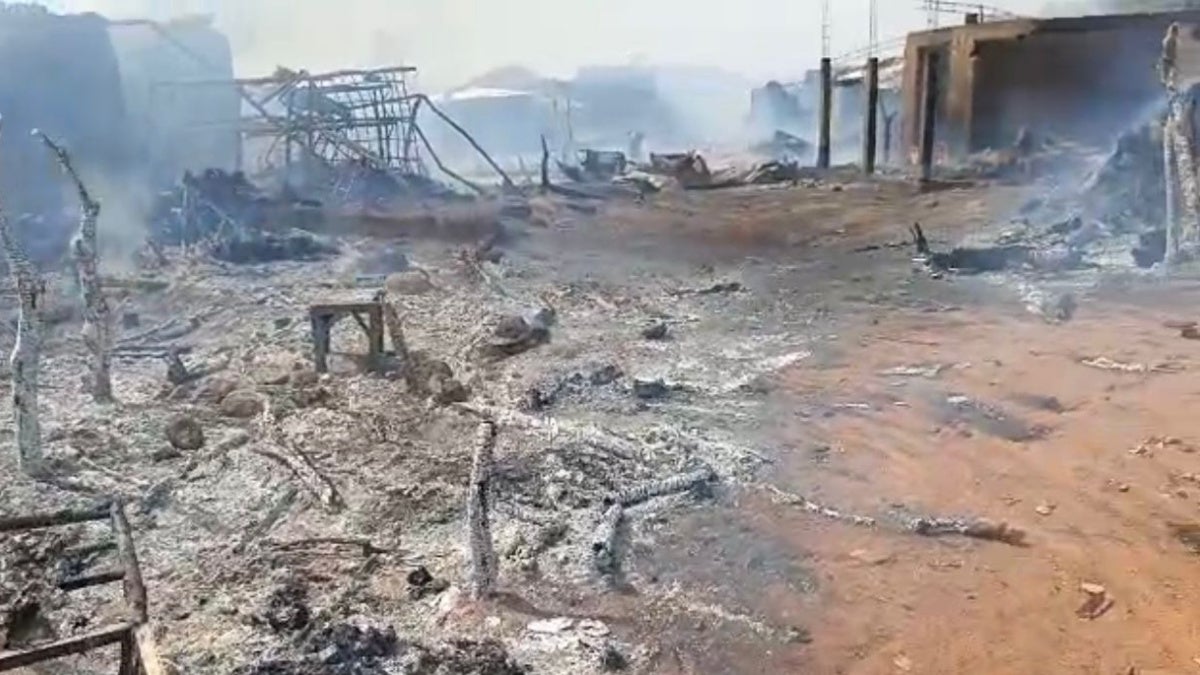
Visual evidence from the scene shows extensive fire damage to market structures. Data from NASA’s FIRMS (Fire Information for Resource Management System) recorded active fires in Kokoloko at 1:31 p.m. on the day of the strike. High-resolution satellite images from later in January confirmed scorched patches along the village’s main road. Witnesses stated that the drone munition ignited fuel and wooden stalls, causing the fire to spread rapidly.
Since 2022, the Niger military has expanded its arsenal with Turkish-made drones, including the Bayraktar TB-2, Karayel-SU, and Aksungur UCAV. These platforms are equipped with advanced sensors for live surveillance and can carry precision-guided munitions. The damage observed at the site suggests the use of high explosives.
Mass displacement and casualty details
The strike triggered a mass exodus, with nearly all of Kokoloko‘s 1,200 inhabitants fleeing to neighboring villages or across the border into Mali. One woman who lost two relatives in the blast described escaping to Mali with almost no belongings.
A list compiled by residents identifies the 17 civilians killed: 11 women aged 29 to 50, two men, and four children aged 5 to 10. Among the 13 injured were four women, seven men, and two teenagers. The three ISS militants killed were buried separately by their group.
Under international humanitarian law, parties in a conflict must distinguish between military objectives and civilians. Launching an explosive attack in a crowded marketplace is considered an illegal indiscriminate action. If such strikes are carried out recklessly or intentionally, they constitute war crimes.
The Tillabéri region remains a flashpoint for violence in the Sahel, with high civilian tolls attributed to the Niger military, ISS, and the Al-Qaeda-linked JNIM. Similar incidents were reported in Injar in September 2025 and Tiawa in early 2024, where military strikes also resulted in significant civilian deaths. International partners are being urged to pressure Niger to adopt stricter civilian protection measures and provide necessary support to those impacted by these tragedies.