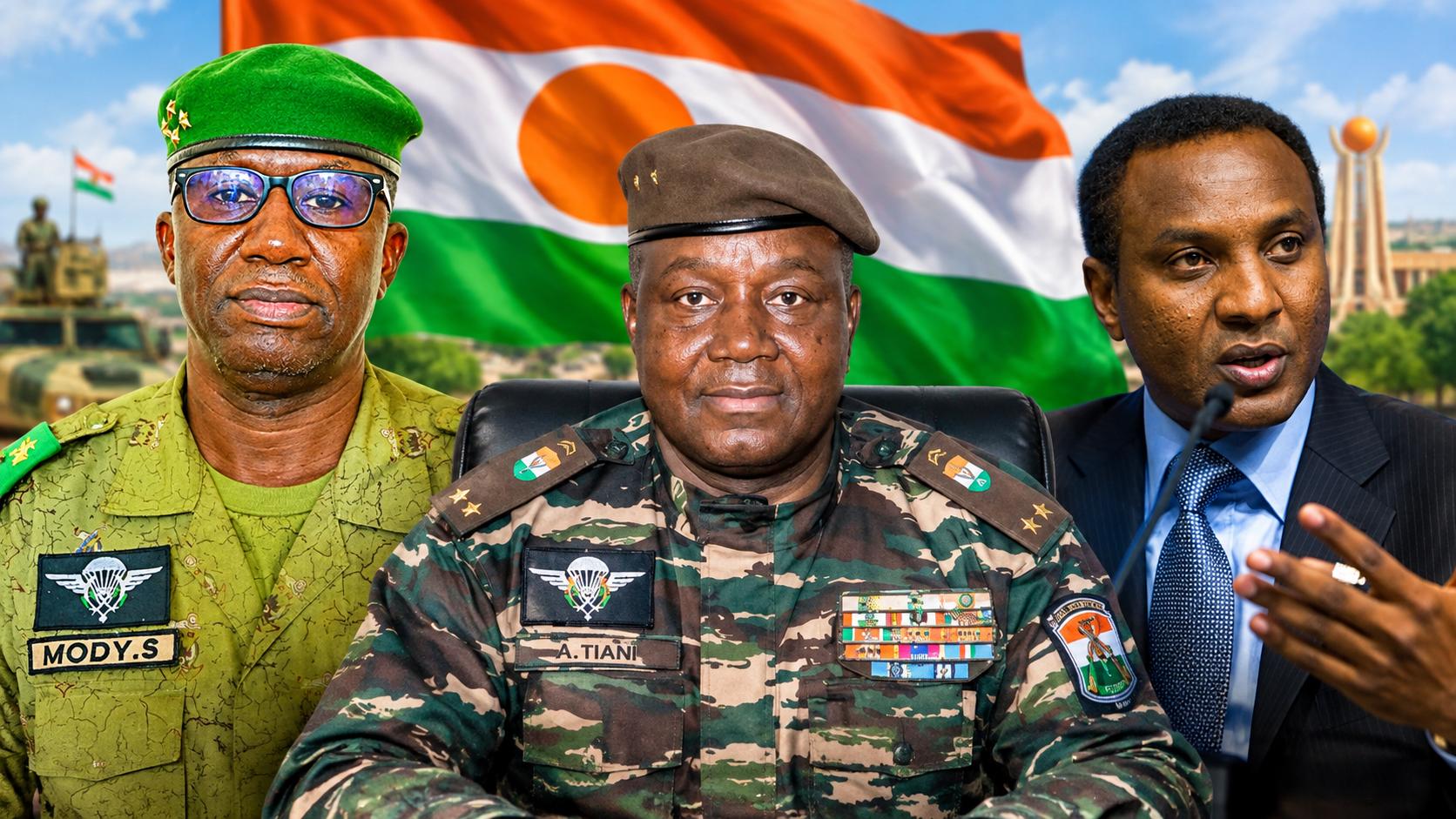
At the highest levels of Niger’s ruling junta, a fierce internal struggle is unfolding over a military structure whose implications stretch far beyond national security. The dispute pits General Salifou Mody, head of the CNSP Abdourahamane Tiani, and former Finance Minister and Prime Minister Lamine Zeine against one another — all jockeying for influence over the Commandement des Forces de Protection et de Développement (CFPD) and the 1.8 billion FCFA it commands each month.
What is the CFPD and why does it matter?
On May 9, 2024, General Abdourahamane Tiani signed decree n°2024-309/P/CNSP/MDN, officially establishing the CFPD. The unit’s stated mission is to safeguard Niger’s strategic infrastructure — mining installations, oil facilities, corridors and pipelines. The Ministry of Defense confirmed the creation of this force, which is tasked with securing key sites and transport routes. In parallel, the recruitment of 10,000 young people in 2024 has bolstered the ranks of the Nigerien armed forces. The project is framed as a security necessity, but it also accompanies the steady expansion of military influence.
The financial engine: article 28 and the 1.8 billion FCFA question
Article 28 of the decree sets a minimum daily allowance (Prime Unique d’Astreinte, or PUA) of at least 12,000 FCFA per man per day, while requiring companies benefiting from security services to contribute financially. Based on a force of 5,000 men, the numbers are staggering:
- Per day: 5,000 men × 12,000 FCFA = 60 million FCFA
- Per month (30 days): 1.8 billion FCFA
- Per year: 21.9 billion FCFA
These figures reflect the financial reality of the system, backed by contracts signed with businesses, actual payments, and deployed personnel. This is the very heart of the power struggle within the regime.
Defense vs. Finance: the institutional tug-of-war
General Salifou Mody pushed hard for the CFPD’s implementation. General Tiani signed the decree under direct pressure from his Defense Minister. But after the signing, the CNSP leader reportedly ordered Finance Minister Lamine Zeine to freeze the CFPD’s financial provisions. The result: the structure exists on paper but lacks the means to operate. Mody thus faced a direct political blockage of his flagship project.
The Mody-Zeine feud: a clash that reshaped the government
Lamine Zeine became the central point of friction. The Finance Ministry deliberately stalled the budgetary translation of the military program. By January 2026, Zeine wore two hats — Prime Minister and Minister of Economy and Finance — while Salifou Mody served as Minister of State for Defense. Mody succeeded in stripping Zeine of the finance portfolio, then forced his departure from the Prime Minister’s office. The CFPD conflict shattered trust among the regime’s key pillars.
Mody takes the helm: concentrating power
The reshuffling of power came through Zeine’s exit. General Mody took over the government and imposed a single condition: he would serve as both Prime Minister and Minister of Defense. In doing so, he consolidated political, military, and administrative levers in his own hands.
Damolleydi: the second battlefield
Faced with the CFPD’s paralysis, the regime launched a general mobilization drive called “Damolleydi” to rally volunteers and existing structures. General Mody was placed at the head of the committee overseeing this mobilization, sidelining General Mohamed Toumba, the Interior Minister. Yet Mody deliberately slowed Damolleydi’s implementation. The initiative lost visibility, overtaken by autonomous local structures.
The three levers of state control
This whole affair locks the state apparatus around three critical axes:
- Command: control over personnel assigned to strategic sites.
- Missions: deciding which infrastructure gets protected and what priorities are set.
- Money: managing contributing companies and the financial flows they generate.
Article 28 of the decree governs this financial mechanism, which amounts to 1.8 billion FCFA every month.
The ultimate prize: total control of the state apparatus
The 1.8 billion FCFA figure is the direct financial stake of the CFPD. It confirms the political dimension of the force, sitting at the crossroads of strategic resources, corporate contributors, and the chain of command. Beyond the rivalry between Tiani, Mody, and Zeine, the winner of this confrontation will hold exclusive control over Niger’s men, missions, and resources. Behind the personal quarrels, what is really at stake is nothing less than the complete lock on the levers of state power.