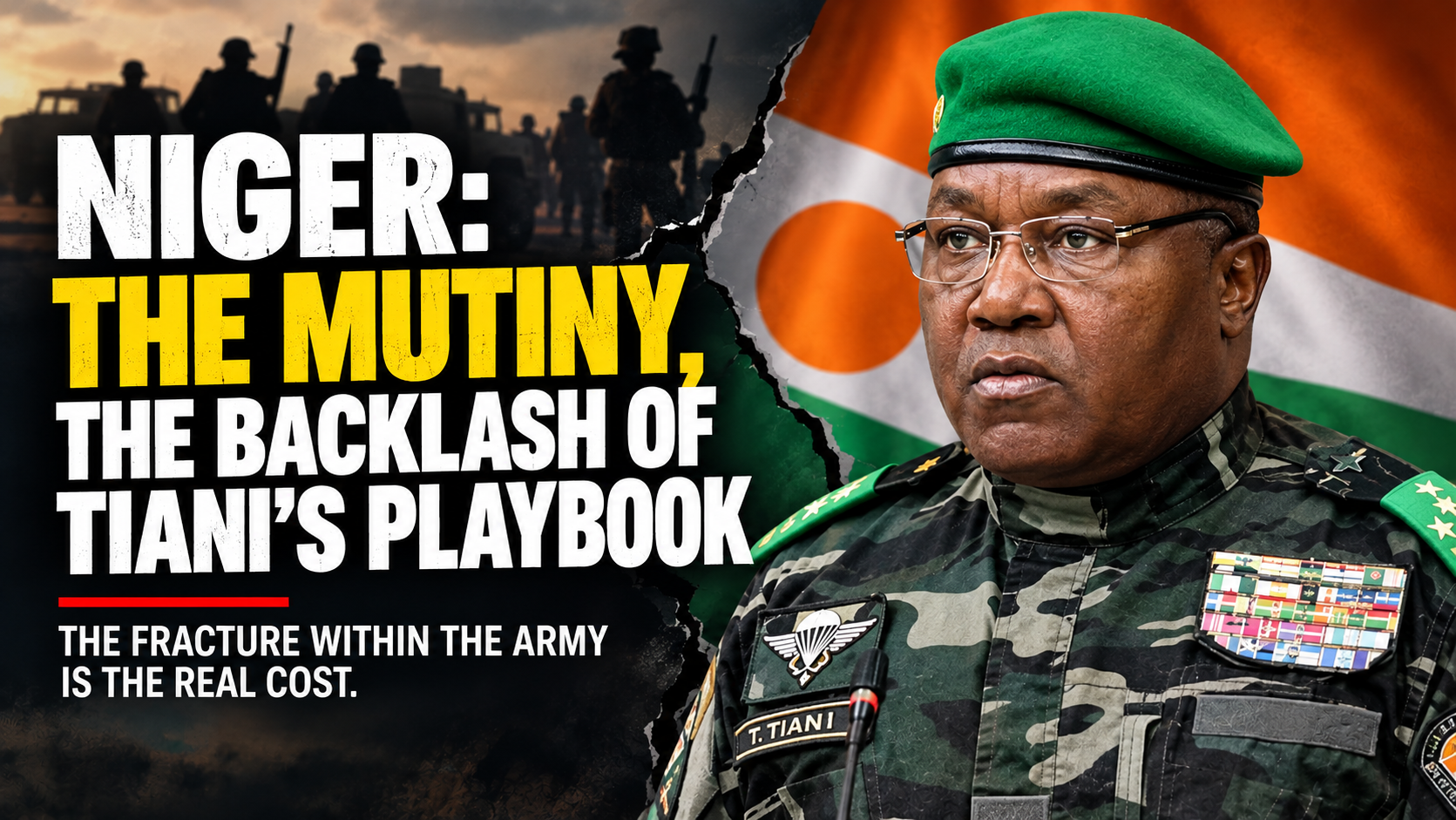
The events of 28 and 29 August in Niger cannot be reduced to a mere disciplinary lapse. The mutiny that shook the armed forces is the direct consequence of a policy pursued since General Tiani came to power: the progressive transformation of the army into an instrument of political control rather than a force dedicated exclusively to national defence.
By multiplying appointments of loyalists, sidelining officers considered too independent, and imposing a logic of personal loyalty on the military hierarchy, Tiani has gradually broken the internal balances that once preserved a certain cohesion within the ranks. As fidelity to the leader took precedence over experience, competence, and institutional neutrality, distrust took root.
This politicisation of the chain of command inevitably has consequences. When a soldier begins to believe that advancement depends more on proximity to power than on service record, a sense of injustice sets in. Frustrations accumulate, rivalries intensify, and trust between different levels of command erodes. The mutiny of 28 and 29 August therefore appears not as an isolated incident but as the symptom of a deeper malaise, nurtured by years of tension, frustration, and defiance within the military apparatus.
The gravity of the situation is compounded by the fact that the army is one of the main pillars of stability for a state facing a permanent security threat. A divided army, suspicious of its own hierarchy and preoccupied with internal score-settling, cannot operate with the same effectiveness as a cohesive force united behind a credible chain of command. When soldiers begin to view their own comrades with suspicion, operational cohesion fractures. In a context where Nigerien forces must confront armed groups on multiple fronts, every additional rift within the security apparatus poses a direct risk to territorial defence.
Opaque management fuels fear
The official silence regarding the fate of the arrested soldiers is not inconsequential. It fits a crisis-management method based on opacity and uncertainty. As long as no one knows precisely who has been arrested, where these soldiers are detained, what charges they face, or under what conditions they are held, fear can gradually spread throughout the troops. Uncertainty becomes an instrument of control: everyone may fear being next in line for arrest, interrogation, or dismissal.
This lack of transparency produces another effect: it prevents any possibility of appeasement. Instead of clarifying responsibilities and enabling an institutional exit from the crisis, silence fuels rumours, suspicions, and contradictory interpretations. Families of the arrested soldiers remain in limbo, their comrades remain wary, and the hierarchy loses further credibility. A crisis that could have been handled as a strictly military affair risks becoming a much broader crisis of confidence.
Media spectacle as a substitute for answers
By displaying rolling and military equipment on television, the regime is not merely communicating; it is constructing a narrative designed to present events from a specific angle. Showing weapons, vehicles, and other equipment as ‘proof’ of a plot may help instil in public opinion the idea that the arrests are automatically justified. But a media demonstration of matériel does not answer the real questions: What exactly were the mutineers’ demands? What individual responsibilities can be established? What procedures have been initiated? And above all, why could such a crisis erupt within the very forces supposed to be the regime’s main bulwark?
This spectacular communication risks diverting attention from the central problem. It is not enough to present weapons or vehicles to prove the existence of an organised conspiracy. Facts must be established, verifiable elements presented, and a transparent procedure allowed. Otherwise, official communication may appear more as a means of legitimising arrests than as a true response to the questions troubling the nation.
More profoundly, this strategy reveals a major contradiction. The authorities claim to strengthen the state and restore authority, yet they seem to govern by distrust within the military institution itself. No army can be effective in the long term if its members feel that the slightest dissent may be interpreted as a threat to power. Military discipline is of course based on obedience, but it also relies on trust in the hierarchy, fairness of procedures, and a sense of belonging to the same institution serving the country.
The operational cost of purges
The multiplication of purges or sidelining also carries an operational cost. Every experienced officer set aside, every command weakened, and every unit destabilised by fear represents a potential loss of skills, experience, and cohesion. In a war against armed groups with networks, local intelligence, and significant adaptive capacity, Niger cannot afford to weaken its own command structures to resolve internal political problems.
There is thus a particularly worrying paradox: while the regime’s discourse constantly emphasises sovereignty, security, and defence of the territory, a significant part of its energy is devoted to monitoring, controlling, and neutralising dissent from within the security apparatus. This prioritisation of the regime’s political security may come at the expense of national security itself.
An army that fears internal purges more than external threats inevitably loses part of its mobilisation capacity. Soldiers must be able to focus on their primary mission: protecting populations and defending the territory. If their attention is gradually diverted to internal power struggles, command rivalries, and the fear of being accused of disloyalty, the military institution loses in effectiveness what it gains in political control.
Ultimately, the question raised by the 28 and 29 August mutiny goes far beyond the fate of the arrested soldiers. It directly questions how Tiani conceives of power, the army, and loyalty. A national army cannot be durably transformed into an instrument for protecting a regime without this transformation eventually producing tensions within its own ranks.
By concentrating his energy on hunting down internal opponents rather than restoring genuine military cohesion, Tiani risks weakening precisely the institution on which the country’s security largely depends. A divided armed forces may offer the regime a short-term political advantage, but it constitutes a long-term strategic threat.
This is where the junta leader’s fundamental political responsibility lies: gradually confusing regime security with state security. By seeking above all to guarantee his own political survival, he runs the risk of weakening military cohesion, deteriorating trust within the armed forces, and thereby further destabilising Niger in the face of the threats it confronts. The current crisis thus appears less as an isolated event than as the culmination of governance based on distrust, concentration of power, and the progressive politicisation of the security apparatus.