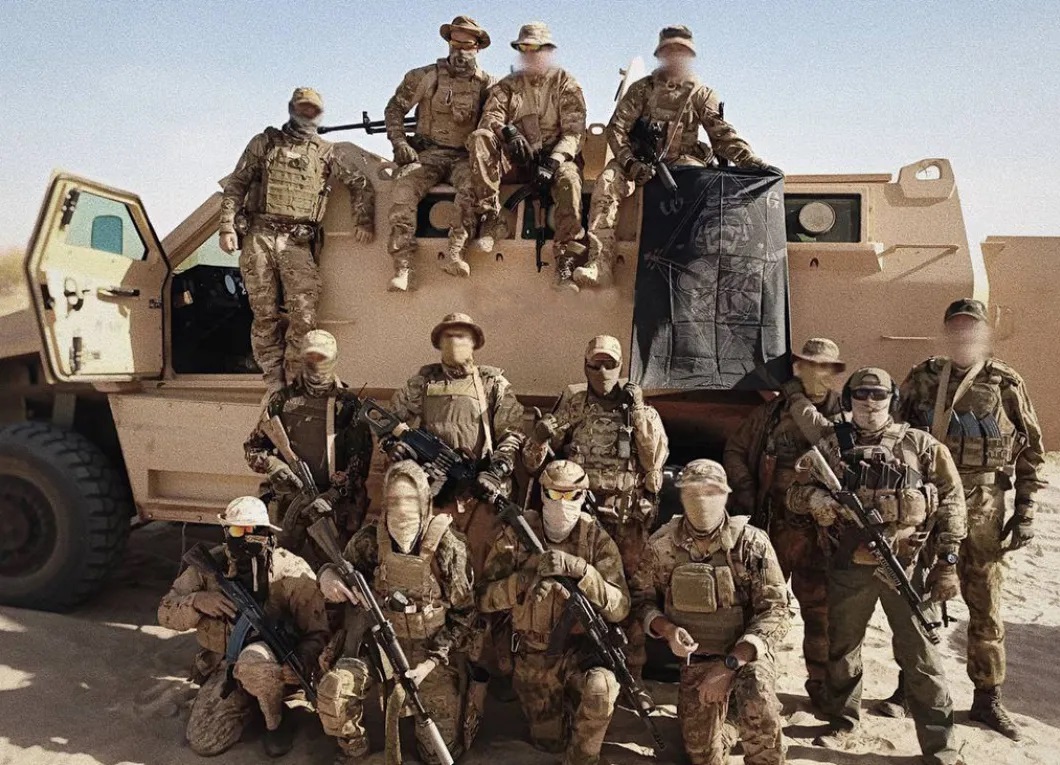
When the notorious Russian mercenary Wagner Group announced its departure from Mali earlier this year, it publicly declared on social media that its “mission was complete.”
However, after three and a half years of counter-terrorism and counter-insurgency operations, the group’s presence proved catastrophic, leaving the Sahelian nation still grappling as a global hub for terrorism.
“Notwithstanding its reputation for combat readiness and intermittent public victory claims in Mali, the Wagner Group’s strategic approach has been marred by a series of setbacks,” noted the investigative organization The Sentry in an August 27 report.
Moscow has since substituted Wagner with its own paramilitary contingent, the Africa Corps, operating under the Ministry of Defense. A July 29 report from the Timbuktu Institute indicated that a significant 80% of Africa Corps members are former Wagner mercenaries.
“The Africa Corps,” the report highlighted, “inherits Wagner’s history of human rights abuses, encompassing extrajudicial executions and torture. Such violations, frequently committed without accountability, foster resentment within communities and inadvertently bolster jihadist recruitment by capitalizing on local grievances.”
Interviews conducted by The Sentry with Malian military personnel, intelligence operatives, and officials from financial and mining ministries reveal a strong aversion among Malian soldiers towards the Russian contingent. These local forces assert that Wagner combatants disregard established command structures, attributing security lapses and operational missteps—which resulted in personnel and equipment losses—directly to the Russians.
Furthermore, the mercenaries’ harsh methods and erratic counter-terrorism strategies have failed to cultivate trust among the Malian populace.
“The presence of Wagner in Mali has coincided with a marked escalation in attacks and casualties among civilians, often linked to Malian security forces and their allied militias. Indeed, the Wagner Group’s tactics frequently involve indiscriminate targeting of non-combatants.”
Reports also document Wagner fighters’ involvement in sexual violence and mass killings, exemplified by the 2022 Moura massacre, where more than 500 civilians perished, including at least 300 executed men.
Early in 2023, experts from the United Nations advocated for an independent inquiry into egregious human rights abuses and “potential war crimes and crimes against humanity perpetrated in Mali by government forces and the private military firm known as the Wagner Group.”
These experts stated they have continuously received “persistent and alarming accounts of horrific executions, mass graves, torture, rape, and sexual violence” since 2021. Despite numerous calls, investigations in Mali have yet to yield any concrete outcomes.
Certain Malian Armed Forces (FAMa) soldiers attributed the Moura massacre to the influence Russian mercenaries held over senior army officials.
A soldier confided to The Sentry: “Moura would not have occurred without Wagner. Not to that extent, not for that duration, and not with such a devastating death toll.”
Locals in Mali increasingly hold the heavy-handed Russian tactics responsible for a spike in recruitment among Tuareg separatist combatants and terrorist groups affiliated with Al-Qaeda and the Islamic State.
Amadou Koufa, head of the Al-Qaeda-linked Islamist militant group Katiba Macina, told France24 in a 2024 interview that the Russians’ brutality had compelled local populations to join the struggle to “protect their faith, their territory, and their possessions.”
Drone strikes by Russians on weddings and funerals, alongside online videos depicting Wagner fighters abusing Tuareg civilians, have further intensified public dissatisfaction and boosted recruitment propaganda.
“Community leaders in central Mali frequently voice concerns that Wagner’s presence has not led to any lasting improvement in their areas,” researchers from the Royal United Services Institute documented in a January 2025 report.
In July 2024, Wagner experienced a significant setback when multiple terrorist factions ambushed a substantial convoy near the northeastern Malian village of Tin Zaouatine. Militants reported eliminating 84 Russian mercenaries and 47 FAMa soldiers during this engagement.
The Sentry highlighted that the dynamic between Wagner and the FAMa deteriorated into mutual distrust. Russian survivors alleged that Malian intelligence underestimated rebel strength and deserted them during combat. Conversely, Malian officers accused the Russians of disregarding command structures, commandeering their vehicles, and exhibiting overt racism.
“We’ve merely exchanged one peril for another,” a senior officer remarked to The Sentry.
Public outrage flared further after the September 2024 militant assault on Bamako airport, which claimed over 100 lives. Despite Wagner units being positioned nearby, they reportedly delayed intervention for five hours.
An airport guard informed The Sentry, “They won’t act unless they’re paid.”
Charles Cater, The Sentry’s director of investigations, unequivocally stated that the Wagner Group’s involvement in Mali has been a demonstrable failure.
“Aggressive and poorly conceived counter-terrorism operations have inadvertently bolstered alliances among armed factions posing a threat to the state, resulted in significant battlefield losses for Wagner, and escalated civilian casualties,” he explained. “Ultimately, Wagner’s deployment served neither the interests of the Malian populace or its military government, nor even the mercenary group’s own objectives.”
Justyna Gudzowska, The Sentry’s executive director, asserted that Mali’s experience should stand as a clear cautionary tale.
“As Moscow expands its influence across the Sahel, rebranding itself with the Africa Corps, it’s vital to recognize that Wagner was neither the invincible fighting force nor the effective economic partner it purported to be,” she cautioned. “Instead, the Malian case demonstrates the group’s profound failure on multiple fronts, a stark warning to other African nations contemplating engagements with the Ministry of Defense-supported Africa Corps.”