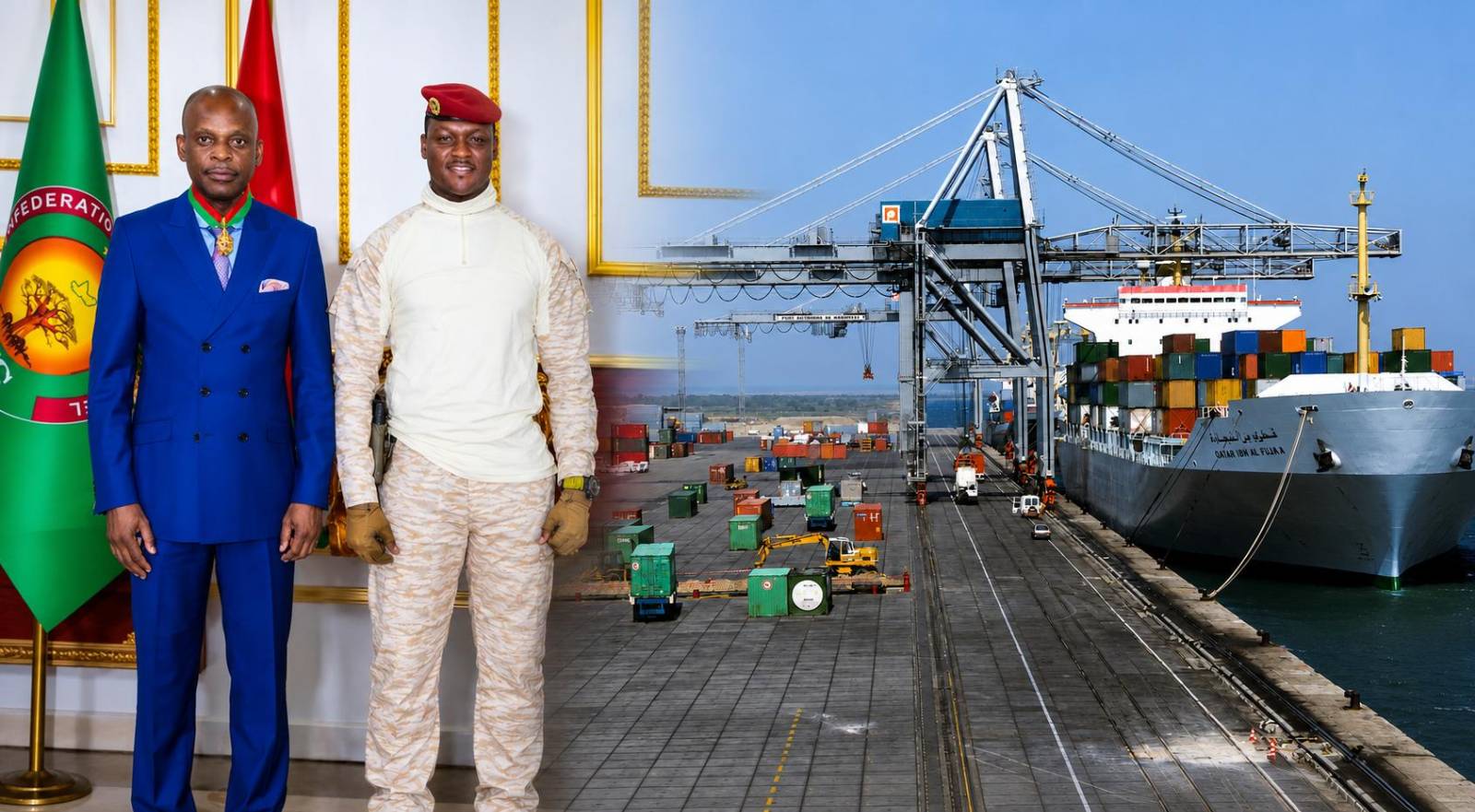
The recent elevation of Togo’s Foreign Minister to the rank of Commander of the Order of the Stallion—Burkina Faso’s highest honor—has sparked a wave of official praise, heralded as a testament to Lomé’s so-called “diplomacy of openness, solidarity, and proximity” toward its neighbors. Yet beneath the ceremonial grandeur lies a far more complex and pragmatic reality.
Award or transaction?
Diplomatic distinctions are often symbolic, but their true significance often lies in the unspoken exchanges they represent. In this case, the accolade raises a critical question: what precisely does it honor? A genuine act of diplomatic goodwill, or the convergence of interests between two regimes navigating shared political and economic pressures?
Diplomatic gestures frequently serve as tools to consolidate alliances, yet they can also convey subtle political messages to neighboring partners. This particular distinction arrives at a sensitive juncture, following a period of considerable political tension. The Togolese government’s decision to grant asylum to former Burkina Faso President Roch Marc Christian Kaboré—albeit briefly—underscores the fragility of regional solidarity.
Economic pragmatism overshadows political principles
For Togo, regional solidarity appears to be negotiable when weighed against economic advantage. By yielding to pressure and facilitating Kaboré’s departure, Lomé prioritized strategic trade agreements with Ouagadougou over principles of asylum and political refuge. The primary objective? Securing comprehensive contracts to facilitate the transit of Burkinabé goods and merchandise through the Autonomous Port of Lomé (PAL).
This approach is rooted in mutual economic dependence. As a landlocked nation, Burkina Faso relies heavily on maritime corridors for trade. The Autonomous Port of Lomé is a vital artery for its imports and exports, making strong ties with Lomé essential for Ouagadougou’s economic stability. Similarly, Togo derives significant revenue from regional transit, reinforcing the strategic value of this partnership for both capitals. The resulting rapprochement is less a display of fraternity and more a calculated alignment of economic interests.
By exchanging the fate of a political exile for assurances of logistical flow, Lomé has demonstrated that its “proximity diplomacy” is, in reality, a transactional strategy driven by financial opportunism.
The erosion of ideological diplomacy
The timing of this distinction coincides with ongoing concerns over regional governance, political freedoms, and public liberties. For many observers, the honor reflects strategic alignment rather than a recognition of democratic values or principled cooperation. This development mirrors a broader trend across West Africa, where economic and security considerations increasingly outweigh traditional diplomatic commitments.
Alliances are now forged and dissolved based on commercial interests, logistical needs, and security imperatives, leaving political and moral principles relegated to the periphery of official discourse. The contrast between these evolving realities and the rhetoric of regional solidarity has not gone unnoticed.
Reality vs. rhetoric in diplomatic relations
While authorities celebrate this distinction as proof of an exemplary bilateral relationship, the narrative falters under scrutiny. The absence of transparency regarding the terms of this rapprochement raises legitimate concerns: what concessions were made, and what compromises were accepted in exchange for this honor? When diplomatic decisions are so closely tied to economic benefits, the once-lofty ideals of African solidarity lose their luster in the eyes of an increasingly skeptical public.
Ultimately, this distinction exemplifies a political landscape governed by cold realism, where state interests supersede ideological consistency. Nations prioritize strategic advantages, trade exchanges, and political stability—even at the expense of ethical coherence and the principles they publicly espouse. Behind the smiles exchanged during diplomatic ceremonies and the medals pinned to official attire lies a stark truth: this accolade is less a symbol of disinterested brotherhood and more a reward for a commercial partnership secured at the expense of ethical integrity and asylum rights. It is this fundamental disconnect that continues to fuel debate over the true nature of relations between Lomé and Ouagadougou.