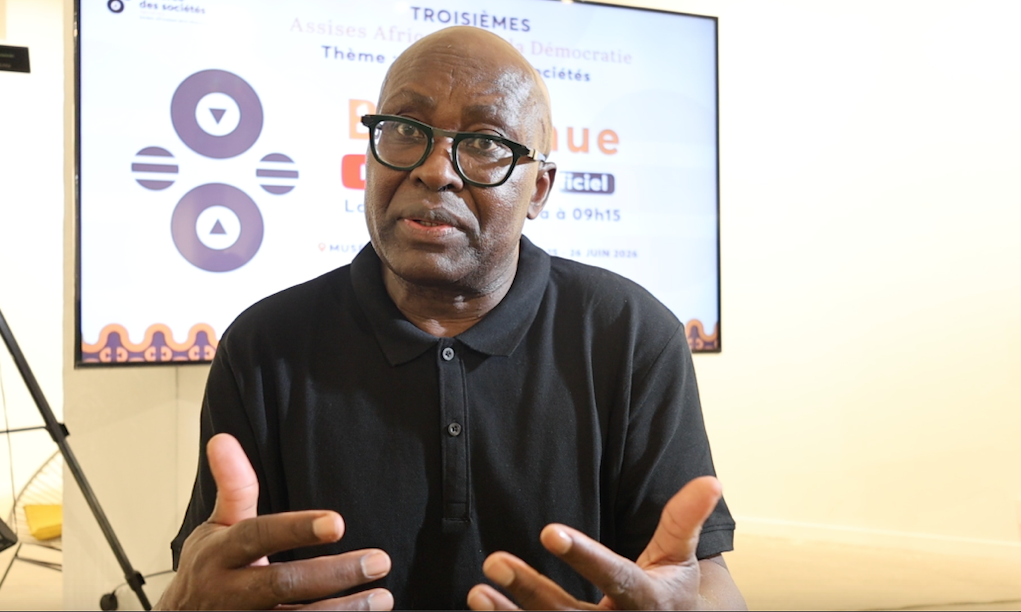
The Cameroonian philosopher Achille Mbembe dismantles long-held misconceptions about Africa’s political and economic systems. In an exclusive interview during the third edition of the African Democracy Forum, held at the Theodore Monod Museum in Dakar, he challenges the very notion that the continent faces a crisis of democracy—arguing instead that such a system has never truly existed in most African nations.
Democracy in Africa: a concept yet to be realized
In his sharp critique, Mbembe asserts that the widespread talk of a democratic crisis in Africa is fundamentally flawed. “There can be no crisis of democracy where democracy has never truly taken root,” he declares. Instead, he describes what many African states have practiced as administrative multipartyism—a system of elections and political competition that lacks substance and is often marred by irregularities and contestations.
Mbembe firmly rejects the notion of a tropical democracy, calling it a colonial construct designed to dismiss African political traditions as inferior. He advocates instead for an endogenous democratization—one rooted in Africa’s own social, cultural, and political realities.
The franc CFA and the illusion of monetary sovereignty
The philosopher also addresses the controversial topic of the franc CFA, arguing that the debate over its existence overshadows a more fundamental issue: Africa’s need for a true African currency. He points to stark differences in political mobilization between West Africa and Central Africa, attributing them to distinct political cultures. West Africa, he notes, boasts vibrant civil societies and influential diasporas, while Central Africa remains trapped in what he describes as “the heart of darkness of postcolonial African politics.”
Mbembe singles out countries like Cameroon, Chad, Equatorial Guinea, Congo-Brazzaville, and the Central African Republic as regimes resistant to change, where governments remain closed off to the aspirations of their people.
The case for reparations: justice beyond measure
Turning to the issue of reparations for the transatlantic and trans-Saharan slave trades, Mbembe acknowledges that some losses are irreparable. Yet he insists that this reality strengthens, rather than weakens, the moral and ethical imperative for reparations. “The more irreparable the loss, the more urgent the demand for justice,” he argues, while also emphasizing the shared responsibility of African elites in perpetuating these historical injustices.
For Mbembe, the path to reconciliation lies in a universal justice—one that acknowledges both vertical (between former colonizers and the colonized) and horizontal (within African societies themselves) dimensions. Only through such a reckoning, he suggests, can Africa move beyond its fractured past and toward genuine emancipation.
The role of citizens in shaping Africa’s future
The theme of this year’s African Democracy Forum, “The Power of Societies”, reflects Mbembe’s belief that true democratic transformation must come from the grassroots. He warns against the corrosive influence of financial capitalism on democratic institutions, insisting that Africa’s democratic future depends on the agency of its people rather than the whims of its political elites.
In this wide-ranging interview, Achille Mbembe offers a provocative reexamination of Africa’s political trajectory. His insights challenge us to rethink democracy, sovereignty, and justice—not as abstract ideals, but as urgent demands for a continent still grappling with the legacies of colonialism and the unfinished business of self-determination.