Look past the headlines that followed the events of July 2023 in Niamey and a less visible story emerges about division general Moussa Salaou Barmou. His public profile as a political figure is recent, but the operational foundations beneath it were laid long before, inside some of the most demanding military institutions in the United States. Understanding how that training was absorbed, and why it mattered so much in the field, reveals the deeper mechanics behind the rise of Niger’s special forces.
The institutional roots of a tactical mindset
Barmou’s military and academic record reads like a deliberate tour through the upper tiers of American military education. Each stage added a distinct layer to his command style, and those layers would later shape how Niger’s elite units were built, trained and deployed.
- Fort Moore (formerly Fort Benning, Georgia): Here he completed the U.S. Army Infantry School program, a benchmark institution for infantry tactics, assault techniques and close-combat conditioning. The emphasis was on speed of decision, physical resilience and small-unit cohesion.
- National Defense University in Washington: Holding a diploma from the College of International Security Affairs (CISA), he sharpened his skills in strategic planning, counterterrorism and the analysis of asymmetric threats. This was less about firepower and more about anticipating how weaker actors exploit gaps in a stronger force.
That combination of theoretical depth and hands-on practice instilled a doctrine centered on responsiveness, the autonomy of small units and the tight integration of intelligence assets into every phase of an operation.
From classroom doctrine to the creation of Niger’s special forces
The real test of any imported doctrine is whether it survives contact with reality. In Niger, the American-influenced approach did more than survive; it became the operating backbone of a new kind of unit.
- Building the Special Forces (PFS): As commander of Niger’s special forces, Barmou organized the elite unit along the lines of the U.S. Special Operations Command (USSOC). He introduced strict selection criteria, rapid interception drills and a heavy reliance on small, mobile patrols rather than large static formations.
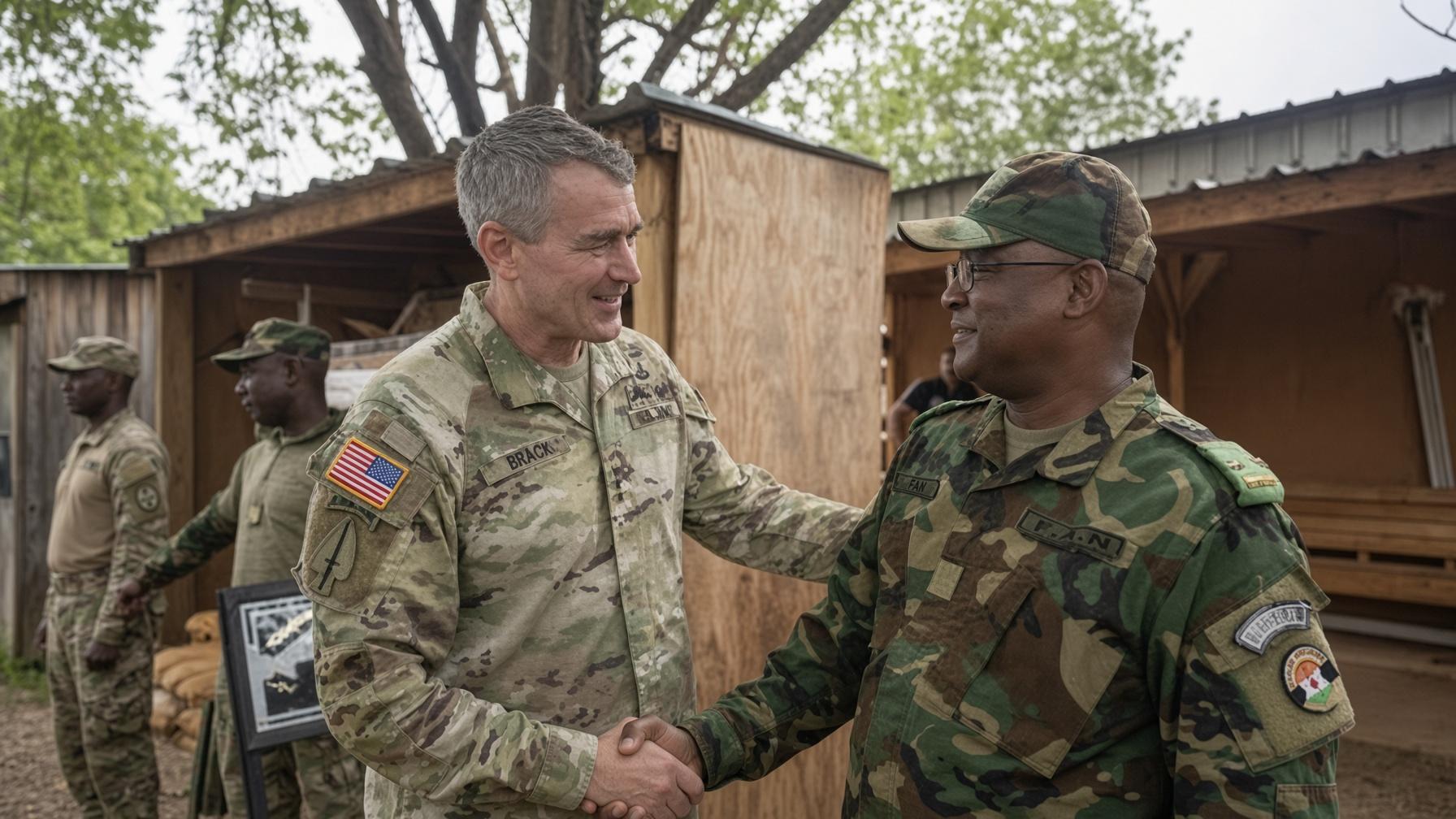
- Joint counterterrorism operations: Working alongside American forces based at Agadez (Base 201) and Niamey, he coordinated complex counterinsurgency missions in the Lake Chad basin against Boko Haram and in the tri-border zone against groups aligned with the Islamic State.
- Military diplomacy: His fluency in American military codes made him the natural point of contact for the Pentagon. During the delicate negotiations that followed the 2023 coup, that credibility and the rigor of his training allowed him to keep a direct channel of discussion open with U.S. diplomacy.
Why this background matters for the transition
Alongside general Abdourahamane Tiani within the CNSP, Moussa Salaou Barmou served as Chief of General Staff of the Armed Forces (CEMA). In that role he reorganized Niger’s security map and the framework of the Alliance of Sahel States (AES) before the military command restructuring carried out in September 2026.
His imprint on the Nigerien armed forces is that of an officer who managed to adapt modern warfare methods and American pragmatism to the tactical realities of the Sahelian theater. The result is a force that thinks differently, moves differently and, crucially, plans differently than it did before.