Bénin’s economic growth stalls without reliable electricity
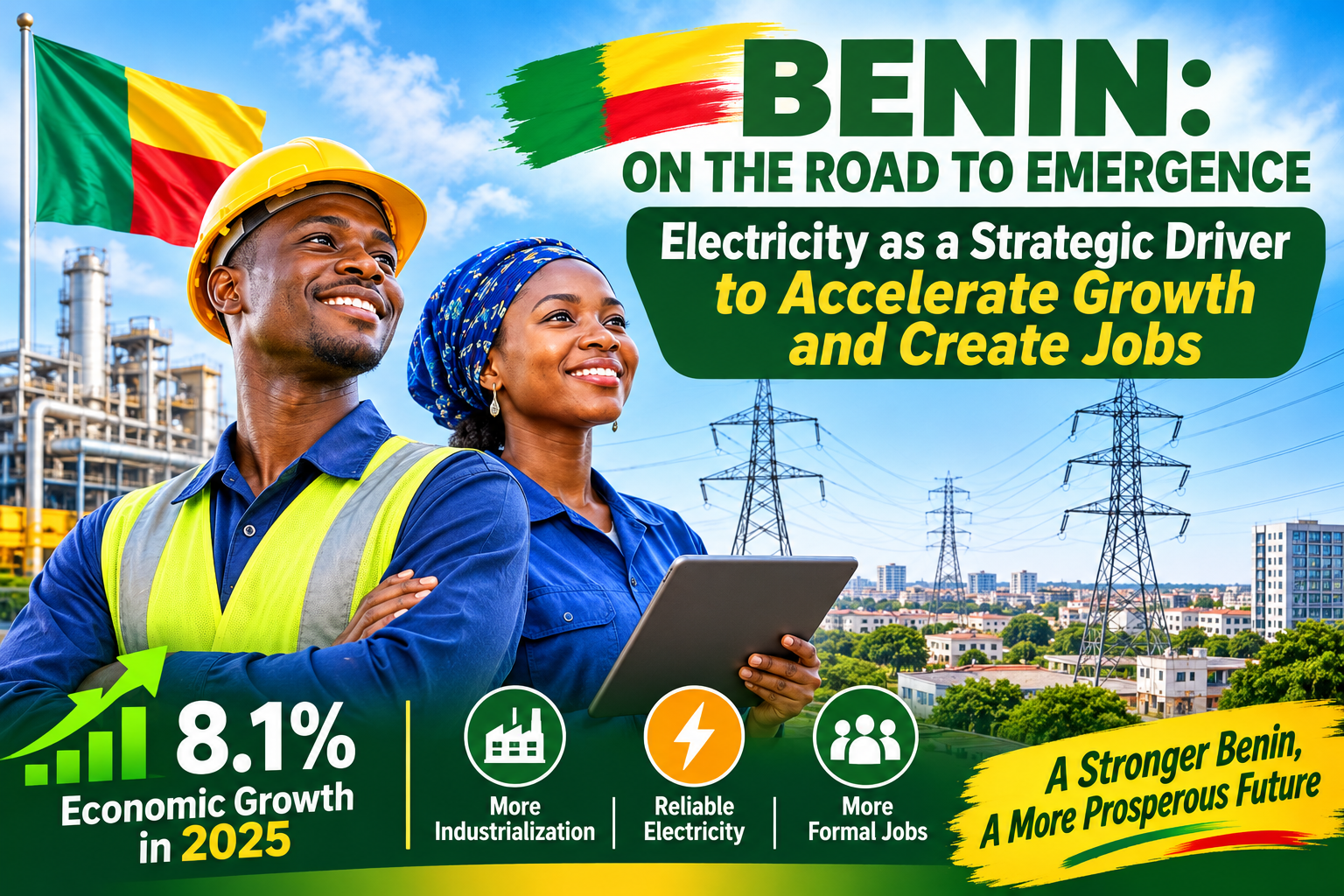
Despite achieving an 8.1% GDP growth in 2025, Benin faces a critical challenge: translating economic expansion into stable, formal employment. The World Bank’s latest economic outlook report highlights a stark imbalance 96.3% of workers remain in the informal sector, and only 19.8% hold salaried jobs. Young workers fare even worse, with just 9% in formal employment.
The paradox is clear: growth alone does not create sustainable jobs. Without a stable power supply, businesses cannot expand, hire, or innovate. Nearly half of Beninese companies cite electricity access as a major obstacle, while 86.1% report frequent power outages. The consequences are severe lost productivity, higher costs, and missed export opportunities.
The cost of unreliable power on businesses and workers
For small agricultural processors, textile workshops, and manufacturing firms, power cuts translate into lost time, wasted materials, and heightened operational costs. Businesses often resort to expensive diesel generators, further straining their finances. In 2024, transmission losses reached 24.7%, and half of the electricity grid’s infrastructure was over 25 years old. These inefficiencies cripple competitiveness and deter investment.
Meanwhile, the informal sector where most Beninese workers operate lacks the capital to invest in backup power solutions. Without reliable electricity, entrepreneurs cannot scale operations or create stable jobs. The result is a cycle of precarious employment and stunted economic mobility.
Mission 300: a roadmap for Benin’s energy transition
To address these challenges, the Benin Energy Compact aligned with the Mission 300 initiative aims to expand access to electricity for 300 million Africans by 2030. For Benin, the plan involves boosting production, modernizing transmission and distribution networks, and mobilizing private investment.
Key projects underway include:
Four new solar plants in Natitingou, Djougou, Bohicon, and Parakou, with a combined capacity of 50 MW.
A 128 MW thermal plant in Onigbolo to bolster baseload power.
If executed successfully, these initiatives could help create or improve 159,000 jobs in Benin by 2030. However, success depends on improving governance, reducing technical and commercial losses, and accelerating grid expansions.
From GDP growth to job creation: the real test
The Glo-Djigbé Industrial Zone (GDIZ) offers a glimpse of what’s possible. Between 2024 and 2025, employment in the zone surged by 28.8%, reaching 22,798 jobs. This growth stems from investments in agro-processing, textiles, and manufacturing sectors that demand consistent power.
Scaling this success across the economy requires more than infrastructure. Policymakers must ensure that electricity reaches small businesses, farmers, and young entrepreneurs at affordable rates. Only then can Benin shift from macroeconomic growth to tangible, inclusive employment.
Bottom line: power defines prosperity
Benin’s economic achievements in 2025 are undeniable but they are incomplete. The true measure of progress will be whether businesses can operate without interruption, whether young workers can secure stable jobs, and whether the energy sector can meet demand. Without these foundations, growth will remain an abstract number rather than a force for change.
By Nicolas Biyong — Journalist