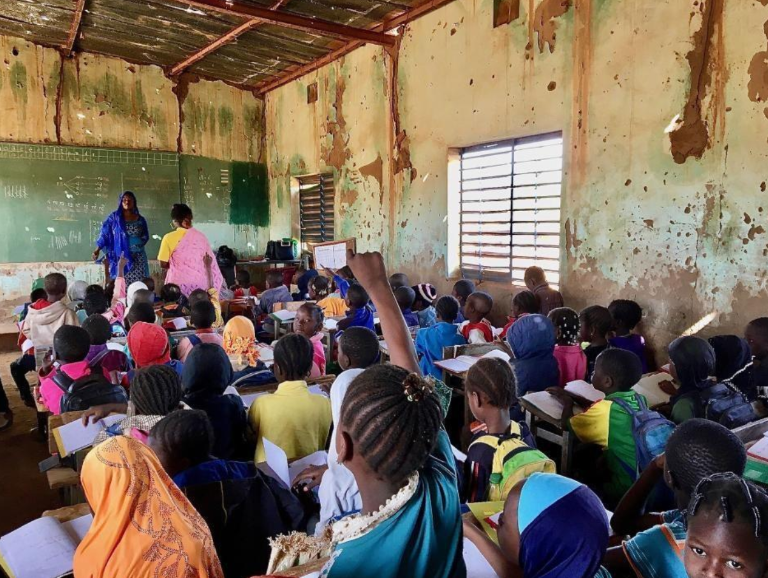
Niamey is hosting the inaugural education summit of the Alliance of Sahel States (AES), bringing together education ministers from Niger, Mali, and Burkina Faso to address the deepening crisis in the region’s school systems. The three-day conference, opened by Niger’s Prime Minister Ali Mahamane Lamine Zeine, marks a strategic push to rebuild an integrated, sovereign, and resilient education framework despite ongoing challenges.
Education ministers gather as schools collapse under dual pressures
The crisis facing the Sahel’s education systems is two-fold: a severe shortage of qualified teachers and the forced closure of thousands of schools due to insecurity. While the AES aims to harmonize educational policies across its member states, the reality on the ground reveals a stark gap between ambition and current capacity.
The summit’s primary objective is to lay the groundwork for a unified education model that ensures continuity for millions of children amid displacement and violence. Yet, the scale of the challenge remains daunting, with decades of systemic underinvestment now exacerbated by armed conflict and population displacement.
Teacher shortages hit all levels of the education system
The shortage of educators is not merely numerical—it reflects a broader structural failure in teacher recruitment, training, and retention. In Niger, the 2023–2024 school year saw 69,636 teachers serving over 3 million primary students, averaging 43 pupils per teacher. Across all education levels, the country had just 105,869 teachers for nearly 3.95 million students in 2026, according to the Ministry of National Education.
Compounding the issue is the reliance on underqualified or untrained staff. A 2017 UNESCO study found that 78.5% of 70,491 public school teachers in Niger were temporary hires, some without prior pedagogical training. The situation is mirrored in Burkina Faso and Mali, where insecurity has prevented educators from reaching remote or conflict-affected areas, further depleting the teaching workforce.
School closures and displacement: a generation at risk
The number of non-functional schools across the AES member states has surged due to armed violence. In Burkina Faso, 5,336 schools were closed as of February 2024, displacing over 820,000 students and 24,000 teachers. Mali reported 2,444 non-operational schools in June 2026, leaving 733,200 children without access to education. Niger, meanwhile, had 1,097 closed schools by the end of 2025, affecting 93,676 students—nearly half of them girls—particularly in the Tillabéri region.
These closures are part of a larger humanitarian catastrophe. According to 2026 data from the International Organization for Migration (IOM) and the UNHCR, Burkina Faso hosted over 2 million internally displaced persons (IDPs), Mali had 414,524, and Niger 548,386. Forced migration disrupts children’s education, as families flee to unfamiliar regions without adequate school infrastructure. Many students face prolonged absences or permanent dropout, deepening the crisis of lost learning.
From political ambition to classroom reality
The AES education summit in Niamey is not just a symbolic gathering—it must translate into actionable solutions. Key priorities include:
- Teacher training and recruitment: Expanding teacher training programs and incentives for educators to work in high-risk areas.
- School reopening and security: Prioritizing the reopening of closed schools and securing them against attacks.
- Alternative learning pathways: Developing mobile schools, digital platforms, and non-formal education options for displaced children.
- Curriculum harmonization: Creating unified standards across the AES to ensure educational continuity for mobile populations.
The stakes are high. Niger alone has nearly 5 million children out of school—a figure that underscores the urgency of the summit’s outcomes. For the AES, the test of sovereignty lies not in declarations, but in whether it can deliver quality education to every child, regardless of their location or circumstances.
The path forward: rebuilding an education system under siege
The Niamey summit represents more than a political statement; it is a test of the AES’s capacity to respond to existential threats to its future. Success hinges on securing the resources, political will, and regional cooperation required to reopen classrooms, train teachers, and protect students.
If the alliance fails to deliver concrete results, the consequences will ripple across generations: a lost generation of learners, deepened inequality, and a weakened foundation for the Sahel’s long-term stability. The time for talk is over—children in the Sahel cannot wait for another summit.