Lula secures historic fourth term despite Bolsonaro’s legal challenge
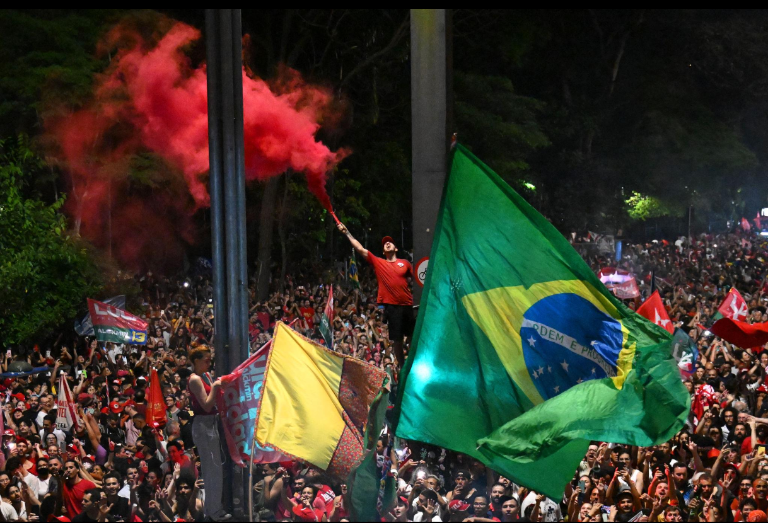
Luiz Inácio Lula da Silva has been declared the winner of Brazil’s 2026 presidential election, securing a fourth term with 51.79% of the vote—just over 4.4 million votes ahead of his rival, Flávio Bolsonaro. The election’s outcome, announced by the Superior Electoral Court (TSE), has been met with immediate legal resistance from the defeated candidate, who alleges irregularities in polling procedures.
Official results show Lula received 64,256,232 valid votes, while Flávio Bolsonaro garnered 59,826,041. Despite this clear margin, the conservative senator has refused to concede, arguing that last-minute changes to voting hours compromised the election’s fairness. His legal team has filed a formal challenge to annul the results, setting the stage for a high-stakes battle in the courts.
Controversial polling extension fuels Bolsonaro’s legal fight
At the center of the dispute is a Supreme Court ruling that extended voting hours until 7 p.m. Brasília time in select polling stations, citing transportation disruptions for voters. While the decision aimed to address logistical challenges in Bahia and São Paulo, critics argue it disrupted the electoral process. Flávio Bolsonaro’s campaign has seized on this, claiming the changes created an uneven playing field.
Interestingly, both campaigns had previously requested extensions for different reasons—Bolsonaro’s team cited severe flooding in southern Brazil. This complicates the legal argument, as the Superior Electoral Court acted on proposals from both sides. The Supreme Court justice overseeing the case, Cristiano Zanin, defended the decision as a necessary response to unforeseen circumstances, though opponents allege it amounted to an arbitrary rule change.
The political landscape: a nation split down the middle
Lula’s victory marks a triumph for left-wing policies focused on social welfare and inequality reduction, while Flávio Bolsonaro’s challenge embodies the conservative backlash against these reforms. The election underscored deep divisions in Brazilian society, with nearly half the electorate rejecting the president-elect’s agenda.
Flávio Bolsonaro, son of the former far-right president Jair Bolsonaro (currently serving 27 years in prison for attempted coup), represents a political lineage that has dominated Brazil’s conservative movement. His refusal to accept defeat raises serious questions about democratic resilience, particularly as his legal challenge could force institutions into uncharted territory.
Lula’s next move: navigating division and institutional friction
Now re-elected, Lula faces the daunting task of unifying a fractured nation. His electoral coalition, though victorious, lacks a dominant majority in Congress, where conservative factions hold significant sway. This balance of power could severely limit his ability to implement sweeping economic and social reforms.
In his first post-election statement, Lula struck a conciliatory tone, emphasizing his responsibility to govern for all Brazilians, regardless of their political affiliations. Yet the legal battle over the election’s validity threatens to overshadow his mandate from the outset, testing the judiciary’s capacity to resolve disputes without deepening political schisms.
The Superior Electoral Court has yet to rule on Bolsonaro’s challenge, and until then, Lula’s victory remains the official outcome. However, the prolonged legal confrontation risks prolonging the country’s political crisis, raising fears of judicial overreach or further erosion of public trust in democratic institutions.
What’s next for Brazil?
The coming weeks will determine whether Flávio Bolsonaro’s lawsuit is dismissed or escalates into a constitutional crisis. Legal experts are divided over the merits of his case, with some arguing that procedural irregularities, while concerning, do not necessarily invalidate the election. Others contend that the Supreme Court’s late-hour changes set a dangerous precedent.
What remains clear is that Brazil’s political future hinges on the judiciary’s ability to uphold electoral integrity without succumbing to partisan pressures. Lula’s presidency begins with a mandate but also with a mandate to heal. Meanwhile, Flávio Bolsonaro’s legal gambit has ensured that Brazil’s democratic experiment will face one of its sternest tests in decades.