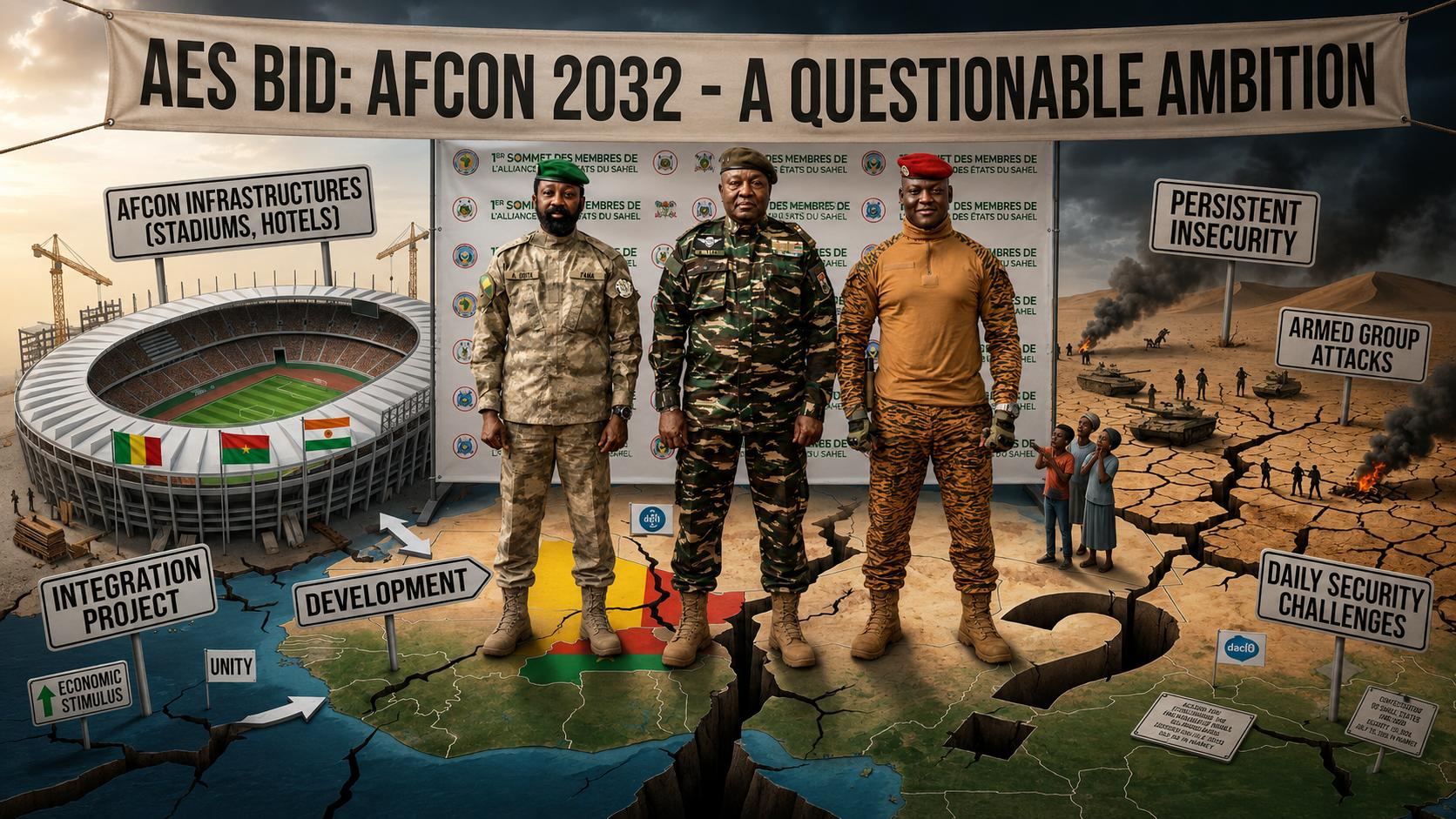
The governments of Burkina Faso, Mali and Niger have jointly submitted an official bid to host the 2032 Africa Cup of Nations (CAN). Positioned as a milestone in regional integration under the Alliance of Sahel States (AES), the proposal is framed as a bold statement of continental unity. Yet beneath the diplomatic optimism lies a pressing concern: can these three nations, currently grappling with deep security crises, realistically meet the stringent requirements to safely stage Africa’s premier football tournament?
Security as the cornerstone of a continental event
The successful hosting of a CAN tournament is not merely about stadiums and infrastructure—it hinges on the ability to ensure the safety of athletes, officials, media personnel, supporters, and the tens of thousands of visitors expected over several weeks. This is where the joint bid raises critical questions.
Since military-led transitions took control in Burkina Faso, Mali, and Niger, restoring security has been the central justification for these changes in leadership. Yet despite years of counter-insurgency efforts, armed group attacks continue to plague civilians, military convoys, and critical infrastructure across all three countries. Entire regions remain under the shadow of insecurity, with local communities facing daily threats.
In this context, the decision to pursue a CAN bid has drawn skepticism. Critics argue that before attempting to welcome thousands of foreign tourists and delegations, the primary responsibility of these governments should be to guarantee the safety of their own people. Can a region where movement remains perilous and public spaces are vulnerable truly be considered ready to host a high-profile international event?
Logistical hurdles compound the challenge
Beyond security, the logistical demands of a CAN tournament are immense. Organizers must provide reliable transportation networks, modern airports, an extensive hotel sector, robust medical services, and an airtight security framework. These requirements demand substantial investment—at a time when all three nations are already allocating a significant portion of their budgets to military operations and emergency responses.
The international credibility of the bid is also at stake. Potential federations, sponsors, broadcasters, and commercial partners prioritize stability and risk mitigation. Any indication of ongoing violence or instability could severely undermine the evaluation process and deter key stakeholders from endorsing the project.
From promise to performance: the credibility gap
The military transitions in Burkina Faso, Mali, and Niger were each presented as a turning point in the fight against armed groups. Yet years later, the security landscape remains fraught with challenges. While progress has been made in certain areas, the persistence of attacks—particularly in border regions and rural zones—has fueled public doubt about the effectiveness of these new regimes.
For many citizens, the most urgent expectation remains the restoration of everyday safety. The initial promise of the coups was rooted in the belief that military leaders would deliver stronger, more decisive action against extremist threats. Today, that promise feels increasingly distant for communities still reeling from violence, displacement, and economic hardship.
A continental dream deferred by reality
A CAN bid can serve as a unifying national project and a catalyst for development. But its legitimacy depends not on political rhetoric, but on tangible results—concrete improvements in security, governance, and public trust. Until such conditions are firmly in place, the venture risks being perceived as premature or even misguided.
For now, the people of Burkina Faso, Mali, and Niger continue to await the fulfillment of their leaders’ core pledge: safety. Only when that is achieved can the dream of hosting a major continental tournament move from ambition to reality.