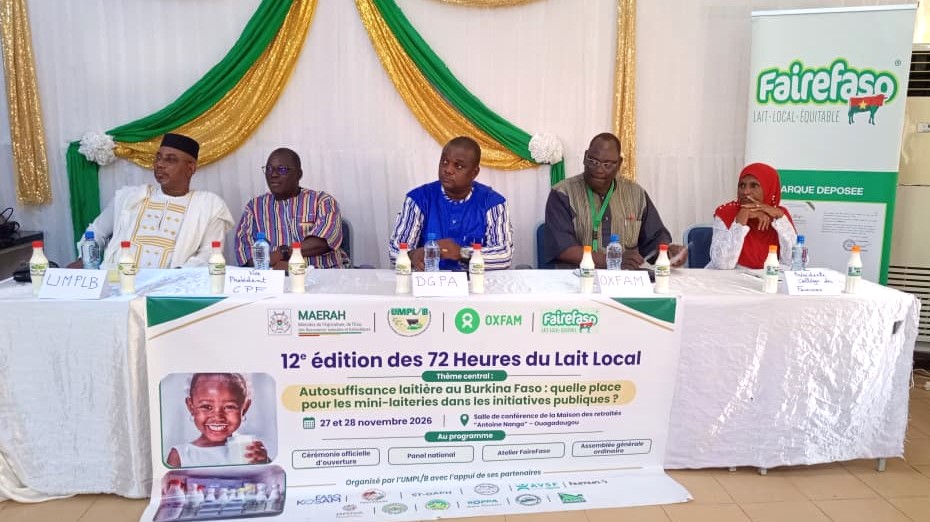
With rising food prices and disrupted supply chains threatening daily meals across Burkina Faso, the 12th edition of the Local Milk 72 Hours forum kicks off in Ouagadougou today. This year’s theme, “Milk self-sufficiency in Burkina Faso: where do small-scale dairies fit into public policy?”, shines a spotlight on the real-world impact of micro-dairies on families, businesses, and the broader economy.
The micro-dairy movement: From backyard units to economic pillars
The Local Milk 72 Hours initiative—now in its twelfth year—was launched in 2015 by the National Union of Small-Scale Dairies and Local Milk Producers of Burkina Faso (UMPLB). Over the past decade, what began as modest community collection points has evolved into a network of 101 active micro-dairies. These small-scale units form the backbone of a larger value chain that now includes 94 producer organizations, totaling around 4,000 members, with nearly 80% women and 35% young farmers leading the charge.
In 2024, the network collected nearly 1.84 million liters of locally sourced milk and generated over 1.3 billion West African CFA francs in revenue. When accounting for direct and indirect employment—each micro-dairy supports an average of five full-time and seven part-time jobs—the sector contributes an estimated 612 livelihoods across the country. These are not abstract numbers: they represent families who now have steady incomes, children attending better-equipped schools, and communities investing in local infrastructure.
Closing the gap: Dairy networks meet public policy
Despite measurable economic progress, micro-dairies still struggle with systemic barriers that limit their growth and integration. El Hadj Ibrahim Adama Diallo, President of the UMPLB, emphasized that the time has come for policymakers to recognize these units as full-fledged partners—not just beneficiaries—in national food security strategies.
His call is backed by tangible outcomes. Since 2021, the sector has benefited from vocational training programs in seven key trades—from milk collection to packaging—and launched nine “milk restaurants” that serve as both culinary hubs and training centers. This year also saw the official registration of the collective trademark “Faso Milk: Local and Fair” with the African Intellectual Property Organization (OAPI), signaling a new phase of brand-building and consumer trust.
What local producers are demanding from policymakers
- Priority access to public procurement programs: Small-scale dairies want guaranteed roles in school canteen programs and public catering services, provided their products meet national quality standards.
- Equitable financing and infrastructure: Farmers and processors are calling for fair access to loans, refrigeration units, renewable energy solutions, and essential inputs like feed and veterinary services.
- Strategic partnerships: Closer collaboration with Faso Kosam and Faso Guulgo is seen as critical to streamlining logistics, reducing waste, and accelerating adoption of best practices.
From dialogue to action: What the forum aims to deliver
The three-day gathering is not just a talk shop. Yisso Ulrich Bakoné, Director General of Animal Production, made it clear that participants must leave with a concrete action plan. The priorities include:
- Mapping high-potential milk basins and identifying gaps in collection, processing, and cold-chain infrastructure.
- Aligning micro-dairy operations with ongoing public initiatives to prevent duplication and maximize synergies.
- Finalizing a realistic roadmap that assigns clear responsibilities, measurable timelines, and transparent monitoring mechanisms.
“Families cannot wait another year,” said Bakoné. “Every delay in turning policy into practice directly affects household budgets, school nutrition programs, and the ability of small businesses to scale up.”
Why this matters beyond the dairy aisle
Micro-dairies are more than economic actors—they are social stabilizers. In regions where droughts and climate shocks routinely displace communities, locally run milk plants offer an alternative to food imports and foster resilience. By formalizing partnerships between small producers and state agencies, Burkina Faso can build a sustainable dairy ecosystem that reduces malnutrition, creates youth employment, and bolsters national food sovereignty.
This year’s forum is more than a milestone. It is a crossroads: either the country deepens its investment in homegrown dairy networks, or risks reversing hard-won gains in food security and social cohesion.