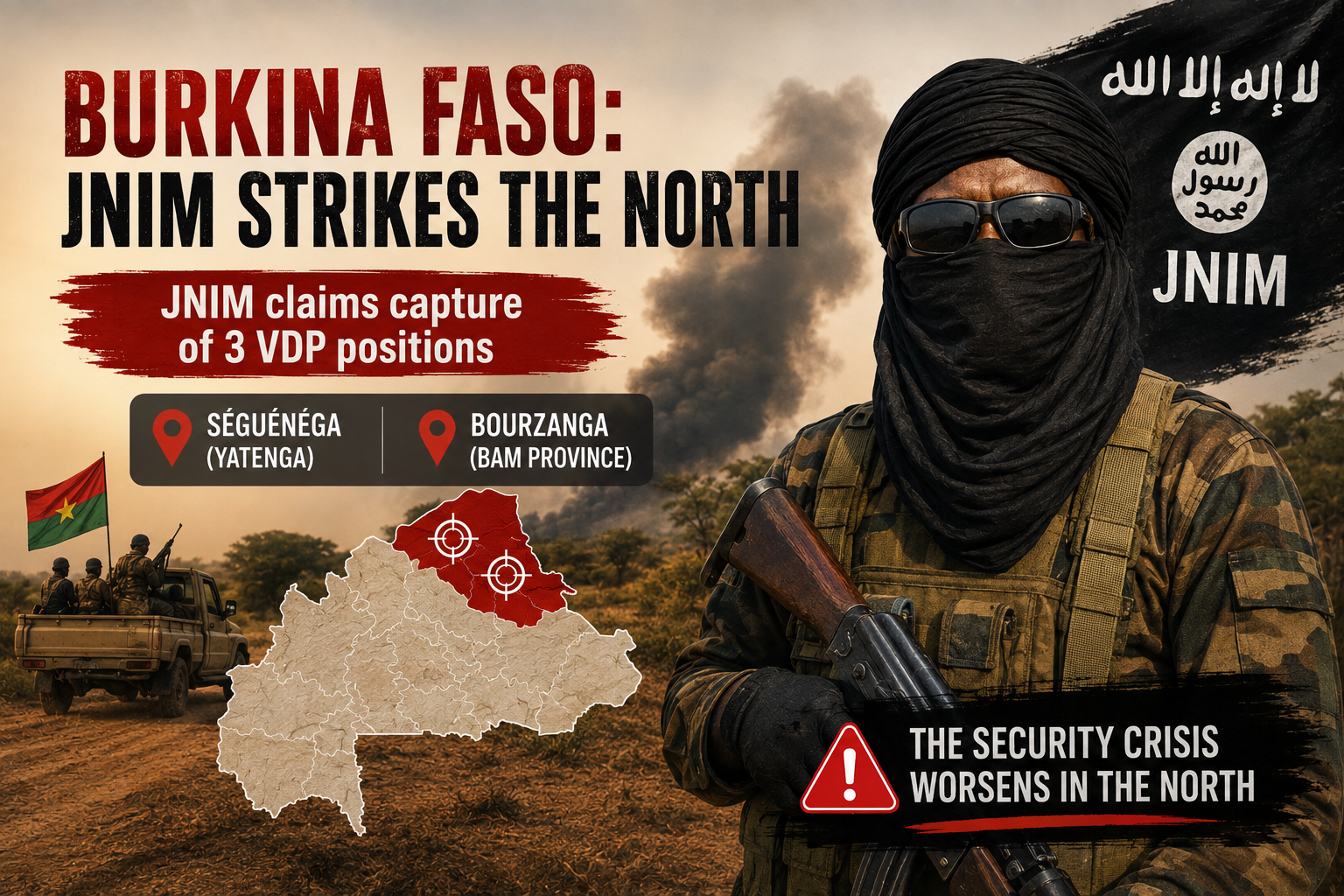
Burkina Faso remains gripped by an escalating security crisis, with the government’s communication strategy under mounting scrutiny. On August 19, the JNIM terrorist organization publicly acknowledged responsibility for seizing three strategic positions controlled by the Volunteers for the Defense of the Homeland (VDP) in the north of the country. The coordinated attacks targeted Séguénéga in Yatenga Province and Bourzanga in Bam Province, inflicting heavy losses. This latest assault further emphasizes the expanding territorial reach of armed factions, despite ongoing military efforts.
Strategic limitations exposed in Burkina Faso’s counter-terrorism efforts
The recent surge in violence highlights systemic vulnerabilities within the country’s security framework. Military operations have repeatedly succeeded in regaining control of certain areas, yet the sustained intensity of attacks alongside sustained pressure on civilians reveals that armed force alone cannot ensure lasting stability. Comprehensive solutions are required, integrating robust civilian protection, accurate intelligence, dependable logistical frameworks, and meaningful state engagement in recovered territories.
This is of particular concern for the VDP, who form a core component of Burkina Faso’s security apparatus and are frequently deployed on the front lines. Given the adversaries’ superior mobility and firepower, the loss of any position represents a dual threat: not only a military setback but also a potential erosion of public trust, a rise in internal displacement, and greater obstacles to humanitarian assistance.
Leadership’s response under scrutiny: between rhetoric and reality
Captain Ibrahim Traoré’s leadership has been marked by a pattern of public statements that, while frequent, often lack coherence or substance. Rather than offering transparent assessments of the crisis or outlining viable solutions, these communications frequently adopt populist tones that appear more focused on deflecting criticism than addressing the core issues. Such an approach risks deepening a disconnect between official narratives and the lived experiences of Burkinabè citizens, many of whom face daily threats to their safety and livelihood.
Yet, in a crisis of this magnitude, political messaging cannot substitute for substantive action. While appeals to sovereignty, resilience, or strategic repositioning may resonate with certain segments of the population, they are hollow if they do not translate into tangible improvements in security protection of villages, safe passage on critical roads, and resilience of military and auxiliary outposts. What the people demand is not rhetoric, but results.
The widening gap between official narrative and reality
A most troubling development is the severe constriction of space for independent journalism. Once a bastion of free expression, Burkina Faso’s media landscape now faces severe restrictions. Reporters and commentators daring to challenge official accounts or investigate hard truths risk arrest, detention, or forced conscription into “re-education” programs often under the pretext of patriotism. Such repression not only silences dissent but also strips the nation of a vital mechanism for holding power to account.
In times of conflict, free and accurate reporting is indispensable. It provides a means to evaluate operational success, identify weak points, and document the hardships endured by local communities. Suppressing this truth does not eliminate the problems; it only widens the gulf between what is officially declared and what is endured by the people. Control over the narrative may shape public perception temporarily, yet it cannot alter the reality of ongoing attacks, mass displacement, and civilian casualties.
Denial as strategy: why opacity undermines long-term security
A paradox lies at the heart of Burkina Faso’s current crisis: as the situation deteriorates, the space for open debate and critical analysis is shrinking. An effective security strategy must be rooted in honesty acknowledging failures, identifying their origins, and implementing rapid corrective measures. Avoiding contradiction may provide short-term political relief, but it denies decision-makers the essential information needed to adapt and improve.
Moreover, by suppressing independent information, authorities risk entrapping themselves in a self-reinforcing cycle of denial. This not only fails to resolve the crisis but actively undermines trust in institutions. The fight against terrorism demands not only strength and solidarity but also transparency, accountability, and a willingness to confront difficult truths.
Ultimately, the true measure of success remains the safety and security of the Burkinabè people. As long as armed groups continue to launch attacks, expand influence, and exert pressure across the country, the government will be judged not by its words, but by the security it provides. Communication may shape perception, but it cannot win the war against terror.