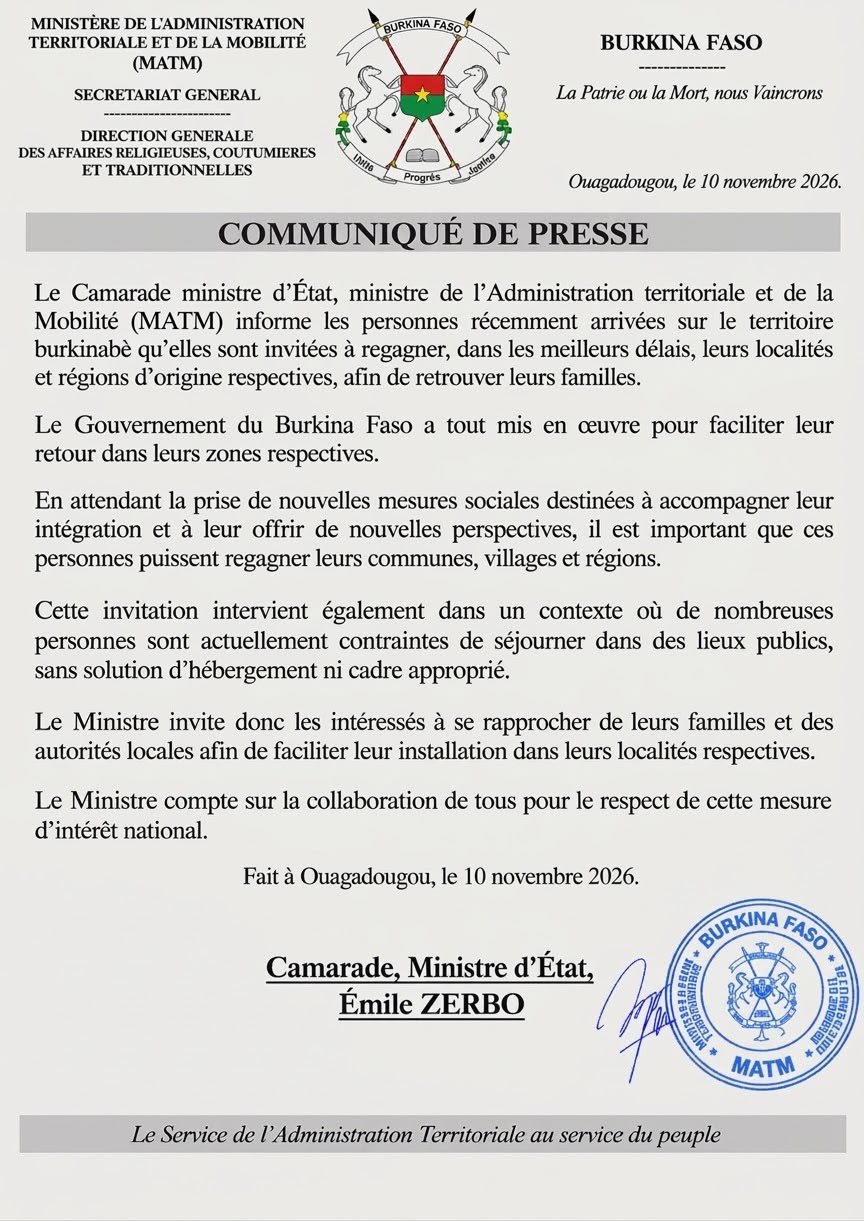
Burkina Faso’s government is confronting a critical test of its economic sovereignty following the mass expulsion of Burkinabè artisanal gold miners from Guinea. Thousands of returnees now confront a stark dilemma: rebuild shattered livelihoods in a country that has yet to present a viable path to professional reintegration.
Government response falls short of economic promises
Rather than unveiling a structured reintegration program with clear timelines, identifiable funding, and measurable outcomes, authorities have urged evicted miners to return to rural villages and reunite with families. This administrative directive resembles damage control rather than a genuine economic recovery strategy.
The human cost of displacement
These miners did not cross into Guinea seeking adventure. For many, artisanal gold mining was not a choice but a necessity often their sole means of supporting dependents. Their abrupt return doesn’t just mean a geographic shift; it signifies shattered income streams, lost revenue, and, for some, the collapse of family projects built around gold extraction.
Fundamental questions persist: Do returning miners have access to employment? Can they secure financial resources to restart livelihoods? Is there structured support to help them escape poverty? A returnee without income remains unemployed. A villager without capital remains vulnerable. Families left without their primary breadwinner cannot subsist on administrative directives alone.
Contradictions in resource sovereignty rhetoric
President Ibrahim Traoré’s political narrative centers on reclaiming natural resources, asserting economic sovereignty, and ensuring Burkinabè benefit from domestic wealth. Yet this rhetoric collides with reality: if Burkina Faso controls vast gold reserves, why do thousands face economic uncertainty after forced returns?
Sovereignty transcends industrial control or nationalist declarations it demands tangible transformation of national wealth into jobs, income, and economic opportunities for citizens. A nation may claim ownership of its gold, but without sufficient income-generating activities, sovereignty remains an unfulfilled promise. The true challenge lies in converting resource wealth into measurable improvements in the lives of ordinary citizens.
Agriculture and livestock are not default solutions
Authorities propose farming, livestock, handicrafts, vocational training, and organized cooperatives as alternatives. While these options sound viable on paper, they are not automatic economic solutions.
Shifting from artisanal mining to agriculture requires arable land, equipment, seeds, agricultural inputs, technical training, and market access. Livestock demands start-up capital, veterinary services, and sales networks. Handicrafts require production tools and viable demand.
Simply advising thousands to pivot sectors ignores the fundamental need: providing the material means to succeed. Short-term training without startup capital guarantees no professional insertion. Paper cooperatives without equipment or operational funds offer no durable solution.
Critical considerations remain unanswered: How many returnees will receive training? What budget is allocated to their reintegration? How many will access affordable credit? Which lands will be allocated? What equipment will be funded? What monitoring mechanisms will track progress after six months, one year, or two years?
Capital access remains the decisive barrier
Many miners lost income-generating activities in Guinea. Some may have used savings to finance their return. Others return with insufficient resources to restart a business. Under these conditions, restarting from zero without adapted financial tools is unrealistic.
A genuine reintegration program must include startup funds, microcredit mechanisms, public guarantees, and entrepreneurial support. It should differentiate between returnees with agricultural experience and those lacking alternatives to mining.
Without this nuanced approach, reintegration risks becoming an empty directive: abandon mining and find something else.
Broader social fallout of economic collapse
Each expelled miner supports dependents, educates children, fulfills financial obligations, and sustains family livelihoods. Job loss ripples beyond individuals affecting entire households. The social consequences extend far beyond the immediate returnee’s situation, creating ripple effects through communities.
Artisanal mining must be part of the solution
Traoré’s mining strategy cannot focus solely on large-scale resource control it must address the fate of those who once relied on artisanal extraction.
A viable model would involve:
Regulated artisanal mining sites,
Improved safety conditions,
Functional cooperative structures, and
Official gold purchasing channels.
Such a model would preserve economic activities, curb clandestine mining, reduce accident risks, regulate informal channels, and mitigate environmental damage from unregulated operations.
The ultimate test for Ibrahim Traoré’s leadership
The situation in Guinea serves as a political and economic litmus test for Traoré’s administration. Moving beyond slogans to deliver concrete solutions for citizens’ daily struggles becomes an imperative.
Denouncing expulsions and defending dignity abroad are valid acts. However, a government’s responsibility extends beyond external advocacy it begins with preparing for citizens’ futures once they return home.
How many miners will secure remunerative work in the coming months? How many will access funding for reconversion? How many will escape poverty through announced programs?
Without clear, measurable answers, reintegration promises risk remaining hollow political statements rather than genuine public policy.
The core issue is not merely the expulsion of Burkinabè miners from Guinea. The issue is that returnees may return to the same economic hardships that drove them abroad in the first place.
Traoré has framed economic sovereignty as Burkina Faso’s solution to hardship. Now, he must demonstrate that this ambition yields results not just in policy statements, but in villages, among unemployed youth, and in families awaiting real solutions.
Governance is not just about denouncing challenges faced by citizens abroad. It is about anticipating needs, financing initiatives, providing support, and creating conditions for citizens to live dignified lives within their own country.
Sovereignty is not declared in speeches. It is measured by a state’s capacity to provide work, income, and a future for its people. On this front, Ibrahim Traoré now faces a moment of reckoning not for new promises, but for results.
By Nicolas Biyong — Journalist