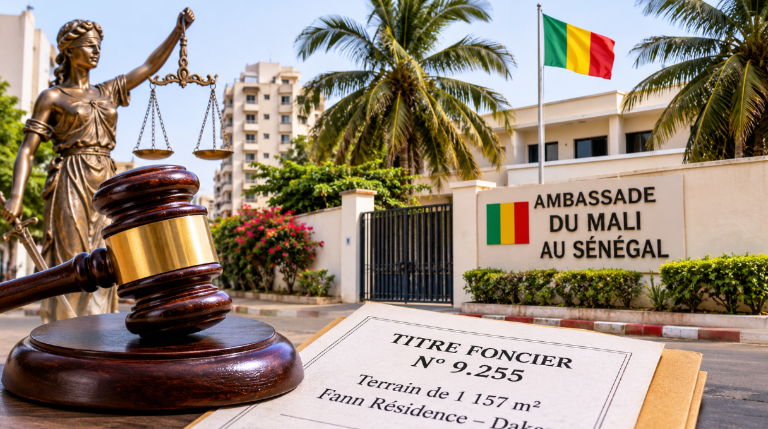
Senegal’s judiciary has issued a decisive ruling in a high-stakes land dispute involving the Malian embassy in Dakar. The court ordered the immediate evacuation of the embassy from a 1,157-square-meter property located in the upscale Fann Résidence district.
At the heart of the legal battle is a claim by Immoland SARL, a Senegalese real estate developer, which asserts ownership of the contested land based on land title no. 9.255. According to court filings, the company initiated legal proceedings after concluding that the Malian embassy’s occupation of the property lacked any legal foundation.
Justice sides with local developer over disputed Dakar plot
The ruling, as reported by Senegalese media outlets, states that the Malian embassy occupies the land « without right or title. » This legal conclusion provides the basis for the expulsion order, which extends beyond the diplomatic representation itself to include all goods and individuals under its authority occupying the premises.
While the court has formally ruled in favor of Immoland SARL, the practical enforcement of the decision remains uncertain. There is no confirmation that the embassy has vacated the property or that any eviction measures have been carried out as of now. The timeline for execution and the eventual removal of diplomatic and personal belongings are still undetermined.
Diplomatic immunity meets property law in Dakar dispute
The case introduces a unique dimension to Senegal’s ongoing struggles with urban land disputes, particularly in high-value areas like Fann Résidence, where real estate pressure often leads to complex legal battles. The involvement of a foreign embassy elevates the stakes, raising critical questions about the intersection of property law and diplomatic immunity.
Under the Vienna Convention on Diplomatic Relations (1961), embassies enjoy immunity from the jurisdiction of the host country in matters related to their official functions. However, this legal protection does not extend to ownership claims or disputes over the land on which an embassy stands. The convention clearly distinguishes between diplomatic immunity and property rights, leaving room for judicial proceedings when ownership is contested.
Unanswered questions loom over legal and diplomatic fallout
With the court’s decision now public, several key questions remain unanswered:
- Is the Malian embassy preparing to challenge the ruling through an appeal, and on what legal grounds?
- What specific procedures will Senegalese authorities follow to enforce the eviction order without infringing on diplomatic protocols?
- How will the governments of Mali and Senegal address the diplomatic implications of this judicial outcome?
The absence of official statements from either embassy complicates efforts to assess the full scope of this case. Without access to the complete court order or the diplomatic correspondence between the two nations, it is premature to predict the long-term consequences for bilateral relations.
Next steps and potential escalation
For now, the focus remains on legal clarification. The Malian embassy’s potential counterarguments—whether rooted in historical land use, prior agreements, or other claims—have not been detailed in the public domain. Similarly, Senegal’s judicial system has yet to outline the mechanics of enforcing such an order against a diplomatic mission, a scenario rarely tested in the region.
One thing is clear: this case transcends a routine real estate dispute. As both Dakar and Bamako weigh their next moves, the international community will closely monitor how Senegal navigates the delicate balance between upholding property rights and respecting diplomatic conventions.