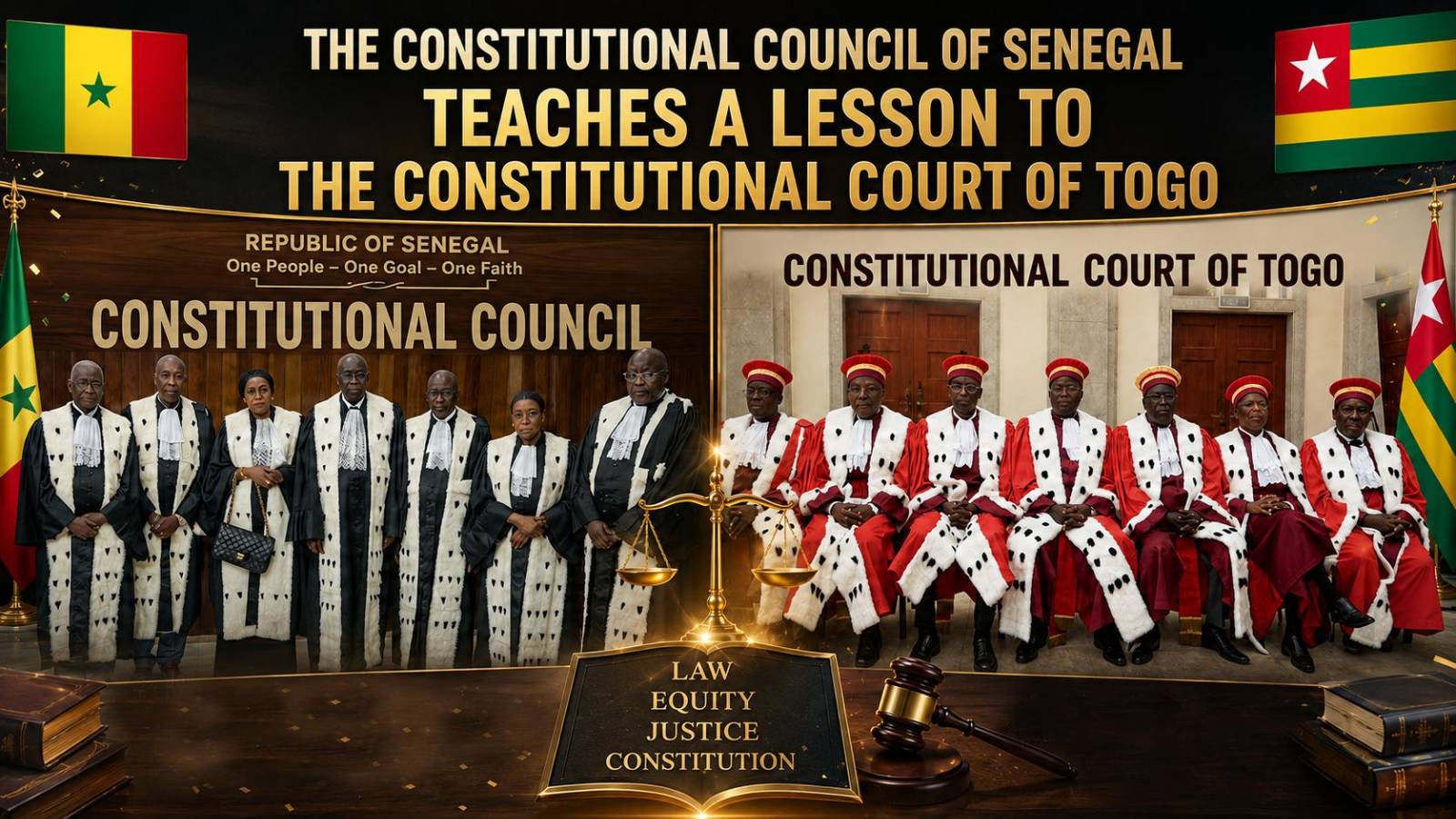
The constitutional divide: Senegal and Togo’s divergent paths
Two West African capitals are today showcasing sharply contrasting approaches to constitutional governance. In Dakar, the Constitutional Council has reaffirmed a firm commitment to legal principle, while in Lomé, the Constitutional Court’s recent rulings have raised concerns about institutional alignment with executive power. These judicial decisions underscore a fundamental divergence in how the rule of law is interpreted and enforced across the region.
Dakar: where the Constitution stands above politics
The Senegalese Constitutional Council recently blocked a constitutional reform proposed by the government of Ousmane Sonko, despite its backing by a parliamentary majority. This landmark decision sends a clear message: electoral legitimacy does not grant unlimited authority. In Senegal, the judiciary has demonstrated that no political force—regardless of its mandate—can override constitutional limits. The Council’s intervention reinforces the perception of a robust separation of powers, where institutions act as genuine checks on government action.
Such judicial assertiveness not only upholds the rule of law but also strengthens public trust. Citizens witness a system where legal decisions are rendered without political interference, ensuring predictability and stability. This judicial independence is a cornerstone of democratic resilience, deterring institutional crises and fostering investor confidence. International observers closely monitor such developments, as they signal a predictable and law-abiding governance framework—critical for economic and diplomatic relations.
Lomé: constitutional reform amid skepticism
In Togo, the Constitutional Court’s validation of a sweeping constitutional overhaul has triggered widespread debate. Critics argue that the reform process lacked broad national consultation, particularly given its far-reaching implications for the country’s institutional architecture. A constitution is meant to embody a social contract, forged through inclusive dialogue. When perceived as a tool of political expediency rather than consensus, its legitimacy is inevitably eroded.
The controversy extends beyond domestic politics. Regional judicial bodies, including the ECOWAS Court of Justice, have been called upon to adjudicate disputes arising from constitutional changes. Such interventions often reflect a deficit of confidence in national legal mechanisms, signaling that citizens may view internal remedies as ineffective. This erosion of trust in domestic institutions can push political actors to seek redress beyond national borders, further destabilizing the legal framework.
The high stakes of constitutional legitimacy
At the heart of this divide lies a fundamental question: what role should a constitution play in a democracy? In Senegal, the Constitution is treated as an inviolable framework that constrains all branches of government. In Togo, critics contend that recent reforms risk reducing the Constitution to an instrument for adapting to immediate political priorities, rather than a durable social contract.
This distinction has profound consequences. A constitution that is frequently amended to suit shifting political winds creates instability and undermines trust in institutions. It signals that power, rather than principle, dictates legal outcomes. Over time, such practices can weaken democratic norms, encourage power personalization, and deter long-term investment. Conversely, a judiciary that vigorously defends constitutional limits fosters stability, predictability, and international credibility.
Lessons from comparative governance
Togo has sought inspiration from foreign constitutional models, including parliamentary systems in India. While studying foreign jurisdictions can provide valuable insights, it cannot replace the need for homegrown solutions rooted in local realities. Africa offers numerous examples of countries where judicial independence has been pivotal in consolidating democracy. Senegal’s Constitutional Council stands out as a model of how institutions can uphold the rule of law, even when their decisions challenge the executive.
Ultimately, the contrast between Dakar and Lomé reflects deeper philosophical differences about governance. One nation treats its Constitution as a shield against arbitrary power; the other risks reducing it to a tool for political maneuvering. The strength of a democracy is not measured by the frequency of constitutional amendments, but by the capacity of its institutions to protect citizens from all forms of excess—executive, legislative, or judicial.