Tragic collision leaves 46 dead and 179 injured on Spain’s high-speed rail network
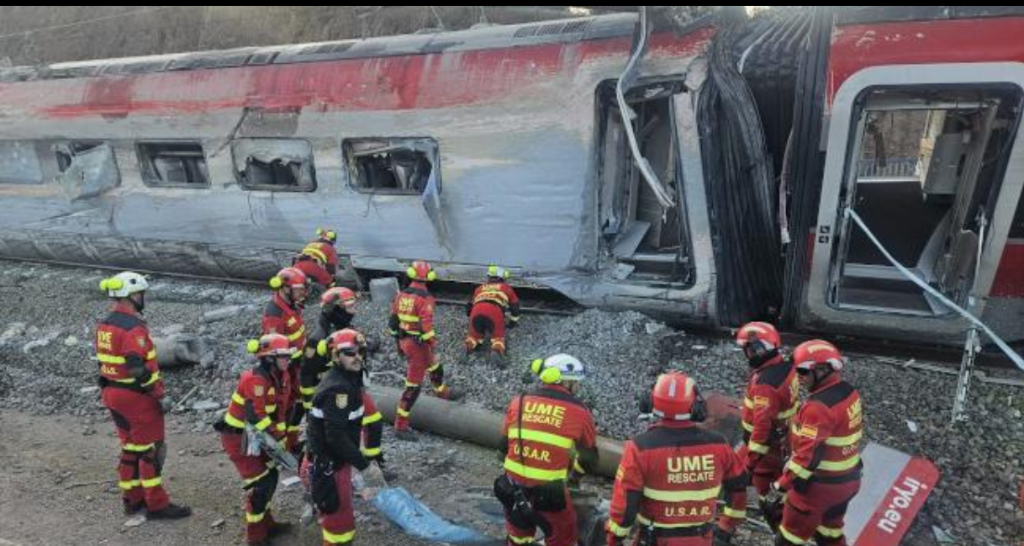
An emergency response unfolded near Urda in Toledo province today after two high-speed trains collided, killing at least 46 people and injuring 179 others. Rescue teams arrived within minutes, but the severity of the crash left countless passengers stranded in wrecked carriages.
The accident occurred on a critical Madrid-to-Andalusia rail link, raising immediate concerns about railway safety across Spain. Authorities confirmed the collision involved an Alvia high-speed train operated by Spain’s national rail service, Renfe, and an Iryo train operated by the private rail company. Witnesses described a violent impact that forced several carriages off the tracks, complicating rescue efforts.
The high death toll reflects the force of the collision, as emergency services worked tirelessly to extract trapped passengers. Medical teams assessed injuries on-site before transporting the most critical cases to nearby hospitals. Rescue operations are ongoing, and officials warn that the final casualty count may rise as further assessments are completed.
Massive emergency response deployed amid shattered infrastructure
Firefighters, paramedics, civil protection units, and security forces converged on the crash site within minutes of the first emergency calls. Heavy machinery was brought in to stabilize the derailed carriages, while search teams combed through wreckage to locate missing passengers. The scale of the devastation forced authorities to suspend rail traffic on the affected line, disrupting travel plans for thousands of passengers.
Hospitals in Toledo and surrounding areas were placed on high alert, with medical staff prepared to handle trauma cases. Rescue workers faced a heartbreaking task—some victims were found deceased in their seats, while others suffered life-threatening injuries. For families waiting for news, the wait has stretched into agonizing uncertainty.
Meanwhile, rail authorities announced temporary service suspensions along the Madrid-to-Andalusia corridor. Travelers heading south or through Toledo were forced to seek alternative routes, adding to the widespread disruption caused by the disaster.
What caused the high-speed train collision?
The precise cause of the crash remains under investigation. Initial reports suggest possible issues with signaling systems or traffic management near Urda. Authorities have indicated that communication breakdowns between train drivers and control centers may have played a role, though no definitive conclusions have been reached.
Investigators will analyze train data recorders, signal logs, and communication transcripts to reconstruct the final moments before impact. Key questions center on whether technical failures, human error, or a combination of factors led to the collision. The outcome of this technical inquiry will determine if preventable safety flaws contributed to the tragedy.
Spain’s rail safety record under renewed scrutiny
This devastating incident comes at a time when Spain’s high-speed rail network—once touted as one of Europe’s safest—faces growing scrutiny over maintenance standards and emergency protocols. While previous accidents were isolated, today’s crash marks one of the deadliest in recent memory, prompting calls for urgent reforms.
Though each rail disaster differs, safety advocates argue that repeated failures reveal systemic vulnerabilities in Spain’s rail infrastructure. Key concerns include outdated signaling technology, inconsistent maintenance schedules, and gaps in emergency response training. Authorities face mounting pressure to address these challenges before another tragedy strikes.
For now, the focus remains on rescue operations and providing support to victims’ families. Once the immediate crisis subsides, the findings of the official investigation will shape the future of Spain’s rail safety policies—and determine whether this collision could—and should—have been prevented.
A nation mourns: the human toll of the rail disaster
Beyond the statistics, this collision has left families shattered, communities mourning, and survivors grappling with trauma. Among the injured are passengers from diverse backgrounds, now facing long recoveries—or lifelong scars. The emotional toll will extend far beyond the wreckage site.
As Spain processes this immense loss, the coming days will bring more clarity on the accident’s cause and consequences. Yet one truth remains clear: behind every number is a life, and behind every life is a grieving family. The priority now is ensuring no stone is left unturned in uncovering the truth—and preventing history from repeating itself.