The age-old trap of governance—where military leaders who seize power later confuse rhetoric with reality—appears to be closing in on Burkina Faso’s transitional administration. Once the euphoria of a coup subsides, the silence of a population, often born of fear or uncertainty, is frequently misinterpreted as unwavering support, creating a precarious foundation for any regime.
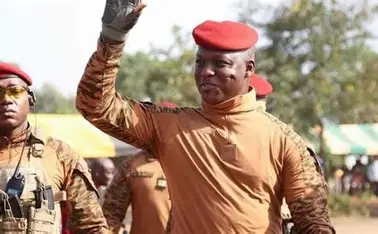
In the case of Captain Ibrahim Traoré, the carefully staged displays of authority, the flawless military parades, and the fiery denunciations of a so-called ‘perfidious West’ are increasingly overshadowed by a different narrative: one of mounting internal strain within his government. What was once projected as unassailable confidence now reveals itself as a leadership navigating a tightening web of distrust.
From united front to escalating suspicions
The image of a cohesive command structure, once forged in the urgency of combating armed groups, has given way to a military institution riddled with suspicion. Reports of attempted coups, frequent reshuffles within the officer corps, and systematic overhauls of the security apparatus point to a leadership that appears more preoccupied with self-preservation than national security.
One of the most telling indicators of this shift has been the removal of key intelligence officials, including those who played pivotal roles in the early days of the transition. When a head of state begins to dismantle the very structures tasked with safeguarding his authority, it signals a crisis of confidence that extends far beyond the barracks. The erosion of trust within the ranks is no longer merely a security concern; it has become a political liability.
Several observers summarize the trajectory as follows:
- 2022: A promise of unity under the banner of national defense.
- 2023-2024: Persistent deterioration of the security landscape.
- 2024: A cascade of military reassignments and leadership purging.
- Present: A climate of deepening mistrust and governance under strain.
Governance through coercion: the cost of fear
Faced with unrelenting security challenges, the regime has adopted an increasingly authoritarian approach. Critics highlight a troubling pattern:
- Targeted arrests: of political figures and intellectuals openly questioning the leadership’s policies.
- Enforced disappearances: documented by human rights organizations, silencing dissent under the guise of counterterrorism.
- Media crackdowns: suspensions of independent outlets and restrictions on journalistic freedoms.
- Civil society intimidation: selective mobilizations and reprisals against activists and community leaders.
These measures, widely reported by international rights bodies, underscore a broader retreat from democratic norms. Meanwhile, state-controlled media amplifies the visibility of Captain Traoré, reinforcing perceptions of a leadership that equates control of the narrative with genuine legitimacy. To his opponents, this strategy reveals not strength, but weakness—a desperate attempt to mask systemic fragility with propaganda.
The security crisis remains unaddressed
Yet the most pressing issue persists beyond the corridors of power: the safety of the nation. Nearly four years after the transition began, large swathes of Burkina Faso remain under the sway or direct threat of armed factions. Humanitarian indicators continue to deteriorate, with millions displaced and communities trapped in cycles of violence. Attacks on civilians, security forces, and civilian auxiliaries (VDP) occur with alarming regularity.
Despite sustained military efforts, data from United Nations agencies and humanitarian organizations confirm that the jihadist insurgency shows no signs of abating. Internal displacement remains among the highest in West Africa, reflecting the state’s inability to restore territorial integrity or social stability.
The paradox of isolation
Patriotic slogans, no matter how stirring, cannot substitute for concrete action. The regime’s fixation on consolidating power—through purges, reshuffles, and a climate of perpetual suspicion—risks isolating its leader from the very forces that once enabled his rise. History offers sobering precedents across the continent: military regimes that prioritize internal policing over national reconciliation often find themselves weakened not by external enemies, but by the corrosive effects of distrust within their own ranks.
The true challenge facing Burkina Faso has not changed. The imperative remains clear: to restore security, rebuild institutional trust, and address the urgent needs of a population enduring the human toll of instability. When a leadership expends more energy on preventing imagined conspiracies than on resolving the crises that justified its ascent, it risks elevating political survival above the national interest—with consequences that may prove irreversible.