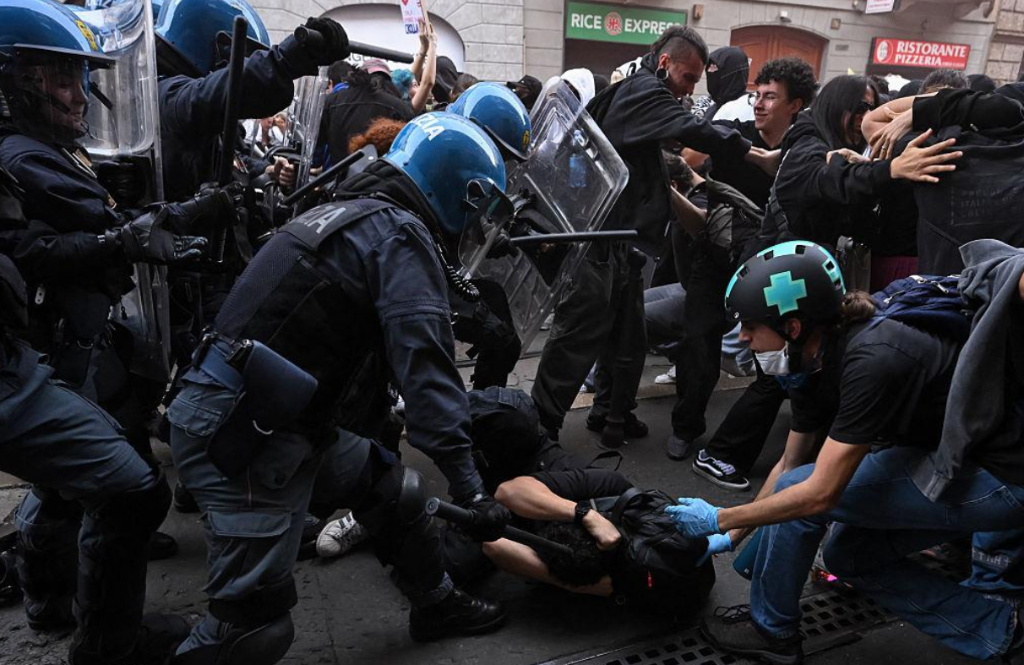
The Italian government has taken decisive action against escalating urban unrest, approving a sweeping new security decree on October 20, 2026, following violent riots in Milan and other northern cities. The move reflects Prime Minister Giorgia Meloni’s ongoing tough-on-crime agenda, with measures targeting collective violence, minors and their families amid growing public safety concerns.
What the new security law changes for protesters and rioters
The decree introduces stricter penalties for large-scale violent gatherings. Participants involved in groups of five or more who endanger public safety now face up to five years in prison and fines up to €20,000. Penalties escalate when perpetrators conceal their identities or when injuries occur. These provisions aim to curb organized violence while distinguishing between lawful protest and criminal behavior.
Crackdown extends to organizers and digital instigators
Organizing violent protests—whether through public calls or digital platforms—can now result in prison sentences ranging from four to twelve years. Justice Minister Carlo Nordio emphasized the government’s intent to hold not just on-the-ground offenders accountable, but also those who plan or encourage disturbances from behind the scenes.
Tougher rules for minors and families
The law expands legal tools against teenage offenders, allowing preventive detention for minors aged 14 to 17 deemed to pose a threat. It also introduces a controversial financial liability clause: parents of minors involved in vandalism or looting can be held financially responsible for damages. The government argues this shift will deter repeat offenses by reinforcing family accountability.
Critics warn the policy risks overreach, particularly in its treatment of parental responsibility—a debate likely to intensify as cases are tested in court.
Milan becomes frontline in Italy’s security push
Northern Italy’s financial capital has emerged as the testing ground for these measures. Starting immediately, 500 additional military personnel will patrol Milan under Operation Safe Streets, a temporary deployment aimed at protecting high-risk locations and supporting civilian police forces. The move follows violent clashes that left businesses vandalized, public spaces damaged and officers targeted.
Link between unrest and economic hardship
While the government frames the crackdown as a response to public safety needs, many of the disturbances coincided with demonstrations against rising living costs, energy prices and housing pressures. Protesters rejected the idea that economic frustration justifies violence, but advocates for social justice argue that punitive measures alone fail to address underlying grievances.
Liberty vs. security: where Italy draws the line
This decree is the latest in a series of security laws implemented since 2022, sparking sharp debate about civil liberties. Key concerns include expanded preventive detention, the criminalization of minors and concerns that punishments may be disproportionate. While the government pressed forward, it scaled back proposals to grant soldiers broader policing powers in Milan following constitutional objections.
The law takes effect immediately, though its final passage depends on parliamentary approval within 60 days. The real test will come in how these measures balance the restoration of order with the preservation of democratic freedoms—especially the right to peaceful assembly.
What’s next for Italy’s urban security policy
The government’s approach signals a new phase in Italy’s long-running debate over safety and freedoms. Will harsher penalties deter future unrest, or will they deepen social divisions? With the decree now in force, the coming months will reveal whether Rome’s tough stance delivers lasting peace—or fuels further conflict.