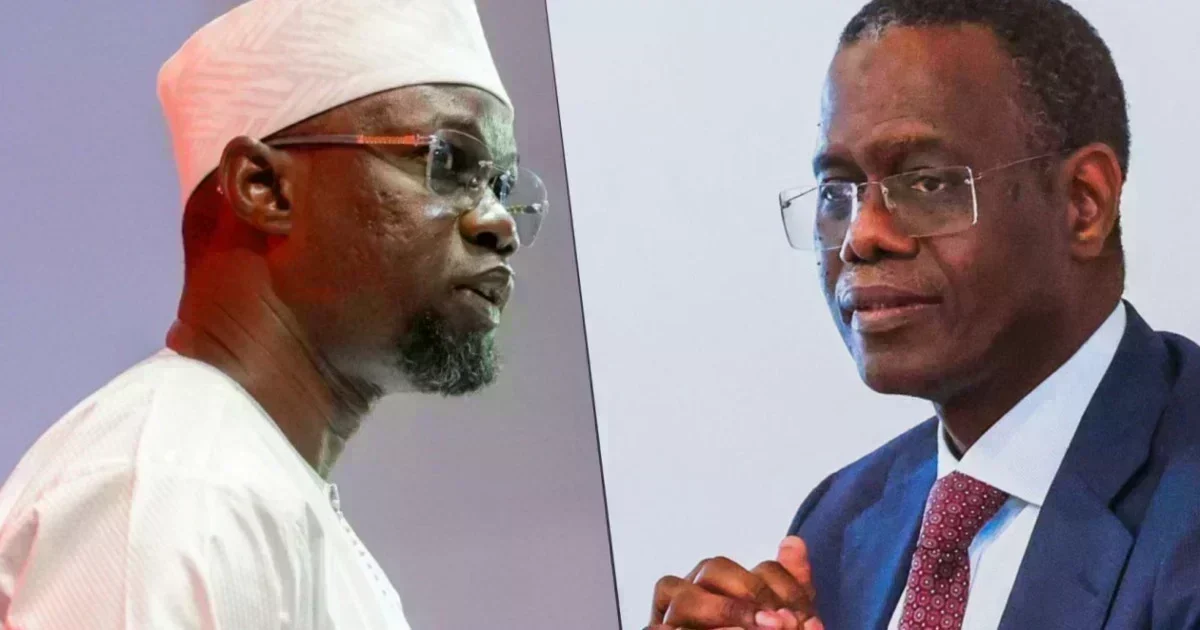
Major administrative changes have reshaped Senegal’s Prime Minister’s Office since Ousmane Sonko stepped down on May 22, 2026, as confirmed by decree n°2025-1431.
Administrative reconfiguration under new leadership
Since Al Aminou Lô assumed office as Senegal’s Prime Minister, the structure of government services has undergone significant reorganization. The new decree not only reallocates responsibilities between the Presidential Palace, Prime Minister’s Office, and ministerial departments but also redefines how state institutions operate.
Key transfers and institutional changes
Several critical adjustments have taken place since Sonko’s departure. Most notably, the National Civic Service and Volunteering Directorate has been transferred to the Ministry of Youth and Sports, while the Government Information and Communication Bureau—previously led by journalist Mame Gor Ngom—now reports to the Ministry of Communication and Institutional Relations.
The National Observatory of Detention Facilities has been placed under the Ministry of Justice, marking another shift in how government agencies are supervised. Additionally, the Technical Secretariat of the National Committee for Local Content Monitoring, which was previously under the Ministry of Petroleum and Mines, has been integrated into the Prime Minister’s Office.
Streamlining government operations
The Prime Minister’s Office has also seen a reduction in its portfolio, with certain departments transferred to other ministries. The General Secretariat of the Government has been relieved of several responsibilities, including the Ministerial Council Preparation Unit and the Information Access Commission, which were previously under its purview.
Communication reforms take center stage
One of the most notable changes involves government communication. The position of State Secretary in charge of Institutional Relations and Government Spokesperson has been eliminated. Instead, these functions have been consolidated under a full-fledged minister in the Ministry of Communication and Institutional Relations, who now serves as the official government spokesperson.
This restructuring reflects a broader strategy to optimize the Prime Minister’s Office by redistributing certain responsibilities to specialized ministries while ensuring more efficient coordination between government institutions.