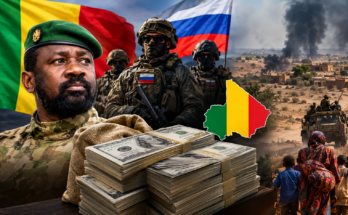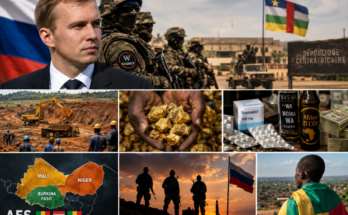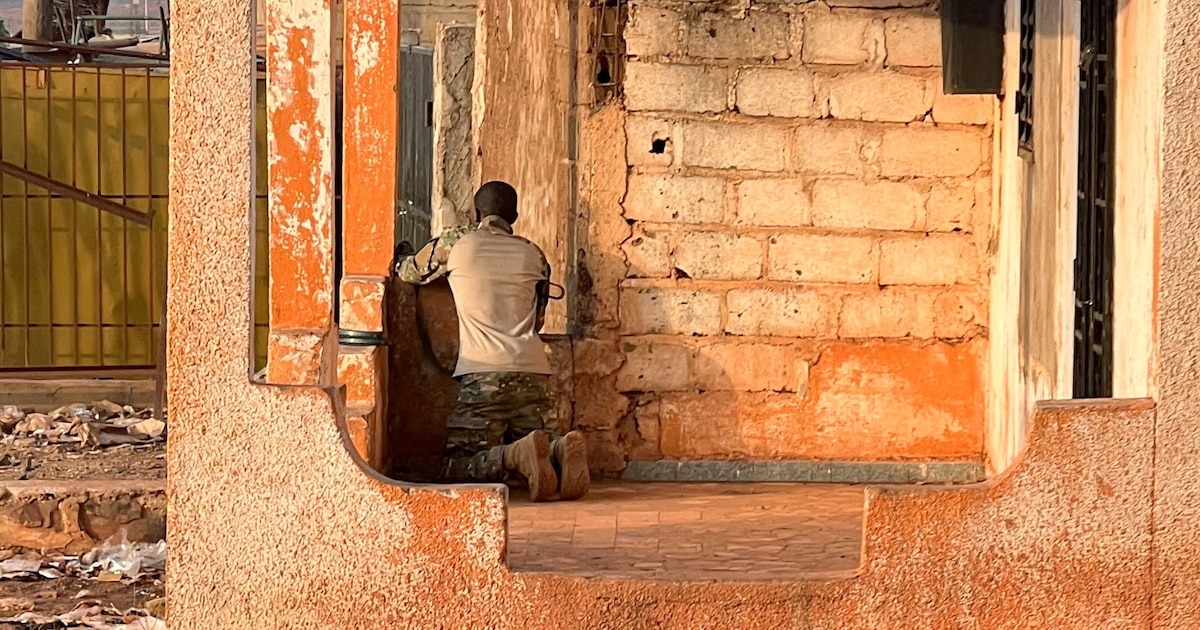
A significant and symbolic defeat unfolded on Sunday, April 26, in Kidal, northeastern Mali. Russian mercenaries from the Africa Corps, who took over from the Wagner group in 2025 and are allied with the Bamako junta, were forced to withdraw. Humiliating images circulated on social media showed Africa Corps personnel hastily departing the area in trucks, disarmed and under pressure from the GSIM (Group for the Support of Islam and Muslims), also known as JNIM, and their Touareg rebel allies from the Azawad Liberation Front (FLA). Their retreat was so rapid that they left behind dozens of armored vehicles and helicopters, which fell into the hands of the jihadists and Touareg rebels. Additionally, several Malian soldiers were captured following short engagements.
Since Saturday, the Sahelian nation has experienced a wave of synchronized assaults. These were spearheaded by GSIM jihadists, an Al-Qaïda affiliate, in conjunction with the FLA’s Touareg separatist rebellion. Their targets included strategic junta positions across the entire country, reaching even the outskirts of the capital, Bamako.
a reversal of fortunes since 2023
On Monday, the Russia Defense Ministry-controlled paramilitary organization, Africa Corps, verified the withdrawal of its forces from Kidal, a key city in northern Mali. This represents a significant comeback for the FLA rebels, who eighteen months prior, in November 2023, witnessed Wagner group mercenaries capture the city and proudly raise their distinctive white skull on a black background banner. For the junta’s Russian partners, this constitutes a bitter setback. Djenabou Cissé, an associate researcher at the Foundation for Strategic Research, highlighted that “the only genuine strategic success the Russians had facilitated since their arrival in Mali in 2021 was precisely the capture of Kidal, a historical Touareg stronghold.” Its recent fall signals a profound repudiation of their efforts.
The synchronized GSIM assaults extended beyond Kidal, also striking the capital, Bamako, the city of Kati—home to Mali’s primary military base—and Gao, a former United Nations outpost. In total, a minimum of six urban centers across the nation became targets.
Since 2021, Mali has been under the control of a military junta that seized power through a coup d’état in the same year. Concurrently, the nation has endured years of siege by the Al-Qaïda-affiliated jihadist group, which, by 2025, had contributed to making the region a global epicenter of terrorism and its victims, according to a report by the Institute for Economics and Peace. From the summer of 2025, these jihadist factions have handed numerous defeats to Malian armed forces and their Russian partners, notably establishing blockades around the capital in an attempt to economically strangle it.
enduring ineffectiveness of russian forces
In an effort to counter the jihadist advance, Malian military leaders enlisted Russian mercenaries, first with Wagner from 2021, and then with Africa Corps since 2025. However, the level of violence has only escalated. Notably, some of the most egregious attacks against civilians have been attributed to these Russian mercenaries and elements of the Malian army. Reports from the United Nations and the International Federation for Human Rights, spanning since 2021, have documented a disturbing surge in conflict-related sexual violence, perpetrated by Malian defense and security forces alongside their Russian auxiliaries.
Wassim Nasr, a journalist specializing in jihadist movements, stated that it had long been apparent that Russian mercenaries, whether operating under the Wagner Group or now as Africa Corps, were proving ineffective as counter-terrorism partners. He suggested that the recent Saturday attacks merely served to underscore these persistent challenges.
Over the weekend, video footage emerging from across Mali starkly illustrated the intensity of the assaults. In Kidal, jihadists stormed the governor’s office. Meanwhile, in Bamako, residents observed GSIM fighters entering the city unimpeded. On the outskirts of the capital, in Kati, the junta’s headquarters, a bomb attack also devastated the residence of Defense Minister Sadio Camara, who tragically perished in the offensive.
allegations of betrayal in Kidal
On Monday, Prime Minister Abdoulaye Maïga addressed the media, paying tribute to the late Defense Minister Sadio Camara while simultaneously attempting to reassure the populace. President and junta leader Assimi Goïta, in his first televised address since the jihadist offensive began on Saturday, asserted on Tuesday evening that the situation was “under control” and that operations would continue until the “complete neutralization of the groups involved” in the attacks.
Despite constraints on freedom of expression in Mali, the efficacy of both the Famas (Malian Armed Forces) and Africa Corps soldiers is already being scrutinized. A Malian officer claimed that “the Russians betrayed us in Kidal,” further asserting that the regional governor had forewarned the Russian mercenaries three days prior to the assault, yet they took no action, suggesting they had already negotiated their withdrawal. Should Russian forces depart other northern areas following Kidal, this could severely weaken the Malian regular army.
Kremlin spokesperson Dmitri Peskov, during his daily briefing on Tuesday, April 28, declined to address whether Africa Corps possessed the capability to control the volatile situation. Nevertheless, he maintained that Russian forces had thwarted an attempted coup d’état in Mali by FLA and GSIM combatants.