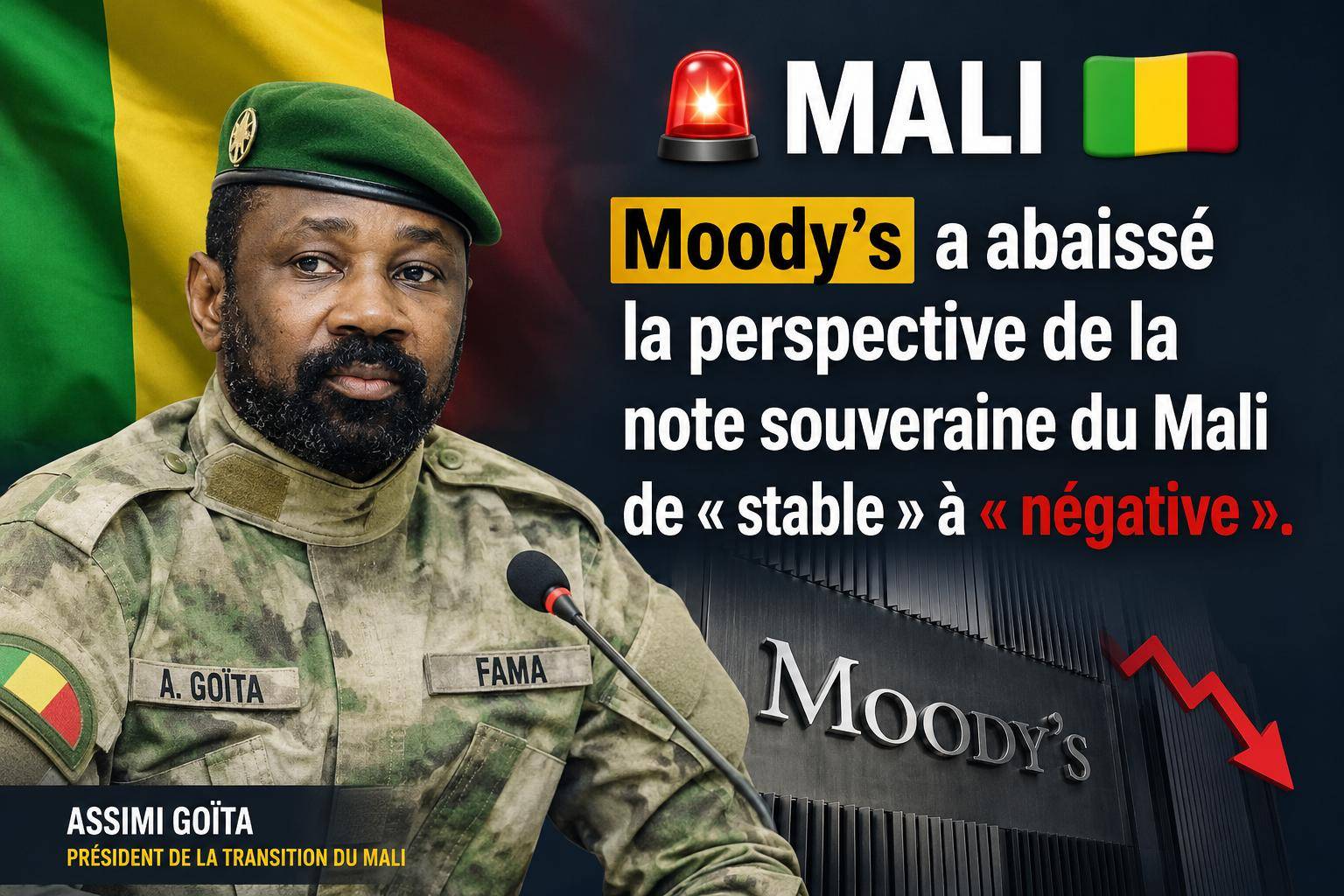
International ratings agency Moody’s has shifted Mali’s sovereign credit outlook from ‘stable’ to ‘negative’, while retaining its Caa2 rating. The move underscores growing concerns over escalating security threats, tightening regional financing conditions, and lingering political instability. For Mali’s economy, already struggling to attract much-needed capital, this downgrade serves as another obstacle on the path to sustainable development.
Financial warning signals to global investors
The shift in Moody’s outlook acts as a market confidence indicator. By downgrading Mali’s prospects, the agency highlights an increased likelihood of further credit rating cuts in the near to medium term. The current Caa2 rating places Mali’s sovereign debt firmly in the speculative, high-risk investment category—a classification that already deters cautious investors.
A security crisis that stifles economic growth
At the heart of Moody’s concerns lies the deepening security crisis. Despite ongoing defense reforms and military operations, insurgent activity continues to undermine economic stability. Repeated attacks and territorial instability disrupt supply chains, cripple agricultural output, and erode the state’s ability to collect vital tax revenue across large parts of the country.
Regional funding becomes costlier and harder to secure
Beyond security, the financing squeeze is tightening. Cut off from traditional external funding channels due to diplomatic and institutional ruptures, Mali has increasingly relied on the regional debt market of the West African Economic and Monetary Union (WAEMU). Yet this lifeline is weakening. The Central Bank of West African States (BCEAO) has hiked interest rates to curb inflation, pushing borrowing costs sharply higher for Bamako. Recent sovereign bond auctions have seen lukewarm investor demand, reflecting growing wariness among regional banks and financial institutions about Mali’s creditworthiness. The result: a tighter fiscal space for the government, leaving fewer resources for critical infrastructure projects and essential public services.
Political transition fuels uncertainty in financial circles
Moody’s assessment also highlights institutional fragility. Mali remains in a protracted transition period, with postponed elections and an unclear roadmap back to constitutional order. This prolonged uncertainty dampens the appetite of multilateral partners and development financiers. Meanwhile, the country’s withdrawal from the Economic Community of West African States (ECOWAS), formalized under the Alliance of Sahel States (AES) alongside Niger and Burkina Faso, has reshaped regional alliances and introduced new layers of unpredictability. While Malian authorities frame this move as a step toward regained sovereignty, global investors perceive it as a potential source of trade barriers and capital flow disruptions within the subregion.
Real-world consequences for Mali’s citizens
The Moody’s decision is more than a technical financial update—it has tangible impacts on daily life. When the government borrows at higher interest rates, funds that could have gone to healthcare, education, or subsidies for essential goods are redirected toward debt servicing. For local businesses, the ripple effects are immediate. Banks, heavily exposed to public debt, are becoming more reluctant to extend credit to the private sector. Small and medium-sized enterprises, the backbone of Mali’s economy, face tighter lending conditions, which stifles job creation and investment.
Path forward: balancing security, stability, and fiscal discipline
While Mali’s economy shows resilience—particularly through gold mining and cotton production—it cannot escape the realities of global finance. To stabilize its outlook and restore investor confidence, Bamako must navigate a delicate balance: restoring security, clarifying its political trajectory, and demonstrating rigorous fiscal management. Only then can it begin to rebuild trust with regional lenders and set the stage for long-term economic recovery.