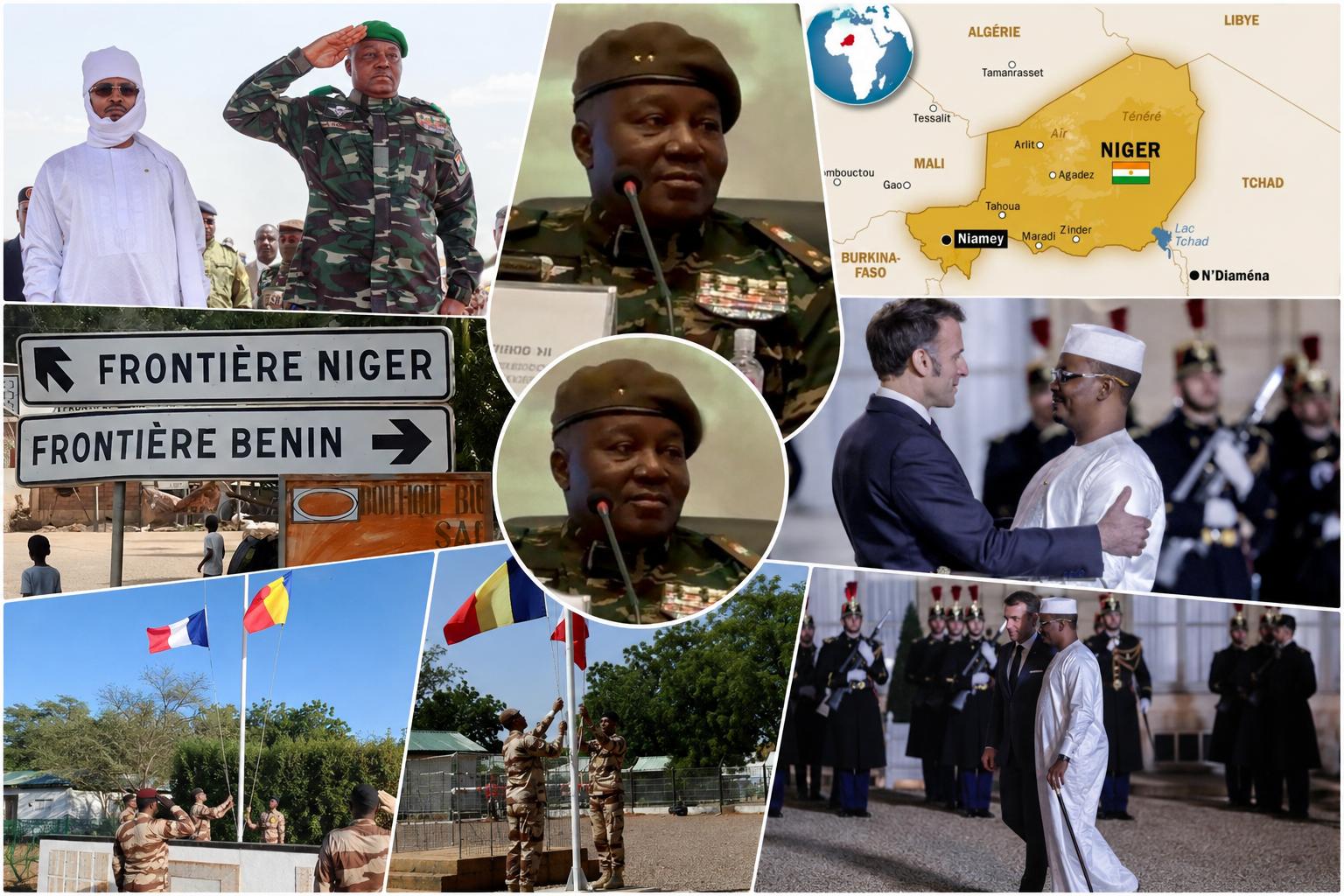
Niamey continues to keep its border with Bénin shut, citing crucial security concerns. This firm stance by Niger takes on a new dimension as Chad, another neighboring nation, strengthens its ties with France. A critical question emerges for Niger: if a French military presence in a neighboring country poses a threat significant enough to justify a border closure, should this same principle not extend to Chad? The vital transit route between Niger and Bénin remains inaccessible, nearly three years after the July 2023 coup, despite earlier hopes for normalization between Niamey and Cotonou.
Despite recent efforts to de-escalate tensions, including renewed dialogue and the establishment of a technical framework to explore reopening conditions, Niamey has not wavered from its demands. Discussions have progressed on security, economic, and legal aspects. General Abdourahamane Tiani, in a public statement, emphasized that reopening the border hinges on ironclad security guarantees and the assurance that no forces deemed hostile would be positioned near the frontier. This reflects a longstanding position by Nigerien authorities: Béninese territory must not be used as a staging ground for operations that could jeopardize Niger’s security. However, Cotonou vehemently disputes this accusation.
Cotonou and Paris issue denials
Throughout the crisis, Béninese authorities have consistently rejected claims of French military bases operating within Bénin, particularly in the northern region. The Béninese government maintains that it has never hosted any foreign military base on its soil, a point reiterated by Béninese Minister of Foreign Affairs, Olushegun Adjadi Bakari, in January 2025. France has also refuted allegations of a military base in northern Bénin. In March 2026, General Fabien Mandon, Chief of Staff of the French Armed Forces, dismissed these accusations, affirming the absence of any French base in that area of the country.
However, a crucial distinction must be made. France undeniably provides security assistance to Bénin. French military personnel have been involved in training and supporting Béninese forces engaged with armed groups in the country’s northern areas. Reports in April 2026 noted the discreet presence of French special forces operating alongside Béninese troops, with French authorities officially referring to them as trainers. This highlights a key point of contention: the acknowledged Franco-Béninese military cooperation is distinct from the alleged presence of a permanent French military base or deployment near the Nigerien border, which both Cotonou and Paris deny. This precise differentiation lies at the heart of the ongoing discussion.
Niamey’s new diplomatic equation
As Niger continues to press Bénin for assurances, another of its neighbors is rekindling ties with Paris. In November 2024, Chad had previously terminated its military cooperation with France, asserting its commitment to full sovereignty and diversifying its security partnerships. This French withdrawal was then seen as a significant shift in relations between N’Djamena and Paris. However, in recent months, the two capitals have been moving closer once more. French military personnel are gradually returning to Chad, albeit within a more discreet and scaled-back framework than their previous deployment. This development addresses Chad’s pressing security realities, including the fallout from the war in Sudan, the persistent threat of Boko Haram in the Lake Chad basin, and critical requirements for intelligence, surveillance, and logistical support. N’Djamena likely views this renewed French engagement as a sovereign and pragmatic decision. Yet, for Niamey, this choice presents a complex question, especially since Chad also shares a border with Niger.
A test of consistency for Niamey’s security doctrine
If Niamey perceives a French military presence near its territory as a severe enough threat to keep its border with Bénin closed, how will Niger respond to the burgeoning Franco-Chadian rapprochement? What makes Chad different from Bénin in this context? This is where a fundamental paradox emerges. Niamey could logically argue that every sovereign state is free to choose its military partners. Under this rationale, both Bénin and Chad would have the right to cooperate with France. However, such a consistent application of logic would then necessitate that Niger not make Franco-Béninese cooperation a prerequisite for reopening its border. Conversely, if Niamey genuinely believes that French military cooperation with a neighbor poses a threat to its national security, then this reasoning should, by all accounts, apply equally to Chad. The issue at hand is not whether Niger should close its border with Chad, but rather to scrutinize the coherence of its own arguments. Why would military cooperation with France be deemed unacceptable for Niger’s western neighbor, yet acceptable for its eastern neighbor? The geographical proximity intensifies this question, as Niger shares extensive borders with both Bénin and Chad. Consequently, a foreign military presence in Chad could, in theory, be considered part of Niamey’s immediate strategic environment.
Chad’s French return tests Niger’s sovereignty doctrine
The developments concerning Chad unfold within a dramatically reshaped regional landscape. Mali, Burkina Faso, and Niger have collectively championed sovereignty and a clear break from former partner powers as foundational tenets of their new foreign policy. These three nations have withdrawn from ECOWAS and solidified their cooperation within the Alliance of Sahel States. Chad, however, has opted for a distinct path. Following its initial break with Paris in 2024, N’Djamena now appears intent on re-establishing military cooperation with France, while simultaneously maintaining its other strategic partnerships. This decision is undoubtedly a sovereign one. Yet, it potentially clashes with a concept of sovereignty that would deny neighboring states the right to choose their own partners. Thus, the core of the current debate shifts from the French presence in Chad itself to the fundamental principle of consistency.
Towards a resolution for Niamey and Cotonou?
Despite the complexities, the situation could still shift. Ongoing discussions between Niger and Bénin indicate that both nations grasp the significant economic and security costs of their prolonged border closure. For nearly three years, residents, traders, and transporters in the border region have borne the brunt of a political crisis that far transcends their local interests. Furthermore, there has been a notable surge in violence across the border zone shared by Bénin, Niger, and Nigeria, underscoring the mutual benefit of enhanced security cooperation between the two countries. Consequently, reopening the border could evolve into a shared imperative. Achieving this, however, will likely require Niamey and Cotonou to move beyond the specific issue of France. The debate cannot sustainably remain confined to a binary opposition between «French presence» and «African sovereignty». If Niger legitimately seeks security guarantees from Bénin, it has every right to request them. Nevertheless, these assurances must be grounded in verifiable facts, transparent mechanisms, and reciprocal commitments. Crucially, they must be applied consistently to all neighboring states. The gradual re-establishment of French military cooperation in Chad thus introduces a fresh dimension to this crisis. Niamey now confronts a pivotal decision: either acknowledge that every sovereign state is free to select its partners, or uphold a doctrine that deems French military cooperation in a neighboring country a threat warranting retaliatory measures. The former approach could pave the way for an easier reopening of the Bénin border. The latter, however, risks forcing Niger to address an unavoidable question regarding the N’Djamena-Paris rapprochement: if France poses a threat in Bénin, why would it not do so in Chad? This apparent contradiction may well represent one of the primary challenges for Sahelian diplomacy today: ensuring sovereignty is a universally applied principle, rather than a tool selectively employed based on the shifting power dynamics between neighboring states.