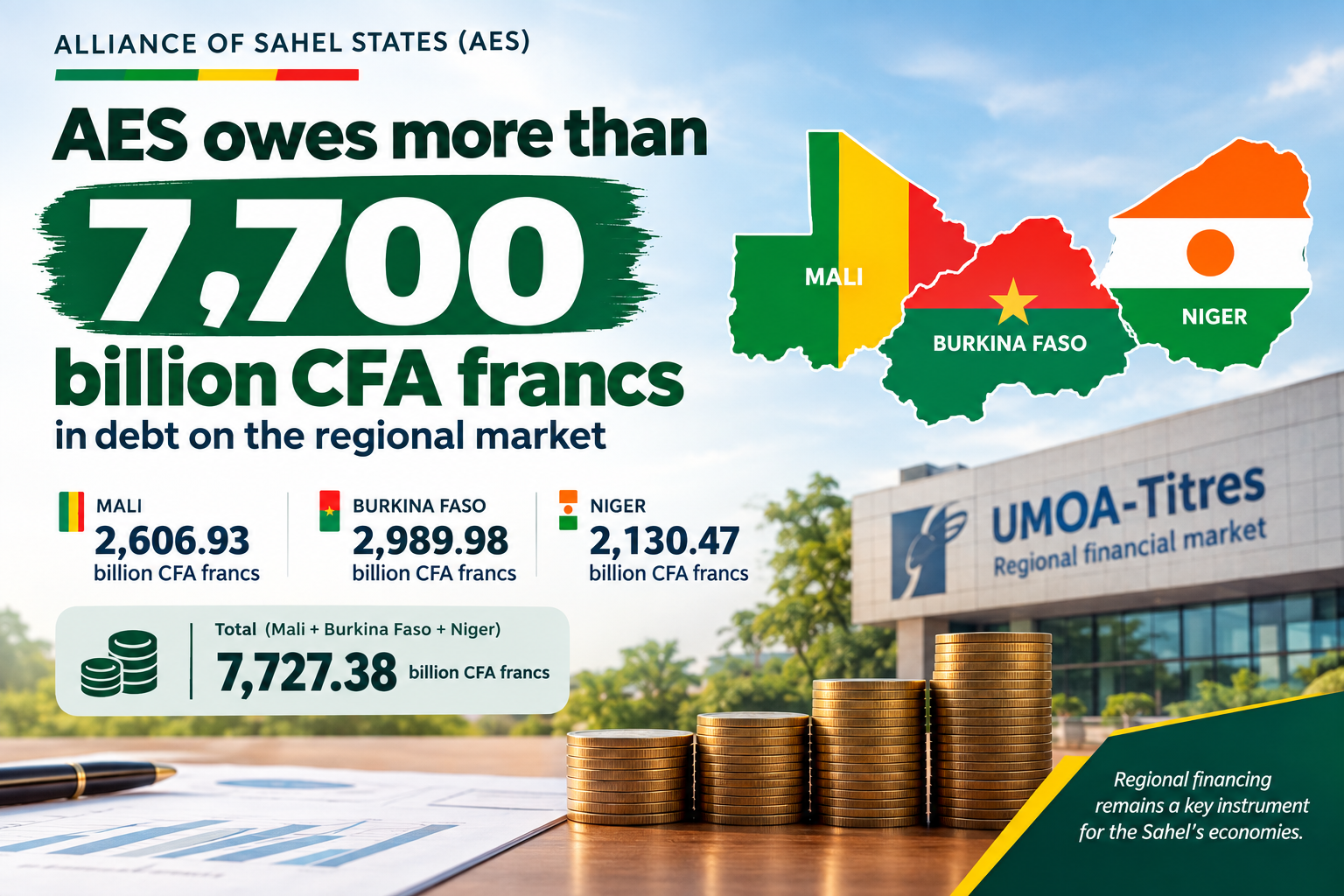
Sahel states’ regional market borrowing exceeds 7,700 billion CFA francs
The three member states of the Alliance of Sahel States — Mali, Burkina Faso and Niger — remain deeply engaged with the West African regional financial market, with their combined outstanding public securities reaching approximately 7,727 billion CFA francs as of 31 July 2026. The figure complicates the narrative of a financial sovereignty built entirely on domestic resources.
The political messaging from the three capitals has been consistent: sovereignty, a break from past dependencies, self-reliant national financing and rejection of externally imposed mechanisms.
Yet the market data tells a more nuanced story.
Figures available as of 31 July 2026 show the three AES states maintaining a substantial presence on the WAEMU regional public securities market. On that date, cumulative outstanding amounts stood at:
- Burkina Faso: 2,989.98 billion CFA francs
- Mali: 2,606.93 billion CFA francs
- Niger: 2,130.47 billion CFA francs
Total: 7,727.38 billion CFA francs.
These amounts do not constitute debt owed to WAEMU as an institution. They represent public securities still in circulation on the regional market. This distinction matters: states borrow from investors who purchase their bills and bonds. UMOA-Titres organises this regional market specifically to finance member states.
Burkina Faso: nearly 3,000 billion CFA francs outstanding
Burkina Faso recorded 2,989.98 billion CFA francs in outstanding securities on the regional market as of 31 July 2026.
The country accounts for roughly 12.4 percent of total WAEMU state outstanding debt, which stood at 24,073.53 billion CFA francs on the same date.
The figure is all the more notable given that Burkina Faso’s outstanding amount was still rising, up 2.46 percent over one month.
During the early months of 2026, Ouagadougou continued to raise resources on the regional market while simultaneously making repayments. In May alone, Burkina Faso mobilised 99.50 billion CFA francs in Treasury bonds and repaid 72.04 billion CFA francs.
In other words, regional financing has not disappeared with the sovereignty rhetoric: it remains an important instrument for treasury management and state financing.
Mali: more than 2,600 billion CFA francs
Mali stood at 2,606.93 billion CFA francs in outstanding securities as of 31 July 2026.
That represents approximately 10.8 percent of the regional total.
Again, the pattern is not a one-off. UMOA-Titres data show that by the end of May 2026, Mali’s outstanding amount had already reached 2,637.64 billion CFA francs. During that single month, Bamako mobilised 93.50 billion CFA francs while repayments totalled 110.07 billion CFA francs.
Mali was therefore borrowing and repaying simultaneously, following a conventional debt management approach.
The question is not simply whether Bamako borrows. The real issue is at what pace, at what cost and to finance what expenditure.
Niger: more than 2,130 billion CFA francs
Niger presented an outstanding amount of 2,130.47 billion CFA francs as of 31 July 2026, or about 8.9 percent of total WAEMU outstanding debt.
It is the trajectory that warrants particular attention.
Between April and May 2026, Niger’s outstanding amount rose from 1,732.05 billion to 2,120.45 billion CFA francs — an increase of nearly 388.4 billion CFA francs in a single month, according to UMOA-Titres data.
This dramatic progression is explained in part by significant financing and debt reprofiling operations.
In May 2026, Niger mobilised 567.49 billion CFA francs, including 519.51 billion in Treasury bonds and 47.97 billion in bills, while 191.31 billion CFA francs were repaid.
Days earlier, a large-scale operation allowed Niger to process 446.386 billion CFA francs in securities, including approximately 59.710 billion CFA francs in short-term securities bought back to ease immediate cash-flow pressures. Net resources generated were estimated at around 327 billion CFA francs.
The 7,727 billion CFA franc figure that unsettles
Adding the three outstanding amounts as of 31 July:
2,989.98 + 2,606.93 + 2,130.47 = 7,727.38 billion CFA francs.
In other words, nearly 7,727 billion CFA francs in public securities from the three AES states remain in circulation on the regional market.
For comparison, all WAEMU states together showed outstanding debt of 24,073.53 billion CFA francs at that time.
The three AES countries therefore accounted for approximately 32.1 percent of the entire regional outstanding amount.
A contradiction with the sovereignty discourse?
This is where the real subject of inquiry lies.
It would be wrong to claim these three states are entirely dependent on the regional market. It would be equally wrong to assert they have stopped using it.
The data demonstrate, on the contrary, a strong and persistent use of the regional financial market.
The market is not merely an external mechanism imposed on states: it has long been a normal channel for financing national budgets within the West African monetary space.
But a political and economic question remains: can a policy be presented as fully autonomous when several thousand billion CFA francs are raised from regional investors to finance state needs?
The answer requires looking beyond slogans.
The AES paradox
The paradox is even more striking since Burkina Faso, Mali and Niger withdrew from ECOWAS.
Politically, the three countries have asserted their intention to build an autonomous trajectory.
Financially, however, they continue to use the WAEMU regional market.
And that market relies largely on banks and investors from the West African space.
An analysis published in late 2025 noted a decline in exposure of investors from other UEMOA countries to AES state debt: their holdings fell from 3,174 billion to 2,801 billion CFA francs, a drop of 373 billion CFA francs between the fourth quarter of 2024 and the third quarter of 2025. At the same time, cross-holdings of securities among the three AES countries declined by 622 billion CFA francs to approximately 3,160 billion CFA francs.
This phenomenon deserves monitoring: when investors become more cautious, financing can become more expensive and more difficult.
The real indicator: the cost of debt
The outstanding amount alone is not sufficient.
To judge the sustainability of this debt, one must also examine:
- interest rates;
- maturities;
- annual repayment amounts;
- tax mobilisation capacity;
- economic growth;
- the share devoted to security spending;
- the capacity to roll over maturing loans.
This is precisely where the risk lies.
A state can carry high outstanding debt but manage it if it has sufficient revenue and solid growth. Conversely, a state can face serious difficulties with a smaller debt if a large portion of securities matures simultaneously or if interest rates become too high.
Niger offers a glimpse of the problem
The Nigerien case illustrates this mechanism perfectly.
In May 2026, the country mobilised 567.49 billion CFA francs but also repaid 191.31 billion CFA francs.
Another operation involved 446.386 billion CFA francs, part of which was used to buy back maturing securities.
This means that part of the new resources does not necessarily constitute new money available to finance projects. It may serve to refinance existing debt.
This is a common mechanism on bond markets, but it must be stated clearly: raising several hundred billion does not automatically mean those hundreds of billions are added in full to resources available for development.
The trap of ‘billions mobilised’ announcements
This is probably one of the most important points to retain.
When a government announces an issuance of 500 billion CFA francs, several questions must be asked:
How much is genuinely new? How much serves to repay old securities? What is the interest rate? What is the duration? What will the total bill be for the taxpayer?
In Niger’s case, the May 2026 operation shows precisely why this distinction is indispensable: 446.386 billion CFA francs in gross amount processed, but approximately 327 billion CFA francs in net resources generated.
The difference is not an accounting detail. It completely changes the political reading of the figure.
Conclusion: sovereignty does not erase debt
The debate on the AES should therefore not simply oppose ‘sovereignty’ and ‘dependence’.
The figures tell something more complex.
As of 31 July 2026, Burkina Faso, Mali and Niger cumulated 7,727.38 billion CFA francs in outstanding public securities on the WAEMU regional market.
This is not debt directly owed to UEMOA as an organisation. It is debt owed to investors who subscribed to securities issued by these states.
But the observation remains: the three countries claiming greater financial autonomy continue to rely heavily on regional bond financing to cover their needs.
The real question is no longer whether the AES borrows.
It is how far these states can continue to borrow without the cost of this ‘financial sovereignty’ ultimately weighing heavily on their future budgets.