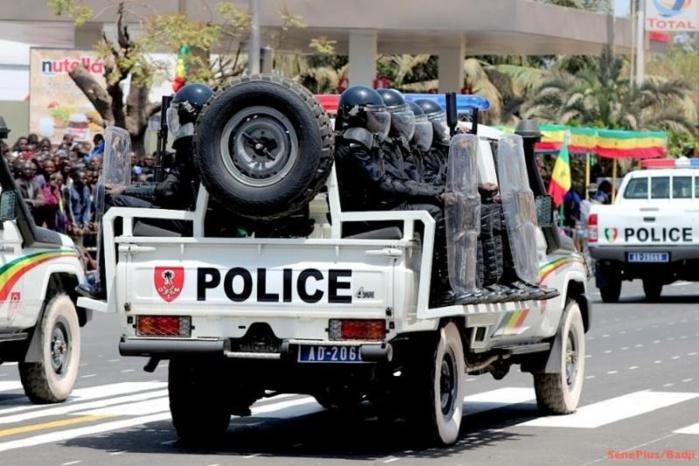
In Dakar, police operations targeting foreigners have intensified over recent weeks, raising concerns among civil society and expatriate communities. According to official figures, nearly 490 foreigners were checked in just eight days, with 36 individuals referred to the prosecutor’s office for irregular stay. These administrative verifications, presented as routine security measures, are increasingly perceived as a growing climate of suspicion toward foreign residents.
a routine check that turns into a nightmare
Amadou Bangoura, a 30-year-old Beninese student pursuing higher education in Senegal for five years, experienced this firsthand. One evening, as he left a gym in the Liberté 6 district around 10 PM, a police patrol stopped him and demanded his identification. Caught off guard, he admitted he didn’t have his documents on him: « My papers are at home, » he explained.
The unfamiliar situation sent a wave of panic through him—deportation, imprisonment, or a summons before the prosecutor flashed through his mind. The officers decided to verify his claims and accompanied him to his residence, where he presented his passport and proof of legal stay. All documents were in order, and the matter was closed without further consequences. Yet, the episode left him shaken.
escalating controls in Dakar and suburbs
The case of Amadou Bangoura is not an isolated incident. Since late June, police units specializing in foreigner documentation have conducted sweeping verification campaigns across several neighborhoods in Dakar and its outskirts. The results, as reported by local authorities, reveal a sharp increase in administrative checks: between June 30 and July 8, nearly 490 foreigners of various nationalities were inspected, and 36 were referred to the prosecutor for irregular stay.
civil society voices growing concerns
These intensified controls have triggered strong reactions from civil society organizations. In a joint statement issued on July 13, several groups—including Legs Africa, Frapp, Nawle, Afrikajom Center, and Diwan Citoyen—expressed deep concern over what they describe as an alarming trend of administrative measures targeting foreigners residing or visiting Senegal.
The organizations acknowledge that every state holds the sovereign right to regulate borders and combat irregular immigration. However, they warn against conflating sovereignty with arbitrariness. « What worries us today is not the existence of migration policies, but the normalization of a permanent climate of suspicion toward foreigners, » they stated. They argue that this shift risks transforming legal stays into bureaucratic ordeals, reducing foreigners from rights-bearing individuals to perceived administrative risks.
balancing security and hospitality
Elimane Kane, president of Legs Africa, emphasizes that security measures should not overshadow Senegal’s long-standing tradition of hospitality. While he acknowledges the state’s responsibility to control borders and identify individuals entering the territory, he cautions against interpretations that frame these operations as a rejection of foreigners.
« Security does not exclude otherness, » he insists, calling for better coordination among security forces. Without it, these checks risk being perceived as persecution rather than necessary administrative measures. Kane also highlights the global reality of professional mobility: « Just as Senegalese citizens work abroad, foreigners have the right to come here and contribute, » he argues. He advocates for policies that empower young Senegalese to seize available opportunities, rather than blaming migrants.