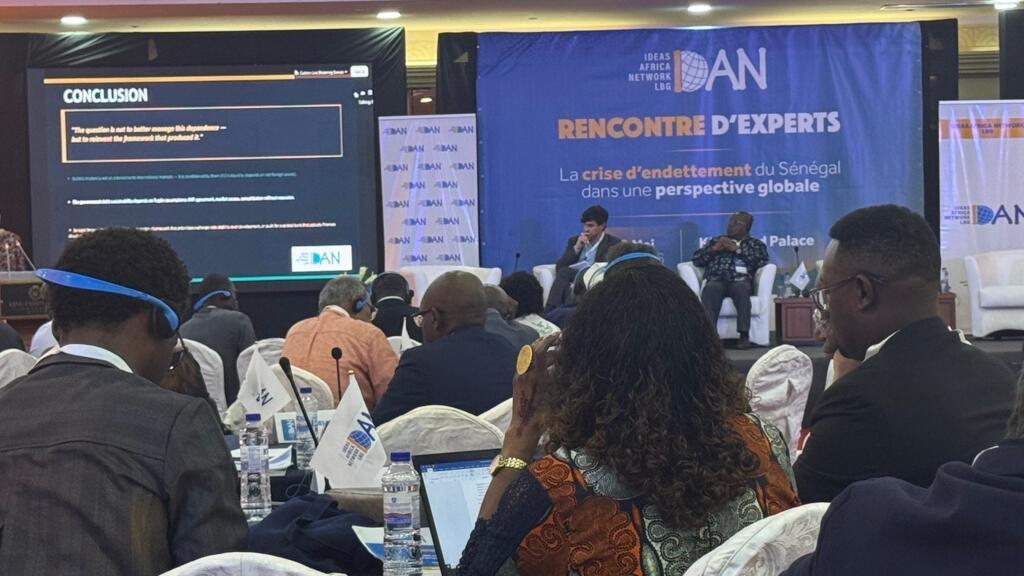

A significant conference addressing Senegal’s debt crisis recently took place in Dakar, sparking discussions on viable alternatives to traditional financial remedies. Although Prime Minister Ousmane Sonko, the patron of the event, was unable to attend due to illness, his absence did not diminish the urgency of the proceedings.
Ayib Daffé, president of the Pastef parliamentary group, delivered remarks on behalf of the ruling party. He underscored the critical need to "broaden perspectives" and "move beyond conventional wisdom" in resolving the nation’s financial challenges. This statement implicitly critiqued the International Monetary Fund (IMF)’s standard proposal for debt restructuring—a strategy involving the renegotiation of loan terms when repayment becomes unfeasible—which Dakar has explicitly rejected.
Seeking alternative debt solutions
Economists attending the conference unanimously concurred that Senegal’s current external debt burden is unsustainable, a position that contrasts sharply with previous government assurances. They stressed the immediate necessity of identifying effective solutions. Economist Souleymane Bah highlighted that the nation’s current state revenues are insufficient to cover both the principal and interest payments on its foreign obligations. He further noted that the practice of borrowing to repay existing debts is not a viable strategy, especially with continually rising interest rates, emphasizing the need for "other alternatives."
The core objective of this conference, organized by the Ideas Africa Network think tank, was precisely to explore these alternative solutions, based on the belief that the IMF’s conventional offerings are inadequate.
Ndongo Samba Sylla, a researcher and economist at Ideas, criticized the IMF’s approach, stating it "is opposed to economic transformation." He described it as a "purely accounting and pro-creditor" method. According to Sylla, the IMF prioritizes lending money to signal a country’s ability to borrow again and repay creditors, rather than fostering investments that lead to genuine economic transformation.
Among the innovative pathways discussed were reforming the monetary system, potentially moving away from the Franc CFA, and advocating for the cancellation of certain debts deemed "illegitimate." The latter refers to obligations reportedly incurred opaquely by the previous administration without proper declaration.
However, a perceived contradiction emerged within the current leadership. While experts in Dakar, under the aegis of Prime Minister Ousmane Sonko, were deliberating on strategies independent of the International Monetary Fund, President Bassirou Diomaye Faye was simultaneously in Nairobi, Kenya. There, he engaged in discussions with IMF Director Kristalina Georgieva, though no significant progress was reported from this meeting at the time.