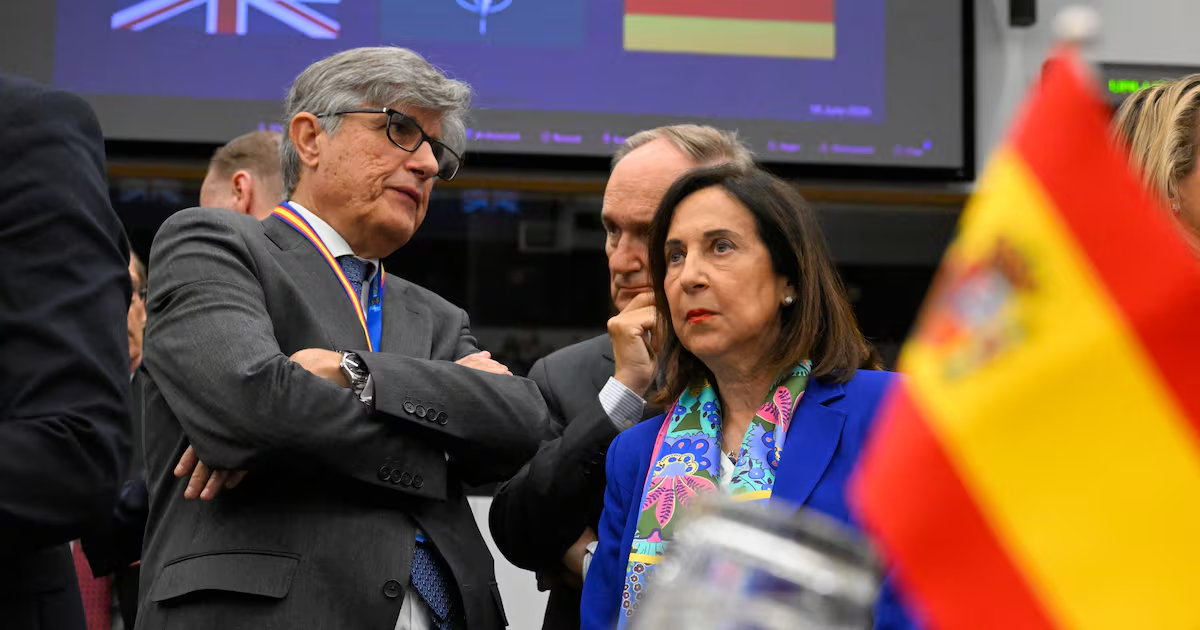
Spain’s Defense Minister, Margarita Robles, confirmed before the Congress on Tuesday that a Supreme Court decision concerning border expulsions in Sebta had indeed generated a “pull effect,” contributing to the significant influx of migrants observed on July 30 and 31.
To substantiate her statements, Minister Robles referenced a report from the Spanish Defense Staff, which outlined the escalation of this mobilization in three distinct phases. The initial phase, characterized as “concentrated migration,” commenced following the July 8 public release of the judicial ruling. This decision stipulated that individuals who had swum to the city could not be immediately repatriated via maritime routes.
Following this ruling, “hundreds” of individuals began to cross the border, a number that progressively swelled into the thousands. The minister specifically pointed to a “pull effect, fueled by a biased interpretation of the court’s decision,” which gained widespread traction across social media platforms.
This initial message was soon amplified by another, portraying Morocco’s Throne Day as an ideal opportunity for border crossings. According to Minister Robles, various Facebook groups actively disseminated the notion that security personnel on the Moroccan side would be less numerous due to the national festivities.
An “auto-organized” mobilization on social media
The minister asserted that the event, often labeled a “massive surge,” did not stem from a centralized organizational effort. Instead, she described it as a form of “self-organization” among the migrants themselves. These individuals, she explained, were drawn to the border by an “opportunity message” and various online posts suggesting a “purported lack of impediments” to entering Sebta.
The narrative put forth by the Defense Ministry therefore highlights social media as central to this mobilization. Robles stated that the rapid dissemination of these messages hindered security forces from “reacting promptly” as thousands of crossing attempts occurred concurrently.
Furthermore, Robles maintained that it was physically impossible “to halt, through the use of force, these torrents of hundreds or thousands of individuals.” She cautioned that such an intervention would have led to catastrophic outcomes, declaring during her testimony before the Defense Committee that “the number of fatalities would have been incalculable.”
Minister Robles’ remarks align with explanations previously offered by Morocco on August 2. At that time, the Moroccan Ministry of Interior had detailed a proactive and comprehensive response, which included early detection of warning signs, heightened vigilance, deployment of security services, and intensified surveillance across land and sea borders. This multi-faceted approach, they explained, effectively managed the situation, safeguarded human lives, maintained public order, and secured the borders, all while adhering to legal frameworks and the principle of proportionality. Rabat had also attributed these crossing attempts to the spread of deceptive information on social media, the activities of human trafficking networks, and an erroneous understanding of Spanish court rulings.
A unified command structure
The testimony of Margarita Robles marks the beginning of a week where eight ministers are scheduled to brief the Congress on the Spanish government’s actions concerning a crisis that erupted 26 days prior, following the entry of an estimated 80,000 migrants.
Concurrently, Prime Minister Pedro Sánchez presided over the inaugural meeting of the National Security Council focused on Sebta this Tuesday. Attendees included the government’s vice-presidents, several cabinet ministers, principal state security leaders, and Juan Jesús Vivas, who joined the discussion remotely.
This gathering served to formalize the establishment of a unified command structure tasked with overseeing the ongoing crisis. The responsibility for coordination will fall to Ángel Víctor Torres, the Minister of Territorial Policy. He will chair a committee comprising Juan Jesús Vivas, the government delegate, representatives from the National Intelligence Center, and relevant ministry officials.