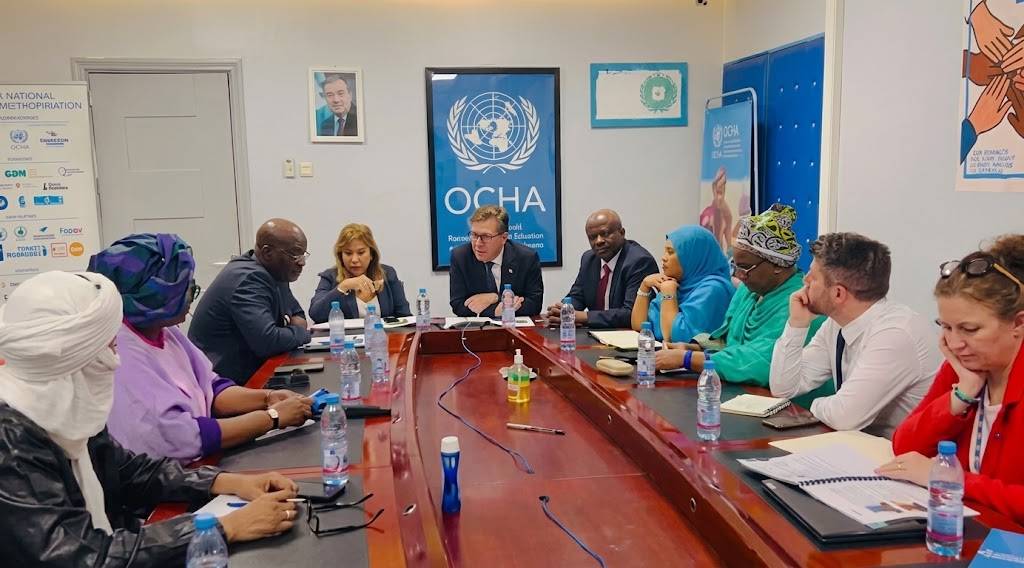
The United Nations has returned to Bamako with a high-level delegation led by Tom Fletcher, UN Under-Secretary-General for Humanitarian Affairs and Emergency Relief Coordinator. The visit comes as Mali confronts a deepening humanitarian crisis affecting 5.1 million people in 2026 — the highest recorded number in recent years.
Mali’s growing human crisis demands urgent action
According to the UN’s 2026 Humanitarian Response Plan, 5.1 million Malians now require urgent humanitarian assistance — including 3.8 million targeted for relief operations. This staggering figure reflects the escalating vulnerability of families displaced by conflict, communities cut off from essential services, and households grappling with rising food insecurity and collapsing healthcare access.
The crisis is not just numerical. Behind it lie real people: children facing malnutrition, women in need of maternal care, displaced communities without clean water, and communities ravaged by ongoing insecurity. With over 3.8 million individuals already prioritized in the humanitarian plan, the gap between needs and available aid remains dangerously wide.
Diplomatic tensions shape a complex response landscape
The UN delegation’s arrival in Bamako follows a period of strained relations between Malian authorities and several international humanitarian organizations. Recent policy shifts by the transitional government have led to the suspension or withdrawal of numerous agencies, altering the humanitarian landscape and complicating access to populations in need.
Tom Fletcher’s mission signals a renewed — though cautious — engagement by the UN. But the visit also underscores a critical distinction: the UN’s presence does not imply a reversal of broader operational restrictions imposed on other agencies. While the Secretary-General’s office maintains dialogue with Malian officials, the broader humanitarian ecosystem faces reduced capacity and heightened uncertainty.
Can sovereignty and humanitarian aid coexist?
At the heart of the challenge is a fundamental question: how can Mali protect its national sovereignty while ensuring that vulnerable populations receive life-saving support?
Despite policy changes aimed at reinforcing state control, the humanitarian imperative remains unchanged. Millions of Malians — many in remote or conflict-affected zones — continue to depend on external assistance for food, medical care, clean water, and protection.
Key action areas for 2026
- Food security: Over 2 million people face acute food shortages, with rising prices and disrupted supply chains worsening the crisis.
- Healthcare collapse: Under-resourced facilities struggle to handle disease outbreaks, maternal complications, and trauma injuries due to insecurity.
- Water and sanitation shortages: Access to safe drinking water has plummeted in rural and displaced communities, increasing disease risk.
- Child protection: Growing numbers of unaccompanied minors and child labor highlight deep social fractures.
Human needs outweigh political considerations
With 5.1 million Malians in urgent need, 2026 demands more than policy adjustments — it requires concrete, coordinated action. The UN delegation’s visit offers a moment to reassess priorities, restore safe access, and mobilize resources. But time is running out.
Human suffering cannot wait for diplomacy to catch up.