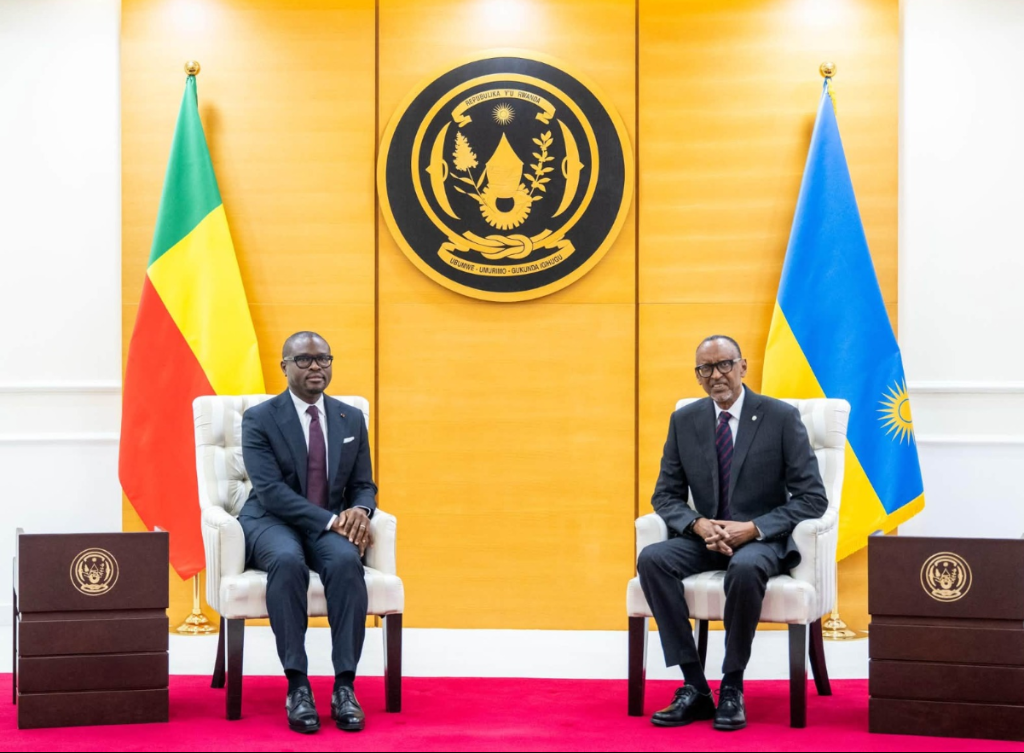
KIGALI — Benin’s President Romuald Wadagni began a two-day official visit to Rwanda on Wednesday, September 16, 2026, marking his first diplomatic trip to the country since taking office in May. The visit includes high-level talks with Rwandan President Paul Kagame and a solemn stop at the Kigali Genocide Memorial in Gisozi to honor the victims of the 1994 genocide against the Tutsi.
Official welcome and presidential talks
Upon arrival in Kigali, Wadagni was greeted by a crowd celebrating his inaugural state visit as Benin’s head of state. He was later received at Urugwiro Village, the Rwandan presidential residence, by President Kagame. Their summit meeting formed the centerpiece of the day’s agenda, reflecting growing efforts by both nations to deepen bilateral ties.
The two countries already collaborate in several strategic sectors, including information and communication technology, public service modernization, urban planning, agriculture, and peace and security initiatives.
A symbolic moment at Gisozi
Beyond policy discussions, Wadagni’s itinerary includes a highly symbolic visit to the Kigali Genocide Memorial in Gisozi. The site serves as the final resting place for over 250,000 victims and functions as both a place of remembrance and an educational center dedicated to preserving historical memory.
The 1994 genocide claimed more than one million lives in approximately 100 days, according to Rwandan authorities. Annual commemorations—known as Kwibuka—remain central to national life, emphasizing remembrance, intergenerational education, and lessons drawn from the tragedy.
Inaugurated in 2004, the Gisozi memorial houses exhibits, survivor testimonies, archival materials, and a dedicated section honoring child victims. For visiting dignitaries like Wadagni, paying respects here is a customary and meaningful gesture that underscores the human dimension of diplomatic engagement.
Building on existing ties
This summit follows Rwanda’s strong representation at Wadagni’s presidential inauguration, where Prime Minister Justin Nsengiyumva attended on behalf of Kigali—a signal of Rwanda’s commitment to strengthening relations with Benin.
Discussions between the two leaders are expected to focus on expanding cooperation and exploring new partnerships. Both nations are pursuing ambitious national agendas centered on economic transformation, administrative modernization, and infrastructure development. Rwanda, in particular, champions digital innovation, entrepreneurship, and foreign investment as pillars of its growth strategy.
Memory as a foundation for partnership
By including the Gisozi memorial in his schedule, Wadagni aligns his visit with Rwanda’s broader philosophy: that remembrance fuels reconciliation, unity, and prevention of future atrocities. The memorial hosts the Genocide Archive of Rwanda, which collects documents and testimonies from survivors and partner organizations worldwide.
For international visitors, the Gisozi stop is a moment of reflection—marked by silence, wreath-laying, and engagement with preserved histories. Wadagni’s tribute thus bridges diplomatic protocol with moral acknowledgment.
With the first day concluding after formal talks and the memorial visit, Wadagni’s remaining time in Kigali will focus on further dialogue with Rwandan officials. This two-day mission aims to lay the groundwork for a renewed phase in Benin-Rwanda relations, anchored in shared values, practical collaboration, and mutual respect for historical memory.