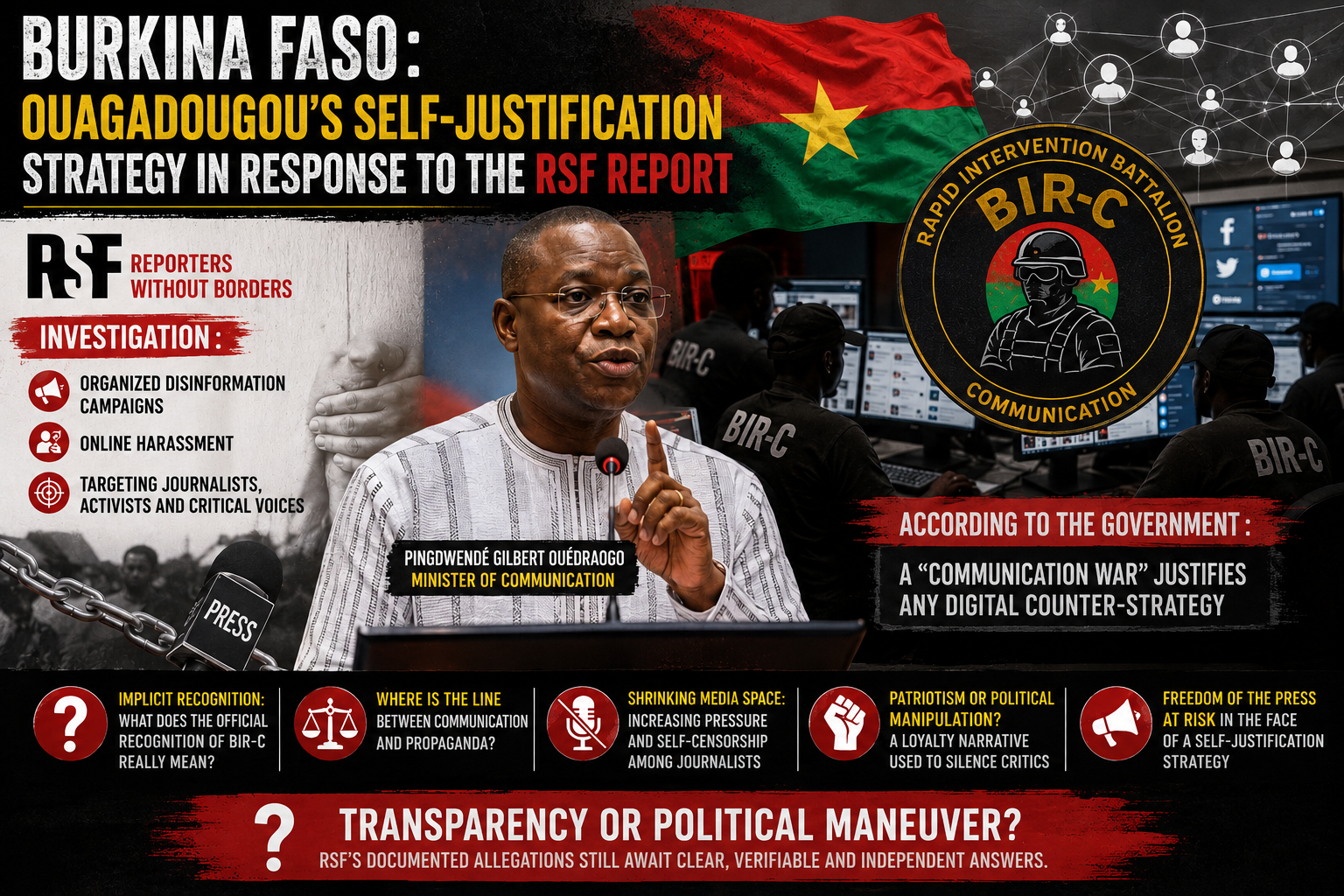
Burkinabè officials have intensified their defense of state-aligned communication strategies following allegations by Reporters Without Borders (RSF), drawing sharp criticism over a perceived lack of transparency. On August 3, during a national event, Minister of Communication Pingdwendé Gilbert Ouédraogo publicly praised the Rapid Intervention Battalion-Communication (BIR-C), portraying it as a bulwark against misinformation. However, this endorsement has only amplified doubts about the government’s motives and its commitment to addressing the core issues raised.
Government response vs. RSF findings
The public tribute to the BIR-C comes amid an RSF investigation that exposes a coordinated network of social media accounts allegedly disseminating disinformation, targeting journalists, and suppressing dissent. Rather than launching an independent review or directly refuting the evidence, authorities opted to publicly back the BIR-C, raising further questions about its role in state communication practices.
The mechanics of the alleged campaign
The investigation reveals a systematic operation involving fake accounts designed to amplify pro-government narratives, discredit critics, and pressure independent media. While officials dismiss these claims, their refusal to address the evidence head-on has intensified debates over where institutional communication ends and state-directed propaganda begins.
The government argues that Burkina Faso is engaged in a « communication war » orchestrated by external forces seeking to destabilize the country. In this narrative, any state-backed digital strategy is framed as a patriotic duty. Yet this justification raises a critical concern: when does legitimate crisis communication cross into the suppression of dissent and pluralism?
Press freedom under strain
Amid escalating political and security tensions, the fight against misinformation is undeniably a priority for state institutions. However, international norms on freedom of expression stipulate that such efforts must not involve harassment, smear campaigns, or intimidation of media professionals. When criticism is routinely equated with subversion, public discourse risks being confined to a narrow, state-sanctioned script.
Observers warn that the shrinking media landscape in Burkina Faso is fostering an environment where journalists increasingly resort to self-censorship to survive. The presence of an organized digital communication apparatus assuming its functions extend beyond official messaging—poses urgent questions about striking the right balance between national security and fundamental rights.
Patriotic framing overshadows factual debate
Minister Ouédraogo’s statements suggest a strategy rooted more in political rhetoric than transparency. By framing the BIR-C’s role in nationalistic terms, officials shift the conversation from evidence-based scrutiny to blind allegiance. This tactic effectively recasts critics not as concerned parties but as enemies of the state, deflecting attention from the methods under investigation.
A functioning democracy, particularly one facing acute security challenges, must uphold press freedom and civil liberties. Responding to allegations with public endorsements of the accused entity does little to allay concerns instead, it may be interpreted as an implicit acknowledgment of its central role within the government’s communication machinery.
Broader implications for digital governance
The controversy highlights a critical juncture in how Burkina Faso manages information in the digital era. Social media has become a pivotal arena for political narratives, and any state-affiliated digital operations must operate within transparent, rights-respecting, and free-expression-aligned frameworks.
At its core, this dispute underscores a deliberate political choice: addressing criticism through nationalist mobilization rather than engaging in open dialogue or evidence-based rebuttal. Until credible, independent responses are provided to the allegations raised by RSF, official statements risk being perceived not as denials but as attempts at self-preservation—perpetuating the erosion of press freedom in Burkina Faso.