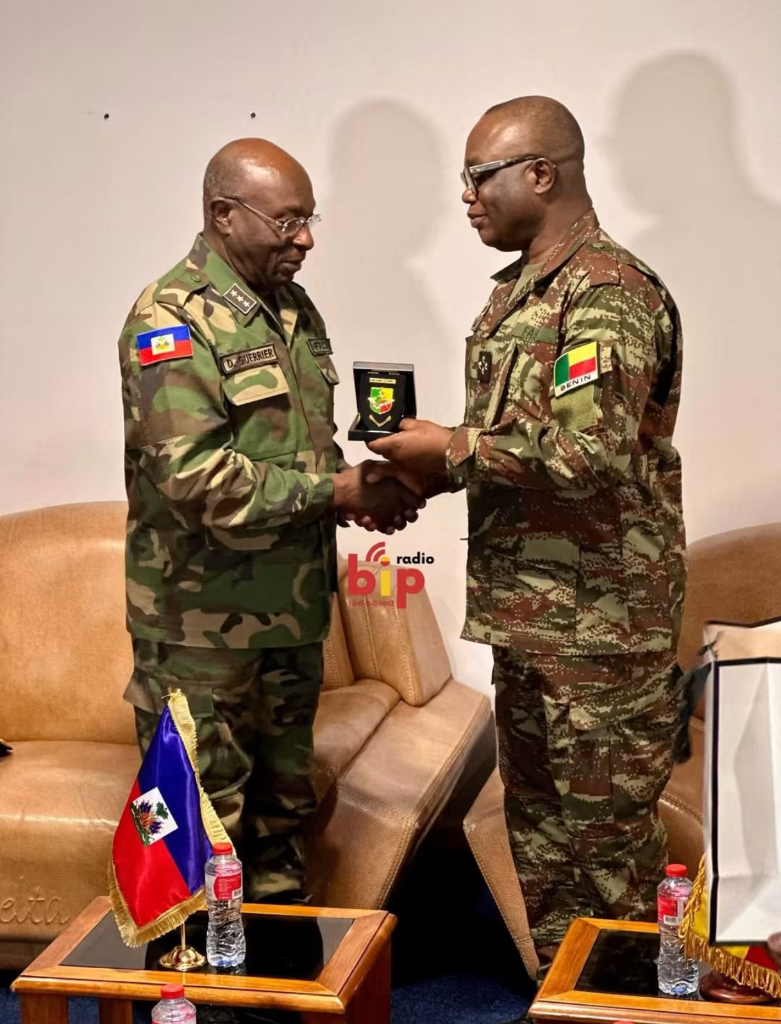
COTONOU, November 2026 — The military cooperation between Haiti and Benin is at a crossroads. The visit of Haiti’s top military commander, Lieutenant General Derby Guerrier, to Benin’s capital marks a pivotal moment in discussions about how African nations can collaborate to address Haiti’s deepening security crisis. Received at the General Staff headquarters by Benin’s Chief of Defense Staff, General Fructueux Gbaguidi, the Haitian delegation is probing the feasibility of a strategic military partnership to bolster stability in Port-au-Prince.
The timing of this high-level meeting could not be more critical. Haiti remains trapped in a cycle of gang violence, institutional collapse, and weakened security forces, with armed groups expanding their influence across the country. Against this backdrop, Haiti’s leadership is seeking fresh avenues for collaboration—including with African nations—to rebuild its armed forces and restore order. Benin, with its own experience in countering regional threats, could offer a model for effective defense modernization and operational resilience.
What 2024’s proposed Benin military deployment means for today’s talks
This isn’t the first time Benin has signaled its willingness to support Haiti’s security. In early 2024, President Patrice Talon publicly pledged 1,500 Beninese troops—and potentially up to 2,000—as part of a broader UN-backed Multinational Security Support Mission led by Kenya. While hailed as a sign of African solidarity, the offer never materialized due to unresolved concerns over operational command, funding, and the integration of troops under a police-led mission.
During this week’s talks in Cotonou, General Derby Guerrier and General Gbaguidi are revisiting those concerns. The question on the table is clear: Can Benin contribute meaningfully to Haiti’s stabilization, and under what conditions? The absence of a concrete deployment plan in 2024 looms large, especially now that Haiti’s security situation has deteriorated further.
Shared security challenges: Why Benin’s experience matters to Haiti
Benin is no stranger to regional instability. The country faces persistent threats from armed groups in its northern territories, compounded by spillover risks from the Sahel’s crisis. To counter this, Benin’s armed forces have undergone a transformation—upgrading training programs, enhancing intelligence gathering, and adapting defense strategies to new threats. These are precisely the areas where Haiti’s military seeks to improve.
The exchange offers mutual benefits. Benin gains a partner with shared democratic values and a commitment to security governance, while Haiti gains access to African expertise in counterinsurgency, border security, and institutional reform—all vital to its reconstruction.
From dialogue to action: What’s next for Haiti-Benin military ties?
The stakes are high. The meeting in Cotonou may not result in an immediate troop deployment, but it could lay the groundwork for deeper bilateral cooperation. Discussions are expected to center on:
- Joint training programs: Benin could help design and deliver advanced military courses for Haitian officers, focusing on leadership, urban warfare, and crisis management.
- Intelligence sharing: Establishing a framework for real-time threat monitoring and coordination between Haitian and Beninese security agencies.
- Logistical and operational support: Exploring the possibility of Benin providing equipment, supplies, or advisory teams to strengthen Haiti’s defense infrastructure.
- Regional security alignment: Integrating Haiti’s efforts into a broader African-led security initiative, rather than relying solely on Western-sponsored missions.
One key obstacle remains: the command structure of any future peacekeeping mission. Haitian authorities have insisted that African forces must operate under unified African command—a principle Benin may now be more receptive to, given its evolving regional role.
A turning point for Haiti’s international partnerships
Haiti’s search for African allies reflects a broader shift in its foreign policy. With traditional Western partners facing internal constraints and public skepticism over direct military interventions, Haiti is turning to the Global South for sustainable, culturally aligned support. Benin, with its strong governance record and strategic location, is a prime candidate to lead this new chapter.
Yet the road ahead is uncertain. While both nations express political will, translating intentions into action will require overcoming logistical hurdles, funding gaps, and lingering doubts from past proposals. The success of this visit will be measured not in vague declarations, but in the signing of tangible agreements and the launch of pilot programs.
Can Benin’s military model help Haiti break the cycle of violence?
The answer may lie in the specifics of what emerges from Cotonou. If Benin commits to a phased advisory role—starting with training and intelligence—it could serve as a confidence-building step toward greater involvement. For Haiti, such support would represent more than a temporary fix; it would signal a long-term partnership rooted in shared values and mutual respect.
As the meeting concludes, one thing is clear: the Haitian-Beninese military dialogue is no longer theoretical. It is now a practical exploration of how two nations, each facing unique threats, can unite to forge a safer future—one where Haiti’s security crisis is met not with isolation, but with African solidarity.