Unprecedented naval maneuvers by Beijing spark regional concerns
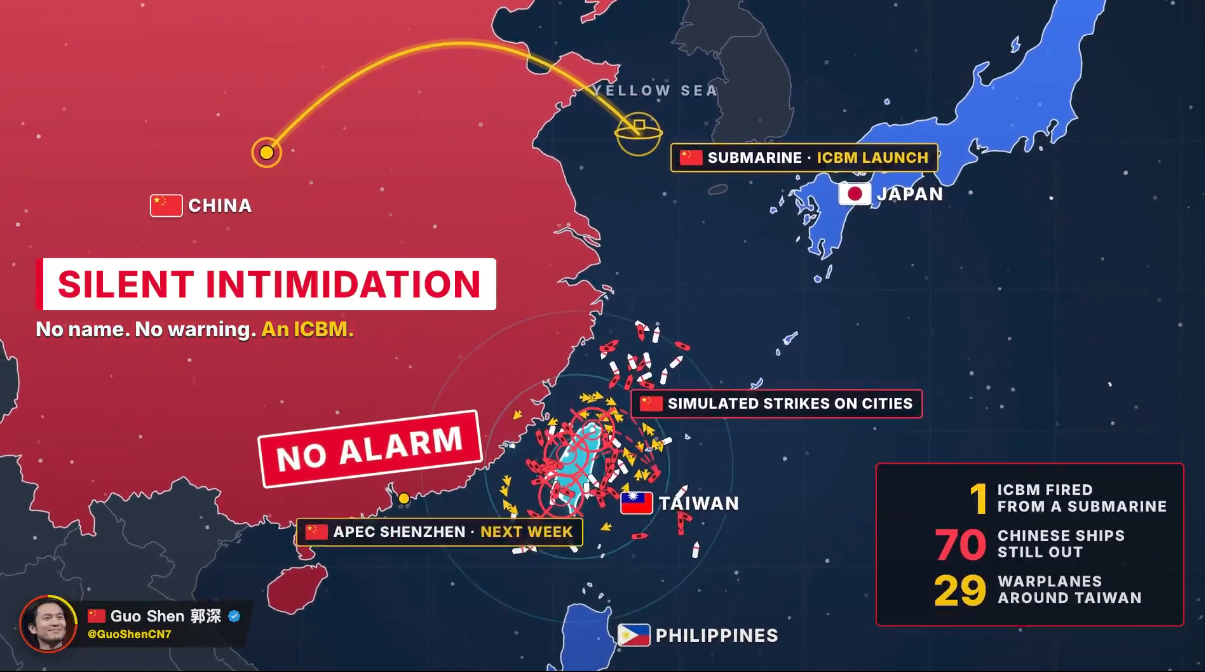
Military tensions in the western Pacific have escalated significantly after China mobilized more than 100 naval vessels and coast guard ships in a sweeping operation near Taiwan. The coordinated deployment, conducted without prior official announcement, involved naval units from all three of China’s military districts—Northern, Eastern, and Southern Commands—and extended well beyond the Taiwan Strait.
According to Taiwanese security officials, the drills included simulated attacks on military targets and urban areas, with approximately 70 vessels still active in the first island chain zone as of mid-November. Military analysts warn that such a large-scale exercise could signal Beijing’s growing capability to enforce a blockade or deny access to Taiwanese air and maritime routes in a future crisis.
The scale and coordination of the naval deployment underscore a deliberate show of force, raising questions about long-term strategic intentions toward Taiwan.
Taiwan’s vulnerability in a tightening military vise
For Taipei, the Chinese maneuvers represent more than routine naval exercises. They could serve as a rehearsal for isolating Taiwan economically and strategically, disrupting supply lines and complicating international support scenarios. The Institute for the Study of War (ISW) highlighted in its November assessment that these movements likely align with Beijing’s denial-of-access strategies, aimed at preventing external intervention in a potential conflict over the island.
Given Taiwan’s pivotal role in global semiconductor production and its position as a maritime chokepoint, such actions have direct implications for regional stability and international trade. Both the United States and Japan—key military partners for Taipei—are closely monitoring developments, though their responses remain calibrated.
US nuclear detection aircraft spotted in sensitive airspace
On November 15, military aviation trackers identified the presence of a WC-135R Constant Phoenix aircraft operated by the US Air Force near Taiwan. The aircraft, which took off from Kadena Air Base in Okinawa, followed a route south of the island before heading toward the southwest approaches of the Taiwan Strait.
The WC-135R, often referred to as the “Nuclear Sniffer,” is equipped with advanced sensors designed to detect atmospheric traces of radioactive particles. Its primary mission involves monitoring nuclear test activities and identifying radiological incidents. While its deployment in the region has drawn scrutiny, no official confirmation has been provided regarding the flight’s specific objectives or whether it was directly related to the Chinese naval exercises.
Analysts caution against assuming a direct link, as multiple operational explanations for the aircraft’s presence remain plausible.
Strategic surveillance or escalation precursor?
The timing of the WC-135R flight—amid China’s largest naval surge in years—has fueled speculation about US intentions. Washington maintains extensive surveillance capabilities in the Indo-Pacific, with Kadena serving as a critical hub for monitoring Chinese military activity. The deployment of a nuclear detection aircraft could reflect a broader intelligence-gathering posture, though its exact purpose remains unconfirmed.
With Taiwan at the center of escalating US-China rivalry, the island’s status continues to be a flashpoint of global significance. Beijing views Taipei as part of its sovereign territory and has not ruled out the use of force to assert control, while Taiwanese authorities seek to preserve political autonomy. A miscalculation or unintended escalation in the region could have far-reaching consequences, particularly given Taiwan’s role in the global supply chain for advanced electronics.
Global stakes rise as tensions in the Taiwan Strait intensify
Any prolonged disruption in the Taiwan Strait would reverberate through international markets. The island accounts for over 60% of the world’s semiconductor manufacturing capacity, making it indispensable to industries reliant on advanced microchips. A military confrontation or even the credible threat of one could trigger supply chain disruptions, drive up technology costs, and deepen geopolitical divides between Washington and Beijing.
While no evidence currently suggests an imminent Chinese invasion, the combination of large-scale naval exercises, denial-of-access drills, and heightened American surveillance paints a picture of a rapidly evolving and increasingly volatile strategic environment.
One fact remains clear: the western Pacific is now a central theater of great-power confrontation, where every military maneuver is scrutinized with unprecedented intensity.