Senegal’s spiritual legacy fuels a new political narrative
In a predominantly Muslim Sénégal where secularism coexists with the profound influence of Sufi brotherhoods, the intersection of faith and governance has taken on a renewed political dimension. The historical journey of these religious leaders is being reinterpreted through a modern lens, positioning them as architects of a distinctly African developmental model.
From spiritual guides to political symbols
Once revered solely for their spiritual guidance, prominent figures within Sénégal’s Sufi traditions are now being invoked in contemporary political discourse. Leaders like Bassirou Diomaye Faye and Ousmane Sonko, despite their recent political rift, share a common strategy: leveraging the moral authority of these religious figures to reinforce national identity while securing crucial electoral support from influential Sufi leaders.
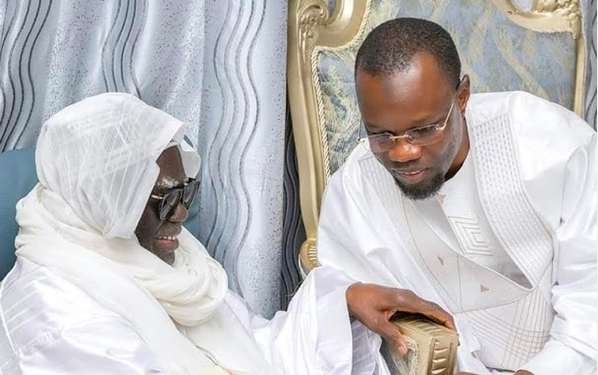
Just days before the Grand Magal pilgrimage in late July, President Bassirou Diomaye Faye made a symbolic visit to Touba to meet Serigne Mountakha Mbacké, the current Khalif General of the Mouride brotherhood. Days later, Ousmane Sonko, now President of the National Assembly, followed suit. These institutionalized pilgrimages underscore the enduring role of Sufi leaders as “pillars of national unity” amid political turbulence.
Ousmane Sonko’s ideological shift and historical parallels
Ousmane Sonko’s recent visit to Touba marked more than a symbolic gesture—it signaled a deliberate ideological alignment. By publicly embracing the legacy of Cheikh Ahmadou Bamba, founder of the Mouride brotherhood and a symbol of nonviolent resistance against French colonial rule, Sonko drew a direct line between his political vision and Bamba’s principles. Notably, Bamba famously rejected French funding to preserve the “independence of Muslim communities”, a stance Sonko now champions as part of his own policy framework.
This reinterpretation of history is not isolated. Across Sénégal, intellectuals and activists are revisiting the anticolonial narratives of religious leaders such as El Hadj Oumar Tall of the Tidjaniya brotherhood and Thierno Souleymane Baal, who established a theocratic state in the 18th century. These figures are being recast as sources of political inspiration, particularly by movements like Frapp, which advocates for greater national sovereignty.
The complexities of rewriting history
Yet the narrative is not without its contradictions. While some Sufi leaders are celebrated for their resistance to colonialism, others are remembered for their later collaboration with French authorities, such as recruiting tirailleurs (colonial soldiers). This historical ambivalence is not lost on the younger generation, who are increasingly willing to confront the complexities of their nation’s past. As Mamadou Fall, editor of the upcoming General History of Sénégal, notes, the challenge lies in integrating these religious icons into school curricula while acknowledging their dual roles—both as anticolonial heroes and, in some cases, as perceived conquerors.
The resurgence of this discourse reflects a broader trend: a reclaiming of national identity through the reinterpretation of religious and historical figures. As Sénégal navigates its political future, the legacy of its Sufi brotherhoods remains a powerful, if contested, tool in shaping the nation’s narrative.