Rabat is deploying a dual strategy to secure decisive backing from Washington on the Western Sahara dispute, combining a symbolic highway tribute with pressure on Spain through the Ceuta migration surge. While the newly christened Donald J. Trump Highway bypasses the Spanish enclave entirely, its naming underscores Morocco’s determination to cement American support for its territorial claims.
The summer of 2026 has witnessed an unprecedented diplomatic chess match involving Morocco, the United States, and Spain. With Donald Trump’s return to the White House, Moroccan officials are doubling down on efforts to lock in U.S. endorsement of Rabat’s sovereignty over Western Sahara—a claim dating back to Spain’s 1975 withdrawal from the territory.
Symbolic Highway Honors Trump
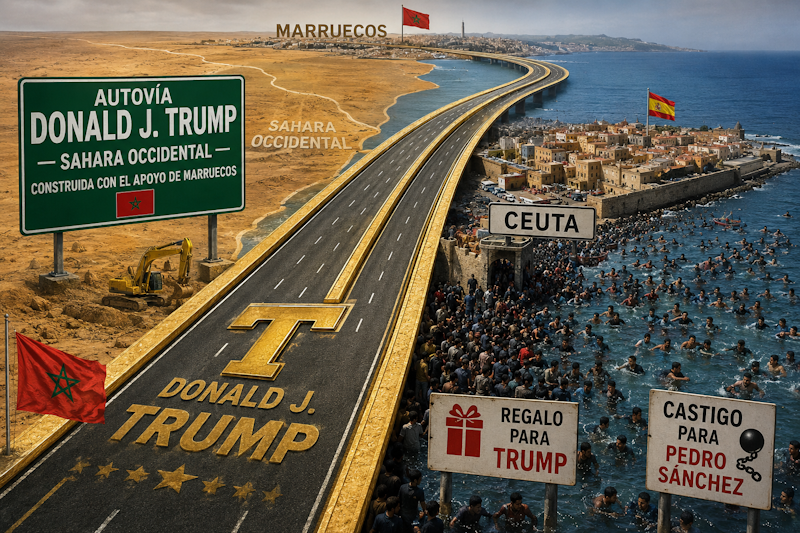
In a move laden with political significance, King Mohammed VI ordered the renaming of the 1,055-kilometer Tiznit-Dakhla highway to honor Donald Trump. The sovereign’s public letter, disseminated by the Moroccan Press Agency (MAP), framed the gesture as gratitude for Trump’s 2020 decision to recognize Morocco’s sovereignty over Western Sahara.
Described by the king as Africa’s longest road infrastructure, the highway snakes from southern Morocco through Laâyoune to Dakhla—a route that cuts through the heart of Western Sahara. Its strategic value lies in linking the country’s northern and southern regions while serving as a vital corridor between Europe and Africa.
Trump swiftly responded on Truth Social: “What a tremendous honor! I look forward to driving this incredible highway someday soon—hopefully very soon!”
Ceuta Migration Crisis: A Diplomatic Bludgeon
The true leverage point, however, lies not in asphalt but in demographics. Late July saw nearly 60,000 migrants surge into Ceuta, Spain’s North African enclave, triggering a humanitarian catastrophe and sparking a major diplomatic standoff. Spanish authorities reported at least 57 fatalities, primarily from drowning or trampling, though Rabat acknowledged only 11 official deaths.
Ceuta’s status as one of the European Union’s two land borders with Africa makes it a pressure valve in Hispano-Moroccan relations. Morocco has long contested Spain’s claim to the territory, labeling it “occupied land.”
History Repeats Itself
This is not the first time migration has been weaponized. In May 2021, a similar influx of 8,000 migrants forced Madrid to reconsider its stance on Western Sahara after Spain admitted Polisario Front leader Brahim Ghali for medical treatment—a move that infuriated Rabat.
“Morocco expected Spain to embrace its autonomy plan for Western Sahara, but mere support isn’t enough—the kingdom demands full recognition of its sovereignty,” noted Carlos Ruiz Miguel, director of the Western Sahara Studies Center at the University of Santiago de Compostela.
The timing of this crisis is particularly telling, arriving just days after Spanish Prime Minister Pedro Sánchez visited Algiers to mend fences with Morocco’s regional rival. Rabat appears to have taken notice.
A Multilayered Diplomatic Offensive
Analysts see a calculated strategy unfolding. “Morocco is deliberately pushing the boundaries of Spain’s constitutional framework,” argued Alejandro del Valle, an international law professor, describing Madrid as a “geostrategic adversary.”
The Moroccan playbook involves three key maneuvers:
- Cultivating Washington: The highway tribute reinforces U.S. recognition of Moroccan sovereignty over Western Sahara, a cornerstone of Rabat’s diplomatic arsenal.
- Exploiting Migration: The Ceuta crisis serves as a stark reminder of Spain’s vulnerability, hinging on Moroccan cooperation to manage border flows.
- Securing U.S. Backing: With UN-led negotiations on Western Sahara stalled, Moroccan officials are prioritizing American diplomatic muscle.
Washington’s Strong Stance
The Trump administration has left no doubt about its alignment with Morocco. U.S. Secretary of State Marco Rubio reiterated Washington’s stance: “The United States recognizes Morocco’s sovereignty over Western Sahara.” Trump himself praised Morocco’s autonomy proposal as “the only viable foundation for a fair and lasting solution,” dismissing alternatives as perpetuators of an unacceptable status quo.
American officials have also taken aim at Spain’s migration policies, with a White House spokesperson warning Madrid that its approach could “jeopardize its own stability.”
European Divisions Emerge
The Ceuta crisis has exposed fractures within the European Union. Italy temporarily suspended its Schengen agreements with Spain, swiftly followed by Finland and Denmark. Belgian MR party leader Georges-Louis Bouchez went further, calling for Spain’s partial suspension from the Schengen Zone.
“Morocco has demonstrated its willingness to weaponize migration as retaliation against Spain, leveraging its control over the two North African enclaves that make the country uniquely exposed,” observed Paul Melly, a researcher at Chatham House.
Diplomatic Chess: The Stakes Couldn’t Be Higher
While the Trump-named highway may be a ribbon-cutting away from completion, its real purpose is symbolic—one thread in a broader tapestry of Moroccan pressure. By intertwining flattery for Washington with migration leverage on Madrid, Rabat is weaving a diplomatic web designed to isolate Spain and sway international opinion. European and Spanish negotiators are now acutely aware that the kingdom holds the keys to the continent’s southern border—and it intends to use them.