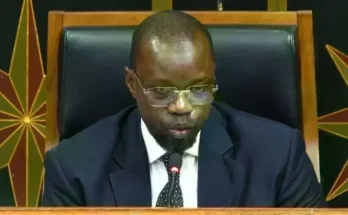
Political tensions are mounting in Dakar. Tafsir Thioye, a prominent civil society figure and vocal critic of the ruling majority, has publicly refuted the latest allegations made by Prime Minister Ousmane Sonko, who also leads the Pastef party. This public confrontation comes amidst escalating political friction between the executive branch and its critics, several months after the Diomaye-Sonko administration assumed leadership in Sénégal.
Direct challenge to the head of government
Tafsir Thioye seeks to correct what he describes as factual inaccuracies in the Prime Minister’s public statements. The well-known political commentator, frequently seen in local media, accuses Ousmane Sonko of presenting misleading information to the public. His detailed response, which circulated widely across social media and digital news platforms, reflects the ongoing friction between the Pastef-led government and independent civil society voices.
This move by the former civil society member highlights a persistent trend in Sénégal since the political transition of March 2024. Every major address by the Prime Minister now triggers structured counter-arguments, with critics brandishing data and official documents to challenge the official narrative. This pattern underscores a deep polarization within the national political arena, a testament to the country’s lively democratic culture.
Rising political friction since Pastef took office
Since taking office in April 2024, Ousmane Sonko has maintained a highly critical stance toward the previous administration of Macky Sall. The Prime Minister has repeatedly called for comprehensive audits of past governance, promising major revelations regarding public finances and strategic state files. These high-profile declarations have sparked intense debates with both the former ruling coalition and independent observers.
Tafsir Thioye is among those analysts who, while not aligned with the former regime, openly question the Prime Minister’s approach and the accuracy of his assertions. In his latest public intervention, the commentator accused the executive of using flawed public data. This dispute points to a larger challenge in Sénégal: maintaining a high standard of economic and institutional debate in a society that demands absolute transparency and accountability.
A strategic clash of political narratives
Beyond a simple disagreement between two public figures, this clash represents a broader battle of narratives shaping modern politics in Sénégal. On one hand, the new leadership aims to establish a clear break from the past by highlighting the shortcomings of their predecessors. On the other hand, independent voices like Tafsir Thioye demand rigorous factual accuracy and question the substance of government announcements.
This confrontation unfolds as the Pastef administration prepares to launch major structural reforms, including renegotiating mining and hydrocarbon contracts alongside tax reforms. In this high-stakes environment, the credibility of official statements is crucial. Every public challenge can potentially impact the government’s ability to rally public support for its transformation agenda.
Ultimately, the intensity of these exchanges demonstrates the strength of democracy in Sénégal, where opposition and dissent remain free and active, even against a government with a strong electoral mandate. For international partners and investors monitoring the nation’s progress, the clarity of official policies and the accuracy of state data will serve as vital benchmarks in the coming months. Thioye has systematically dismantled the points he considers incorrect within the Prime Minister’s address.