The presence of foreign military personnel in Togo has sparked growing concerns among citizens and observers alike. While national defense operations often require discretion, prolonged secrecy over such matters risks undermining public trust rather than strengthening it.
Military partnerships shrouded in mystery
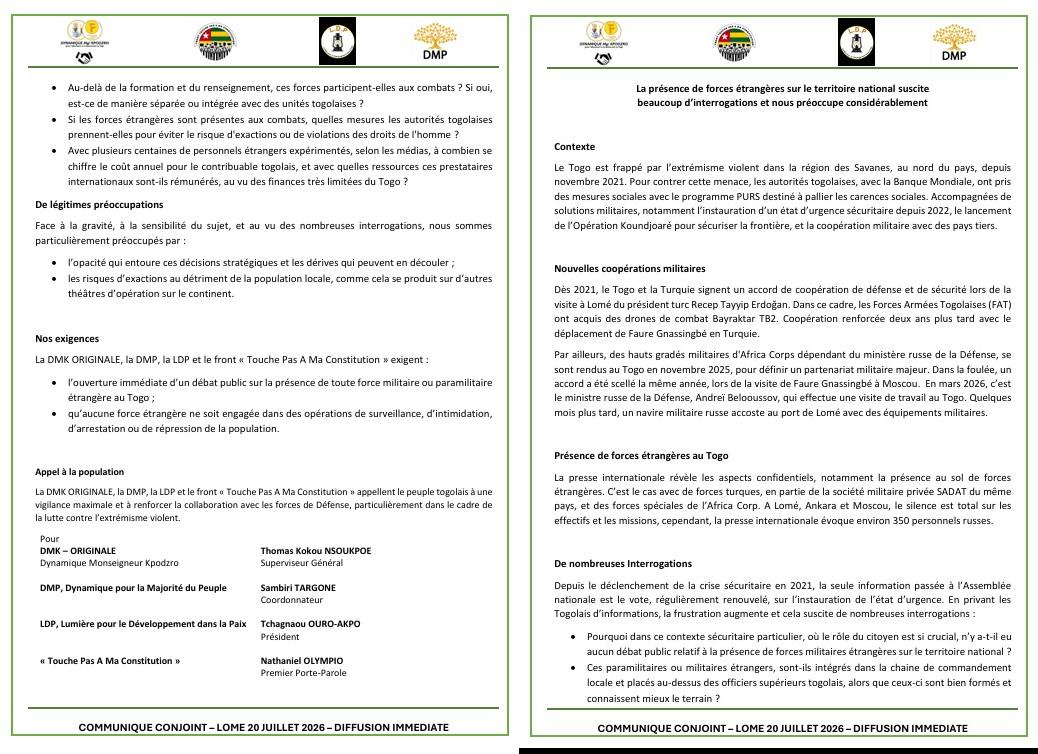
Rumors and reports suggest that military personnel from countries such as Russia and Turkey have been deployed on Togolese soil. If confirmed, this development raises critical questions that demand clear answers from the government. What is the precise nature of their mission? Are they involved in training, intelligence, strategic advisory roles, or the protection of high-level officials?
Concerns over political motives
Beyond strategic defense considerations, the opacity surrounding these foreign forces has fueled suspicions about the government’s true intentions. With persistent allegations of poor governance, economic hardship, and institutional restrictions, some analysts argue that the regime of President Faure Gnassingbé may be using these partnerships as a safeguard against potential internal or popular unrest. Rather than viewing them as a defensive measure, critics interpret their presence as a lifeline for a leadership determined to cling to power at all costs.
Unresolved operational and legal ambiguities
The exact scope of their activities remains unclear. Do these foreign personnel operate strictly within advisory or technical support roles, or do they participate in domestic security operations? Clarifying these distinctions is essential to assess the nature of the agreements in place and their potential impact on Togolese sovereignty.
Another pressing issue is the legal framework governing their presence. What safeguards are in place to ensure compliance with national laws and international obligations? Without transparent oversight mechanisms, concerns over accountability and potential abuses persist.
The financial implications of secrecy
The lack of transparency extends to financial matters. How many foreign military personnel are currently stationed in Togo? What are the terms and duration of their deployment? Who bears the financial burden—whether the Togolese government, the partner countries, or a shared agreement? Taxpayers, whose contributions fund public policies, have every right to demand clarity on these expenditures.
While military cooperation with foreign partners is not inherently problematic—especially in the face of regional security threats like terrorism—it must be conducted with full transparency to maintain public confidence.
Transparency as the cornerstone of legitimacy
A government’s credibility hinges on its ability to communicate openly about security partnerships. By providing clear explanations regarding objectives, legal frameworks, and operational roles, authorities can mitigate rumors and speculation. In a region marked by political instability and shifting security alliances, such transparency is not merely desirable—it is essential.
The silence surrounding foreign military personnel in Togo does not serve the public interest. In a democracy, where accountability is paramount, opacity erodes trust and invites doubt. The authorities must address these concerns head-on, balancing the imperatives of national security with the necessity of public reassurance. After all, in governance as in defense, clarity is not a luxury—it is the foundation of legitimacy.