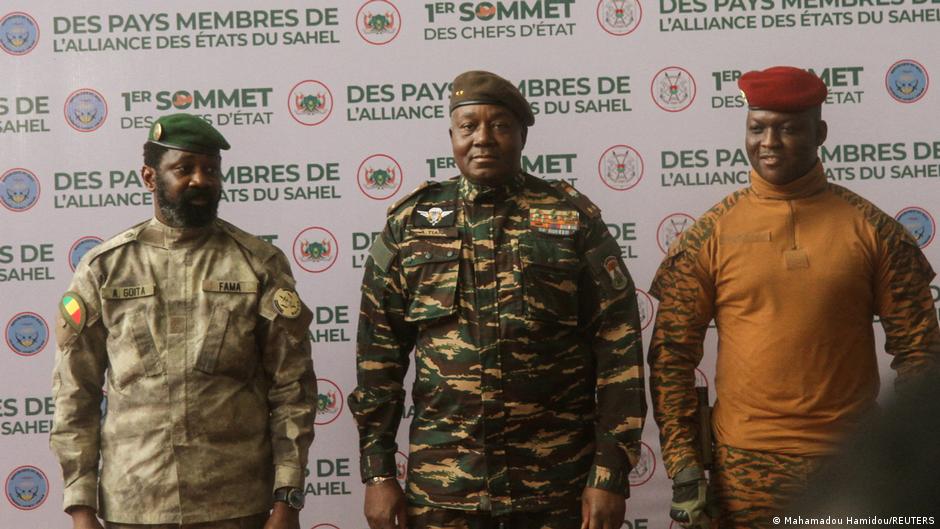
The European Union and the United States are recalibrating their engagement strategies in the Sahel region, marked by evolving political dynamics and shifting alliances. Recent diplomatic overtures—including financial commitments, high-level visits, and renewed dialogue—suggest a cautious attempt to rebuild bridges with military-led governments in Burkina Faso, Mali, and Niger.
On February 25, the U.S. Department of State announced a five-year bilateral agreement with Burkina Faso, pledging $147 million in aid to support HIV/AIDS and disease control initiatives in Ouagadougou. Earlier in February, Washington also reaffirmed its respect for Niger’s sovereignty during a phone call with the country’s transitional Prime Minister, Ali Mahamane Zeine.
Meanwhile, the EU’s Special Representative for the Sahel, João Cravinho, recently visited Bamako despite strained relations with Mali’s military authorities. Could these moves signal a thaw in relations between Western powers and the Alliance of Sahel States (AES)?
evolving diplomatic approaches in the Sahel
Western powers are increasingly adopting a country-by-country strategy in the Sahel, moving away from a unified regional policy. This shift reflects the complex geopolitical landscape, where historical ties—particularly with former colonial power France—are being reevaluated by Sahelian governments.
Francis Kpatindé, an expert on West Africa and lecturer at Sciences Po Paris, offers insights into these developments.
Q: The EU recently dispatched its Special Representative, João Cravinho, to Sahel capitals to advocate for a new partnership approach. Is this a sign of a potential rapprochement between these countries and the EU?
Francis Kpatindé: Caution is warranted, as the Sahel has repeatedly defied expectations in recent years. While not a full thaw, there may be subtle shifts in relations. However, it’s premature to speak of a rapprochement, as tensions between Western powers and Sahelian states remain high or at best, limited.
Q: Following Niger and Mali, Washington has shown renewed interest in Burkina Faso by signing an agreement focused on HIV/AIDS and other diseases. Is this a positive sign?
Francis Kpatindé: Absolutely. This is a positive indicator. Western powers are now offering limited economic and humanitarian cooperation, alongside security training to combat terrorism. They recognize that ignoring these countries could have repercussions. Abandoning them entirely would be irresponsible. However, another critical factor is the growing interest in mineral resources—Niger’s uranium, Burkina Faso’s gold, and Mali’s abundant gold reserves.
Q: Is the EU shifting from a regional approach to a country-by-country strategy in the Sahel?
Francis Kpatindé: Yes. Germany, for instance, maintains strong ties with several Sahelian nations and is welcomed in many. These countries are not all aligned with France, the former colonial power in Mali, Niger, and Burkina Faso. This divergence is driven by differing interests. France, however, can leverage other EU members—such as Germany or Hungary—to maintain minimal contact with the AES countries, including Niger, Mali, and Burkina Faso.
economic and strategic interests driving engagement
The recalibration of Western strategies in the Sahel is not merely diplomatic but also rooted in economic and strategic interests. The region’s vast mineral wealth, particularly uranium and gold, has become a key factor in shaping international engagement. While political tensions persist, the potential economic gains are too significant to ignore.
As Western powers navigate this evolving landscape, the outcome remains uncertain. Will these cautious steps lead to meaningful collaboration, or will historical grievances and shifting alliances continue to hinder progress? Only time will tell.