Introduction of a new presidential aircraft amid mounting security concerns
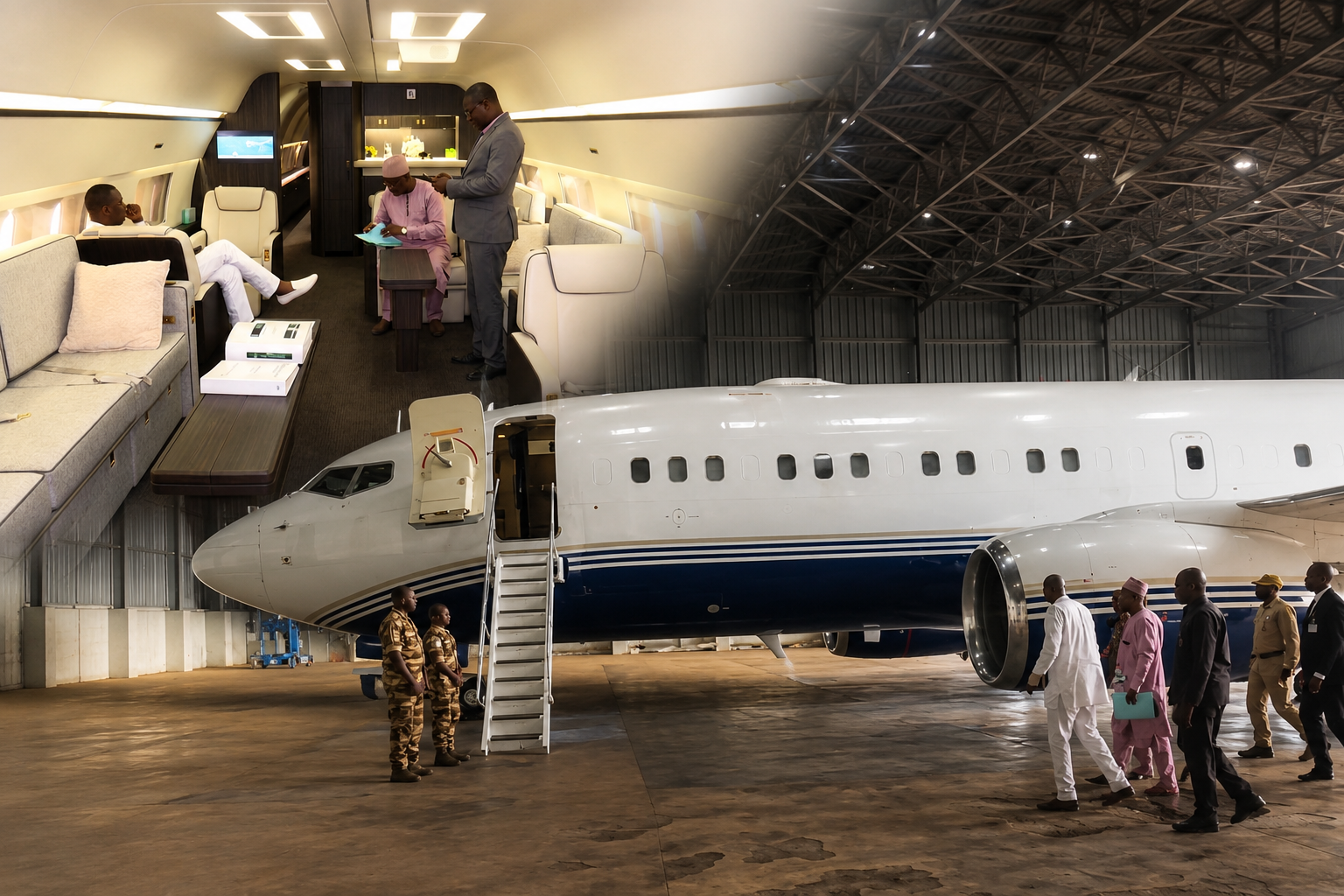
On Wednesday evening, viewers of Mali’s national broadcaster witnessed the unveiling of a state-of-the-art Boeing 737, designated for official travel by Colonel Assimi Goïta and other high-ranking officials. The government has framed this acquisition as a financially sound decision, citing a net cost of approximately 6 billion CFA francs—significantly reduced from the initial 15.6 billion due to insurance compensations and the resale of components from the previous aircraft.
A stark contrast to pressing national challenges
The timing of this announcement has drawn considerable scrutiny. While authorities repeatedly urge citizens to embrace sacrifice, resilience, and patriotism, the introduction of a luxurious new presidential aircraft appears to prioritize optics over immediate national needs.
Security conditions remain dire across multiple regions. Military outposts continue to face attacks, civilian roads are frequently targeted, and entire communities remain isolated due to persistent instability. The state’s administrative presence remains fragile in several areas, further complicating efforts to restore order.
Unresolved security threats persist
Three years into the Transition’s stated goal of reclaiming national territory, significant obstacles remain. In the north, alliances such as the Cadre stratégique permanent—including the Front de Libération de l’Azawad (FLA)—retain considerable operational capacity and contest control over key zones.
Meanwhile, in central and southern Mali, the Jama’at Nusrat al-Islam wal Muslimin (JNIM) continues to expand its influence through repeated assaults on military installations, economic infrastructure, and state representatives. Critical transportation routes remain perilous, disrupting commerce, trade, and daily life.
Financial priorities under scrutiny
The government asserts that the investment’s true cost is far lower than the headline figure, yet critics argue that billions could have been reallocated to more pressing priorities, including:
- Enhancing the operational readiness of the Malian Armed Forces;
- Procuring armored vehicles, communication systems, and protective gear;
- Strengthening intelligence and aerial surveillance capabilities;
- Supporting injured soldiers and the families of fallen military personnel;
- Assisting internally displaced persons and rebuilding war-damaged infrastructure.
Beyond accounting, this debate centers on the allocation of finite public resources and the hierarchy of national priorities.
A departure from the discourse of austerity
Since assuming power, the Transition has cultivated its legitimacy on promises of sobriety, national integrity, and popular service—marking a clear break from past regimes. However, the acquisition of a large-capacity presidential jet appears to contradict this narrative. For many citizens, it symbolizes a return to the politics of prestige and personalized power, at odds with the sacrifices demanded of the population.
This dissonance is compounded by ongoing economic hardship: rising living costs, strained public finances, unmet social needs, and stagnation in key economic sectors.
Diplomatic utility weighed against domestic realities
Proponents argue that a modern presidential aircraft facilitates high-level diplomacy, official missions, and international representation. Yet skeptics counter that a nation’s credibility hinges not on the sophistication of its leadership’s travel arrangements, but on its ability to secure its people, stabilize its institutions, and restore territorial sovereignty.
In their view, true sovereignty is measured by the state’s capacity to project authority and protect its citizens—not by the opulence of its presidential fleet.
Symbolism fuels political skepticism
Within critical circles and opposition ranks, the acquisition has been interpreted as more than a logistical decision. Some see it as evidence of a leadership more invested in its own mobility than in the functioning of the state. Others speculate that a long-haul jet serves as an emergency escape route for top officials, though such claims remain unverified.
Regardless of intent, the move has deepened public mistrust in governance choices during a period of profound uncertainty.
Reassessing governance under the Transition
The introduction of this Boeing 737 transcends routine state procurement. It underscores a broader question: as security threats intensify, attacks continue unabated, and economic strain deepens, every high-profile expenditure is being measured against the state’s most urgent obligations.
For many Malians, the true test of sovereignty lies not in the modernization of the presidential aircraft, but in the government’s ability to ensure public safety, restore full territorial control, and improve living conditions. Until tangible progress is made on these fronts, symbolic investments risk widening the gap between official priorities and the aspirations of the people.