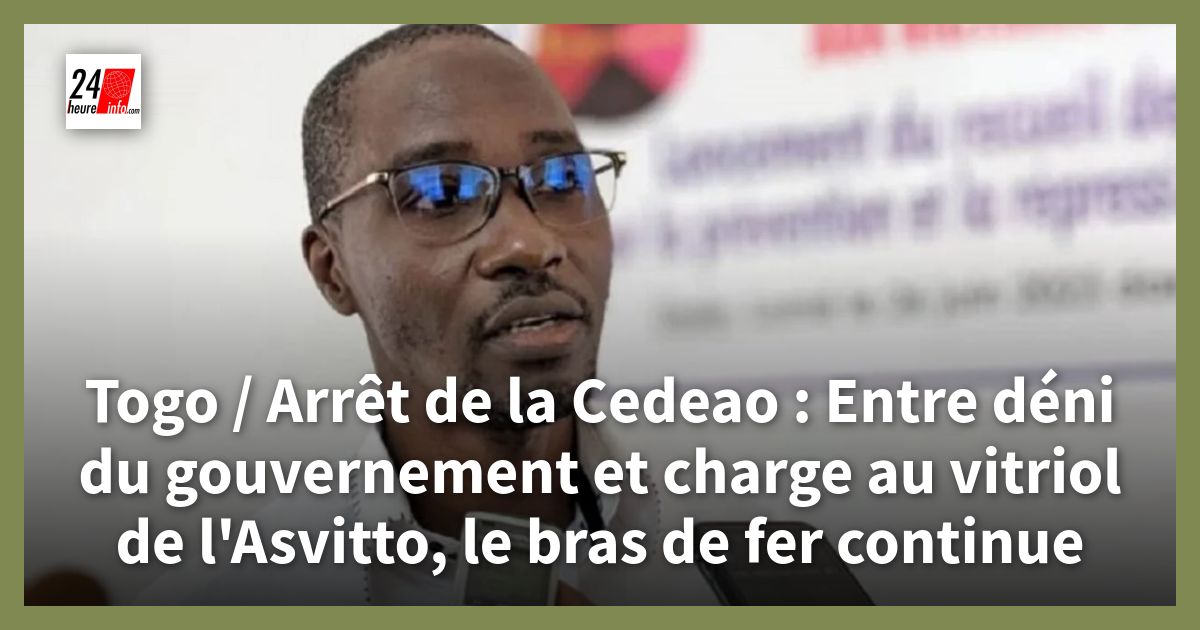
Togo’s government defies CEDEAO ruling amid civil society backlash
Lomé remains embroiled in a fierce legal and political standoff following the Economic Community of West African States (CEDEAO) Court’s decision on the country’s constitutional amendment. While the Togolese government dismisses the ruling as legally irrelevant, a prominent human rights group has launched a scathing counterattack, accusing authorities of orchestrating a constitutional coup.
Lomé invokes lack of jurisdiction
The Togolese administration has swiftly countered the regional court’s verdict, arguing that the CEDEAO Court lacks the authority to oversee internal constitutional matters or challenge national constituent powers. By framing the ruling as ultra vires, authorities aim to neutralize its domestic impact and preserve the contested reforms.
Civil society fires back: ‘A desperate denial of reality’
The government’s stance has drawn sharp criticism from the Association of Victims of Torture in Togo (ASVITTO), which took to social media to denounce what it describes as a “constitutional coup”. In a series of pointed statements, the group warned that the architects of the amendment are now trapped in their own “fearful anticipation”, clinging to power while the tide of public outrage rises.
ASVITTO condemned the executive’s refusal to comply with regional rulings, highlighting a “long-standing pattern of disregard” for CEDEAO decisions. The association pointed to the ongoing detention of political prisoners in Lomé, despite multiple court orders demanding their immediate release, as proof of the government’s defiance.
Call for decisive CEDEAO intervention
Frustrated by the impasse, ASVITTO has issued a direct appeal to the regional bloc, urging it to take “urgent corrective action” against what it brands “state gangsterism”. The group is pushing for strict enforcement of CEDEAO Court Judgment ECW/CCJ/JUD/01/26, issued in January, which ruled that Togo’s 2024 constitutional reforms violated the African Charter on Democracy, Elections and Governance.
The NGO’s message is unambiguous: “This form of state lawlessness must end in our subregion.”
A stalled process with human consequences
As legal arguments and social media exchanges dominate the discourse, the CEDEAO ruling remains unenforced, leaving detainees in limbo. Behind the diplomatic and rhetorical battles, real lives hang in the balance—political prisoners continue to languish in detention, their hopes of freedom deferred amid a cycle of defiance and delay.